Estimated per-person rate for this size — your guide confirms the exact quote.
The Bhutan Cultural Tour is a 7-day guided circuit of western Bhutan covering Thimphu, the Dochula pass, Punakha, and the Paro valley, ending with the walk up to Paro Taktsang at 3,120 m. Six nights in the country means USD 600 per person in Sustainable Development Fee alone, plus a one-off USD 40 visa fee, both paid to the government rather than to us and both quoted as separate lines on every price below.
Bhutan is the one destination on this site where the government sets a per-night price floor before any operator quotes anything. A licensed Bhutanese guide is mandatory by law rather than recommended, independent wandering is not an option, and the fee applies to every night you are in the country whether you spend it walking to a monastery or asleep in a hotel. Those rules decide the shape of a Bhutan trip more than any itinerary preference does.
Highlights
What our guides know that others don't.
Fee status
The USD 100 rate is a 50% discount on a statutory USD 200, valid to 31 August 2027
Insurance
No longer mandatory for a Bhutan visa since 23 April 2024, though still worth carrying
In pictures
Bhutan Cultural Tour gallery
What does a Bhutan cultural tour actually cost in 2026?
Budget USD 2,400 to 3,200 per person for this 7-day itinerary including the Kathmandu to Paro flight, of which USD 640 is government fees you would pay on any Bhutan trip through any operator. That splits into USD 600 of Sustainable Development Fee for six nights and a USD 40 one-off visa fee.
The band above is an approximate market range rather than a fixed quote, because two of its largest lines move independently of us. Hotel rates vary by season and standard, and the Kathmandu to Paro air fare moves sharply between the March-to-May and September-to-November peaks and the quieter months either side. What does not vary is the fee structure, which is why the government lines are shown as exact figures and the rest as a range.
One number to check against any other quote you are comparing: the Sustainable Development Fee is charged per person per night, so it scales with the length of the trip rather than being a flat entry charge. A ten-night trip carries USD 1,000 of fee before a single hotel is booked. Any Bhutan quote that does not show this line separately is either absorbing it silently or has not counted it, and the difference is large enough to explain most of the gap between two quotes that look otherwise similar.
| Sustainable Development Fee, 6 nights at USD 100 per nightGovernment fee, fixed, paid at visa application. Children aged 6 to under 12 pay half; under 6 pay nothing | $600 |
| Bhutan tourist visaOne-off per person, non-refundable even if the application is declined | $40 |
| Kathmandu to Paro return flightDrukair and Bhutan Airlines are the only carriers into Paro; fares move with season | $500–800 |
| Hotels, 6 nights tourist-standard | $420–780 |
| Licensed guide, driver, and vehicle for 7 days | $560–700 |
| Meals throughout | $180–260 |
| Monument and museum entry feesCharged separately from the Sustainable Development Fee under Tourism Rules and Regulations 2024 Clause 14 | $40–80 |
| Company margin and contingency | $150–300 |
What is Bhutan's Sustainable Development Fee, and is it really USD 100?
The Sustainable Development Fee is a per-person, per-night tourism levy set by the Royal Government of Bhutan, and the honest answer on the number is that the statutory rate is USD 200 while the rate actually charged today is USD 100. Bhutan's Tourism Rules and Regulations 2024 set the fee at USD 200 per night. A 50% discount announced by the Ministry of Industry, Commerce and Employment on 25 August 2023 brought the effective rate to USD 100, and that discount runs from 1 September 2023 to 31 August 2027.
This distinction matters commercially rather than academically. The discount was announced with an explicit end date and the government reserved the right to discontinue it after periodic assessment, so a Bhutan trip booked for travel after August 2027 cannot assume the USD 100 rate will still apply. Anyone planning that far ahead should treat the fee as a variable, and any page telling you flatly that Bhutan's fee "is" USD 100 without the expiry attached is giving you half the picture.
Three further points decide what a family or a couple actually pays. Children aged 6 and up who have not yet turned 12 pay half, at USD 50 per night. Children under 6 pay nothing at all. Indian nationals travelling on an Indian passport or Voter ID pay a different levy set in ngultrum rather than the USD rate, so a mixed-nationality party will not have a single blended figure. The fee is paid at the time of the visa application rather than collected on arrival.
Do you actually need a guide in Bhutan?
Yes, and unlike in Nepal this is a legal requirement rather than a safety recommendation. Bhutan's Tourism Rules and Regulations 2024 Clause 20 makes a tour guide mandatory for all tours except as far as the first designated checkpoint, and Clause 15 lists a guide alongside accommodation and transport as one of three arrangements every tourist must have in place before travelling.
The rule is often confused with a separate one that genuinely did change. Since Bhutan reopened in September 2022, tourists have no longer been required to book through a licensed tour operator, and a great deal of writing online has read that as "Bhutan no longer requires a guide." Those are different rules. You may arrange the trip yourself; you may not then travel the country unaccompanied. The Department of Tourism specifically flags a guide as required to enter dzongs and monuments, for all treks, and for visitors driving themselves.
For a trekking route rather than a cultural circuit, a further rule applies: Clause 52 sets a ratio of one trekking guide per seven tourists, capped at 15 with a tour leader, and Clause 51 requires written parental permission for trekkers aged 18 and under. None of that binds this itinerary, which involves no trekking, but it is worth knowing if you are weighing a Bhutan trek against a Nepal one where guiding rules work differently.
How hard is the walk up to Paro Taktsang?
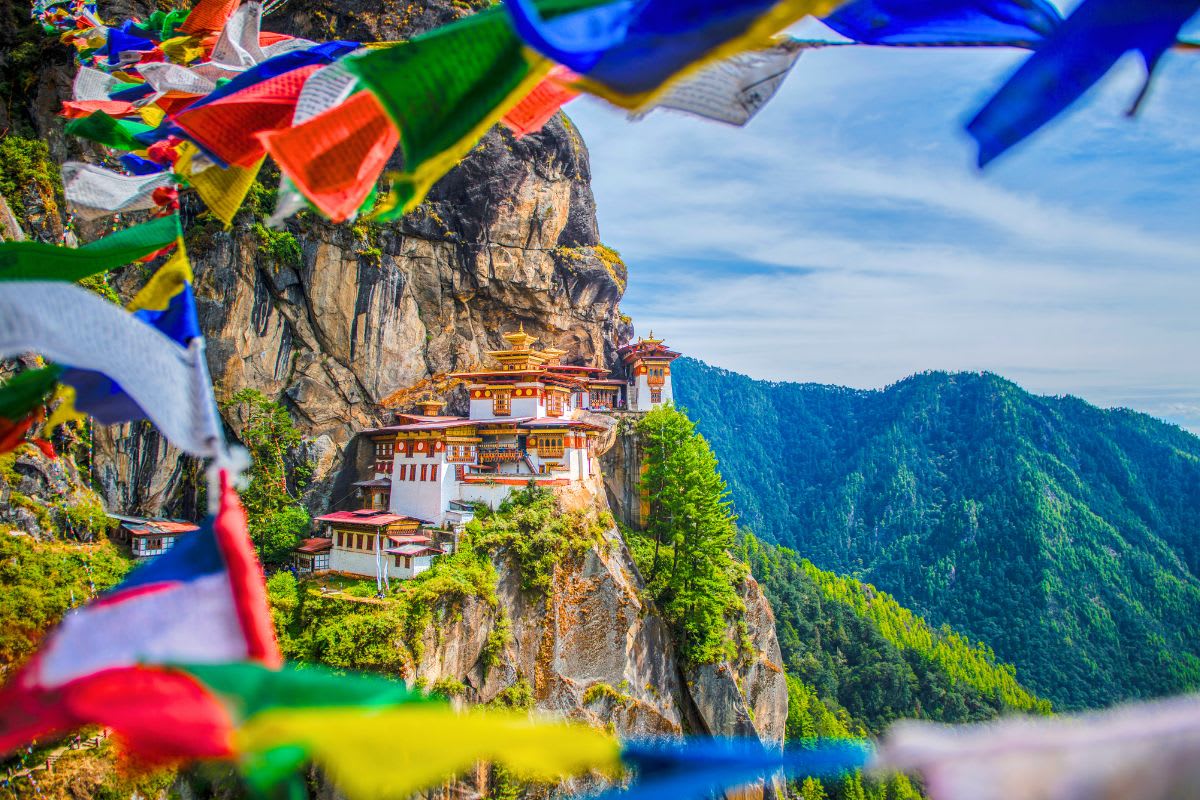
Allow 5 to 6 hours round trip, the figure Bhutan's Department of Tourism publishes for the Paro Taktsang hike. The monastery sits at 3,120 m, roughly 900 m above the floor of the Paro valley, and reaching it is a steady uphill walk on a maintained path rather than a trek in any technical sense. It is the single most physically demanding thing on this itinerary and the reason the tour is graded easy rather than trivial.
That 5-to-6-hour band covers the walk in both directions plus time at the monastery itself, and where you land inside it depends mostly on how long you stop at the cafeteria partway up. The itinerary gives the whole day to it rather than trying to pair it with anything else, so there is no schedule pressure to move faster than the group wants to.
Two practical notes. A mule track runs up toward the monastery and animals can be arranged locally, though how far up they go varies, so treat it as something to confirm on the ground rather than to plan around. And the altitude deserves respect even though it is modest by the standards of everything else on this site: 3,120 m is higher than Poon Hill's sleeping altitude, the day is sustained uphill effort, and it falls on day six rather than day one specifically so the earlier nights at 2,320 m in Thimphu have done some quiet acclimatization work first.
What do you actually see on this route?
The circuit covers three valleys at markedly different elevations, which is most of what makes western Bhutan worth a week rather than a long weekend. Thimphu sits at 2,320 m, Punakha drops to 1,242 m, and the Dochula pass between them tops out around 3,100 m.
| Place | Altitude | What it is |
|---|---|---|
| Paro | Around 2,200 m | The valley holding Bhutan's only international airport, at 2,235 m |
| Thimphu | 2,320 m | The capital since 1955, and the seat of government |
| Dochula pass | About 3,100 m | The pass on the Thimphu to Punakha road, site of the 108 Druk Wangyal Chortens |
| Punakha | 1,242 m | Bhutan's capital until 1955, in a valley warm enough to grow rice |
| Paro Taktsang | 3,120 m | The cliffside monastery above the Paro valley |
Punakha Dzong is the one most visitors rate highest, and it earns that on more than looks. It stands at the confluence of the Pho Chhu and Mo Chhu, the male and female rivers, was built in 1637 and 1638 under Ngawang Namgyal, and has hosted every royal coronation since 1907. It sits on Bhutan's UNESCO tentative list. The 1,242 m elevation is why the valley feels like a different country from Thimphu two hours away, and why this is the warmest night of the trip.
Dochula is worth the stop even in poor weather. The 108 Druk Wangyal Chortens there were commissioned by Queen Mother Ashi Dorji Wangmo Wangchuck in memory of Bhutanese soldiers killed in 2003, and were consecrated in June 2004. On a clear morning the Himalayan skyline behind them is the best mountain view on the route; on a clouded one the chortens themselves still carry the stop.
How do you get to Bhutan from Nepal?
Fly Kathmandu to Paro direct. Paro is Bhutan's only international airport, sitting at 2,235 m, and two carriers serve it: Drukair, the national airline, and Bhutan Airlines. Both fly the Kathmandu route, which makes Bhutan the most straightforward international add-on to a Nepal trip on this site.
The flight itself is short, around an hour, and we have not printed a precise duration because Nepal runs on UTC+5:45 and Bhutan on UTC+6:00, which means subtracting the published departure time from the published arrival time gives a figure fifteen minutes off. Confirm the schedule with the airline when you book rather than working it out from a timetable.
Two things are worth building into the plan. Paro's approach is flown visually through a valley rather than on a standard instrument approach, so departures are weather-sensitive in a way that will be familiar to anyone who has flown to Lukla, and a same-day connection onward from Kathmandu to a long-haul flight is a bet rather than a plan. Leave a night in Kathmandu at each end. And book the left-hand side of the aircraft flying Kathmandu to Paro if you want the Himalayan skyline, which on a clear day is one of the better views available from a commercial seat anywhere.
When is the best time for a Bhutan cultural tour?
March to May and September to November are the two reliable windows, for the same reason they are in Nepal: clear air and settled weather either side of the monsoon. Spring brings rhododendron across the passes; autumn brings the clearest mountain views from Dochula.
Bhutan's festival calendar, the tsechu season, sits inside those windows and is the single biggest reason to prefer one specific week over another. Tsechu dates follow the Bhutanese lunar calendar rather than the Gregorian one, are released annually, and shift year to year. We have not printed dates on this page because the only calendars we could find for 2026 and 2027 are operator-published rather than government-published, and a festival date is exactly the kind of detail that ruins a trip if it is wrong. If a specific tsechu is the point of your trip, tell us and we will confirm the date against the Department of Tourism before you book anything.
Winter is underrated for this particular itinerary. Nothing on the route crosses a high pass beyond Dochula at around 3,100 m, Punakha at 1,242 m is genuinely mild, and the trade-off is cold mornings in Thimphu against thinner crowds at the dzongs. Monsoon, June through August, is the window to avoid: the Taktsang path is wet and the mountain views that justify the Dochula stop are usually absent.
What should a Nepal trekker expect to be different in Bhutan?
The biggest adjustment is that Bhutan is priced and regulated as a whole country rather than route by route. In Nepal you buy permits per region, walk where the permit allows, and a guide is required on some routes and not others. In Bhutan a single per-night fee applies everywhere, a guide applies everywhere, and the itinerary is agreed before you arrive rather than adjusted on the trail.
Accommodation is the other clear difference. This is a hotel-based trip throughout, not a teahouse one. Nights are spent in tourist-standard hotels in three towns with road transfers between them, so the daily rhythm is closer to a Kathmandu Valley heritage tour than to anything in the Khumbu, and the physical demand is concentrated into the single Taktsang day.
One rule changed recently and is worth knowing because a lot of published advice has not caught up: travel insurance stopped being mandatory for a Bhutan visa on 23 April 2024. It is still worth carrying, and we would not travel without it, but it is no longer a document the visa application will reject you for missing. The Department of Tourism also states no minimum length of stay, so a shorter or longer version of this route is possible; what changes with the length is the fee, at USD 100 for every additional night.
Waypoints mark named stops on the route; the line between them is a straight-line approximation, not a surveyed trail. Map data © OpenStreetMap contributors.
Day by Day
7-day itinerary, every detail planned.
The direct flight into Paro lands at Bhutan's only international airport, where your licensed guide meets the group before the road transfer to Thimphu. The drive follows the Pa Chhu and Wang Chhu valleys and takes a little over an hour, arriving in the capital with the afternoon free to adjust.
What's Included
Transparent, all-in pricing.
Included in your price
Not included
Why Nepal Travel Packages
Built on published proof, not adjectives.
A named, licensed guide before you book
Full name, photo, NMA or TAAN license number, and a direct WhatsApp line. The guide on the page is the guide on the trail.
Itemized pricing, not a lump sum
Permits, guide, porter, lodging, and food broken out on every trip page. You see exactly where the price comes from.
Trail conditions updated monthly
Dated field reports from the guides running the route this season, not boilerplate written once and left to go stale.
Permits handled, not hidden
Every permit fee, checkpoint, and paperwork rule is filed for you and published in the guides — no surprise admin at Lukla.
FAQ
Common questions
How much is Bhutan's Sustainable Development Fee?+
USD 100 per person per night at the rate currently charged, which is a 50% discount on the statutory USD 200 set by Bhutan's Tourism Rules and Regulations 2024. The discount runs from 1 September 2023 to 31 August 2027, so trips booked for travel after that date should not assume the lower rate. Children aged 6 to under 12 pay USD 50 per night and children under 6 pay nothing.
How much does a 7-day Bhutan tour cost?+
Budget USD 2,400 to 3,200 per person including the Kathmandu to Paro return flight. USD 640 of that is fixed government charges: USD 600 of Sustainable Development Fee for six nights, plus the USD 40 one-off visa fee. The rest covers hotels, the licensed guide, driver and vehicle, meals, and monument entry fees, and moves with season and hotel standard.
Do you need a guide to travel in Bhutan?+
Yes. Bhutan's Tourism Rules and Regulations 2024 make a licensed guide mandatory for all tours beyond the first designated checkpoint, and list a guide alongside accommodation and transport as something every tourist must arrange. The rule that changed in September 2022 was the requirement to book through a licensed tour operator, which is a different thing: you can arrange the trip yourself, but you cannot travel the country unaccompanied.
How high is Paro Taktsang and how hard is the walk?+
The monastery sits at 3,120 m, roughly 900 m above the Paro valley floor, and Bhutan's Department of Tourism puts the hike at 5 to 6 hours round trip. It is a steady uphill walk on a maintained path rather than any technical trail, and the hardest single thing on this itinerary, which is graded easy overall. We schedule it for day six so earlier nights at 2,320 m in Thimphu have done some acclimatization work first.
How do you get to Bhutan from Nepal?+
Fly Kathmandu to Paro direct. Paro is Bhutan's only international airport, at 2,235 m, and it is served by two carriers, Drukair and Bhutan Airlines, both of which fly the Kathmandu route. The flight takes around an hour. Paro's approach is flown visually through a valley, so leave a night in Kathmandu at each end rather than booking a same-day long-haul connection.
Is travel insurance mandatory for Bhutan?+
No, not since 23 April 2024, when Bhutan removed mandatory travel insurance as a visa requirement. A lot of published advice still says otherwise. We would still not travel without a policy, particularly one covering medical evacuation, but its absence will no longer stop a visa being issued.
What is the best time of year to visit Bhutan?+
March to May and September to November, the same two windows that work in Nepal, giving clear air and settled weather either side of the monsoon. Winter suits this particular route better than most, since nothing on it goes higher than the Dochula pass at about 3,100 m and Punakha at 1,242 m stays mild. Avoid June to August, when the Taktsang path is wet and the mountain views are usually clouded out.
Can children come on a Bhutan tour?+
Yes, and the Sustainable Development Fee is reduced for them: children aged 6 and up who have not yet turned 12 pay USD 50 per person per night rather than USD 100, and children under 6 pay no fee at all. The itinerary itself is hotel-based with short valley walks, so the only demanding day is the Taktsang climb, which a family can shorten by turning around at the cafeteria partway up.