Explore
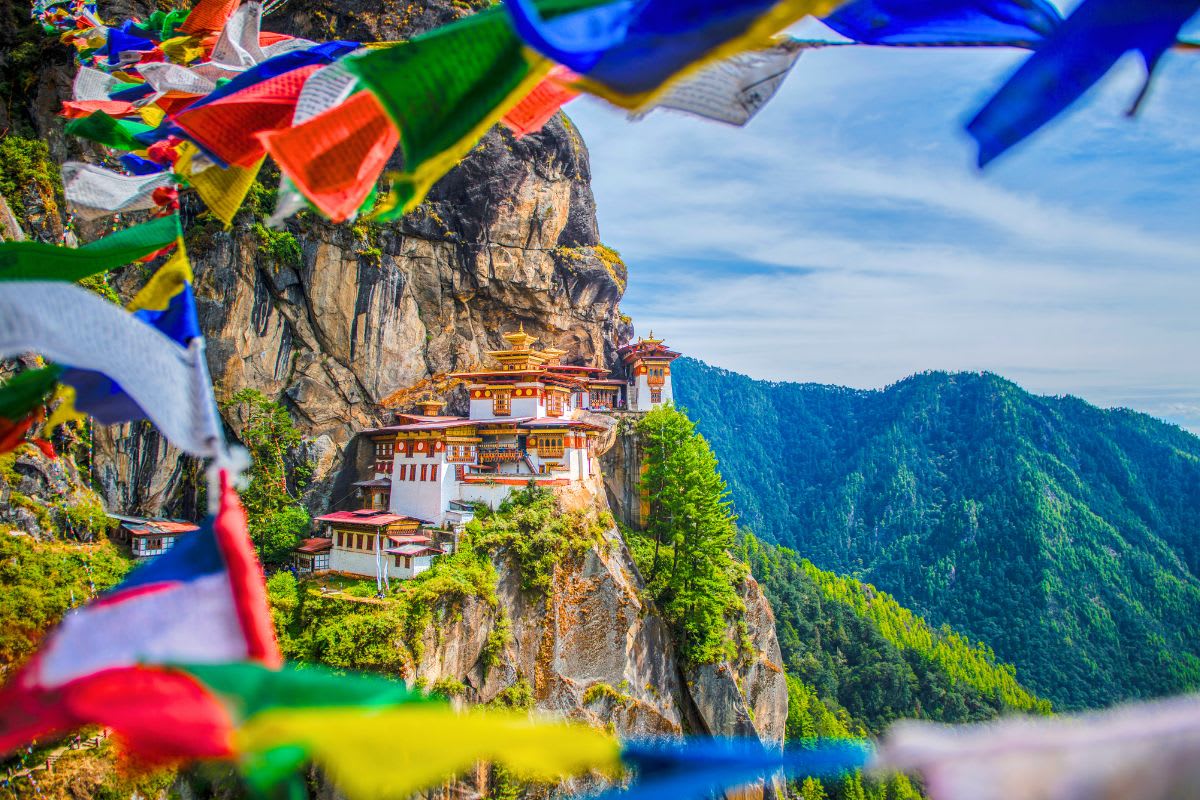
A Bhutan tour package is a guided trip to the Himalayan kingdom east of Nepal, where every visitor pays a Sustainable Development Fee of USD 100 per person per night and travels with a licensed Bhutanese guide because the law requires one. We run two Bhutan itineraries: a 7-day cultural circuit through Thimphu, Punakha, and Paro ending at Paro Taktsang at 3,120 m, and the 7-day Druk Path Trek, which walks between the Paro and Thimphu valleys to a maximum elevation of 4,200 m.
Bhutan prices differently from everywhere else on this site, and it is worth understanding before comparing any quote. The government sets a per-night fee that applies to every night you are in the country, so the length of a Bhutan trip drives its cost more directly than the route does. Six nights carries USD 600 in fee before a hotel, a guide, or a flight is booked.
Both itineraries fly Kathmandu to Paro direct, which makes Bhutan the most straightforward international addition to a Nepal trip on this site.
Routes
Two fixed government charges sit under every Bhutan quote: a Sustainable Development Fee of USD 100 per person per night, and a one-off tourist visa fee of USD 40 per person. On a 7-day trip with six nights in the country, that is USD 640 before anything else is counted.
| Package | Days | Max altitude | Group price |
|---|---|---|---|
| Bhutan Cultural Tour | 7 | 3,120 m at Paro Taktsang | USD 2,400-3,200 |
| Druk Path Trek | 7 | 4,200 m | USD 2,900-3,900 |
Both bands include the Kathmandu to Paro return flight and are approximate market ranges rather than fixed quotes, since hotel rates and the Paro air fare both move with season. The government lines do not move, which is why they are shown as exact figures on each trip page.
The gap between the two packages is almost entirely the trekking crew. There are no teahouses on the Druk Path, so a camping trek carries a cook, camp equipment, and pack animals that a hotel-based cultural tour does not.
The rate charged today is USD 100 per person per night, but the statutory rate is USD 200 and the difference is a discount with an expiry date. Bhutan's Tourism Rules and Regulations 2024 set the fee at USD 200. A 50% discount announced by the Ministry of Industry, Commerce and Employment on 25 August 2023 brought the effective rate to USD 100, running from 1 September 2023 to 31 August 2027.
This matters for anyone planning far ahead. The discount was announced with an explicit end date, and the government reserved the right to discontinue it after review, so a Bhutan trip for travel after August 2027 cannot assume USD 100 will still apply. Any page that states Bhutan's fee "is" USD 100 without that expiry is giving you half the position.
Children are charged differently: those aged 6 and up who have not yet turned 12 pay USD 50 per night, and children under 6 pay nothing. Indian nationals travelling on an Indian passport or Voter ID pay a separate levy set in ngultrum rather than the US dollar rate.
Yes, and it is a legal requirement rather than a recommendation. Bhutan's Tourism Rules and Regulations 2024 make a tour guide mandatory for all tours beyond the first designated checkpoint, and list a guide alongside accommodation and transport as one of three arrangements every tourist must have in place.
This is regularly confused with a rule that genuinely did change. Since Bhutan reopened in September 2022, tourists have no longer been required to book through a licensed tour operator, and much of what is written online reads that as "Bhutan no longer requires a guide." They are different rules. You can arrange a trip yourself; you cannot then travel the country unaccompanied. A guide is specifically required to enter dzongs and monuments, for all treks, and for visitors driving themselves.
Trekking carries a further rule: one licensed trekking guide per seven trekkers, capped at 15 with a tour leader, with written parental permission required for trekkers aged 18 and under. Nepal leaves guide ratios to the operator. Bhutan does not.
Bhutan costs several times more for a comparable walking week, and the reasons are structural rather than a margin decision. The Druk Path Trek runs USD 2,900-3,900 for seven days to 4,200 m; Langtang Valley runs USD 650-950 for seven days to a higher 4,984 m.
Three things account for almost all of that gap: the Sustainable Development Fee, the Paro air fare, and the camping crew a country without teahouse infrastructure requires. None of it is trail-related, and none of it is negotiable.
What Bhutan offers in exchange is a country that caps visitor numbers by design. Trails carry a fraction of the traffic that Nepal's popular routes see in October, and the cultural sites are not built around volume tourism. Whether that is worth the difference is a judgment about what you want from the week rather than a question with a right answer. The Nepal trek cost breakdown sets out the other side of the comparison in detail.
Fly Kathmandu to Paro direct. Paro is Bhutan's only international airport, at 2,235 m, served by two carriers, Drukair and Bhutan Airlines, both of which fly the Kathmandu route in around an hour.
March to May and September to November are the reliable windows, the same two that work in Nepal. For the Druk Path Trek specifically, the Department of Tourism publishes permitted months of March through June and September through November, excluding July and August for monsoon and December through February for cold. Where an informal source and the government list disagree about when a trek is open, the government list decides whether a permit is issued.
Paro's approach is flown visually through a valley rather than on a standard instrument approach, so departures are weather-sensitive in a way that will feel familiar to anyone who has flown to Lukla. Leave a night in Kathmandu at each end rather than booking a same-day long-haul connection.
Travel insurance stopped being mandatory for a Bhutan visa on 23 April 2024. A great deal of published guidance still says otherwise. We would not travel without a policy, particularly one covering medical evacuation, but its absence no longer blocks a visa.
The Department of Tourism also states no minimum length of stay, so these itineraries can be shortened or extended. What changes with the length is the fee, at USD 100 for every additional night, which is the arithmetic that shapes most Bhutan planning decisions.
FAQ
Budget USD 2,400 to 3,200 per person for the 7-day cultural tour and USD 2,900 to 3,900 for the 7-day Druk Path Trek, both including the Kathmandu to Paro return flight. USD 640 of each is fixed government charges: USD 600 of Sustainable Development Fee across six nights plus a USD 40 one-off visa fee.
USD 100 per person per night at the rate currently charged, which is a 50% discount on the statutory USD 200 set by Bhutan's Tourism Rules and Regulations 2024. The discount runs from 1 September 2023 to 31 August 2027. Children aged 6 to under 12 pay USD 50 per night, and children under 6 pay nothing.
Yes. Bhutan's Tourism Rules and Regulations 2024 make a licensed guide mandatory for all tours beyond the first designated checkpoint. The rule that changed in September 2022 was the requirement to book through a licensed tour operator, which is separate: you may arrange a trip yourself, but you may not travel the country unaccompanied.
Yes, direct to Paro, Bhutan's only international airport at 2,235 m, on either Drukair or Bhutan Airlines. The flight takes about an hour. Paro is flown on a visual approach through a valley, so it is weather-sensitive: leave a night in Kathmandu at each end rather than connecting the same day to a long-haul flight.
Yes, in two ways that matter. There are no teahouses, so treks are full-service camping trips with a cook, camp equipment, and pack animals, which is most of the cost difference. And guide ratios are set by regulation at one trekking guide per seven trekkers rather than left to the operator, as they are in Nepal.