Collection

Six routes on this site come in under USD 1,000 as a group departure, from USD 350 for Poon Hill to USD 1,000 for Gosaikunda and Rara Lake.
Cheap trekking in Nepal is never a matter of finding an operator who charges less for the same thing. Permits are set by the government, minimum guide wages are set by TAAN, and a teahouse room at 4,000 m costs what it costs whoever booked it. An operator quoting well under everyone else is usually paying a guide below the recommended rate, skipping the porter, or putting you on a dining-room floor at Gorak Shep.
The levers that actually move a price are structural, and there are three. Skip the domestic mountain flight. Stay out of restricted areas. Share the guide, porter, and transport on a fixed departure. Get all three right and a real Himalayan trek costs USD 350-1,000 rather than USD 2,000 and up.
Curated for you
 Easy
Easy 4 days
3,210 m
From
USD 350 pp
 Moderate
 7 days
4,984 m
From
USD 650 pp
Moderate-Strenuous 8 days
4,610 m
From
USD 700 pp
 Moderate
 5 days
4,200 m
From
USD 550 pp
Moderate 7 days
3,165 m
From
USD 550 pp
Easy 6 days
2,990 m
From
USD 700 pp
USD 360-440 per person on a round trip. That's the fixed foreign-national fare band between Kathmandu and Lukla in 2026, and no operator can discount it because the airlines set it. It's the main reason Everest routes start higher than Annapurna or Langtang routes of the same length.
Langtang Valley shows what happens when you remove it. The route reaches 4,984 m at Tserko Ri, within 400 vertical metres of Everest Base Camp, and costs USD 650-950 against Everest's USD 1,200-1,800. It isn't shorter or much lower. It starts with a seven to eight hour drive to Syabrubesi instead of a 30-minute flight, and that swap is most of the difference.
Restricted-area permits work the same way at the other end of the country. Upper Mustang adds USD 500 for the first ten days; Manaslu adds USD 75-100 for a week. Both mandate agency filing and a licensed guide; neither has required a second trekker since March 2026. Every route on this page uses ordinary TIMS and national park permits costing about NPR 5,000 combined, roughly USD 38, issued over the counter the morning you apply.
Six: Poon Hill, the Tamang Heritage Trail, Mardi Himal, Langtang Valley, Gosaikunda, and Rara Lake, at USD 350-1,000 per person as a group departure. All six use road access or a cheap regional flight, avoid restricted-area permits, and finish in four to ten days.
| Trek | Days | High point | Access | Group price |
|---|---|---|---|---|
| Poon Hill | 4 | 3,210 m | Jeep from Pokhara | USD 350-600 |
| Tamang Heritage Trail | 7 | 3,165 m | Drive from Kathmandu | USD 550-800 |
| Mardi Himal | 5 | 4,200 m | Jeep from Pokhara | USD 550-900 |
| Langtang Valley | 7 | 4,984 m | Drive from Kathmandu | USD 650-950 |
| Gosaikunda | 8 | 4,610 m | Drive from Kathmandu | USD 700-1,000 |
| Rara Lake | 6 | 2,990 m | Flight to Talcha | USD 700-1,000 |
Rara Lake is the odd one out. It does involve a domestic flight, to Talcha in the far west, and still lands in the USD 700-1,000 band because the trek is short and daily costs in the region are low. It's here because reaching Nepal's largest and least-visited lake for under a thousand dollars is a good deal, not because it follows the pattern.
USD 350-600 for four days, which makes it the cheapest multi-day trek on this site. Few days on the trail, a 3,210 m ceiling, and a jeep from Pokhara instead of a flight. No restricted permits, no acclimatization days.
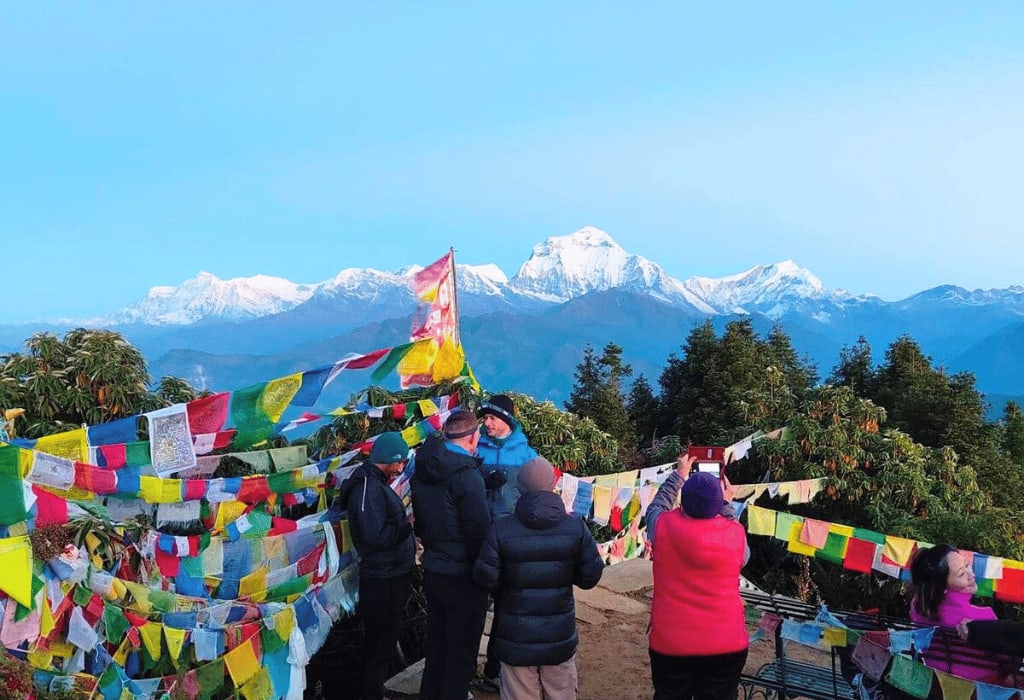
The route climbs through Ghorepani to the viewpoint and loops back down through Ghandruk, mostly through rhododendron forest, finishing on a dawn panorama that runs from Dhaulagiri to Machhapuchhre. It's cheap because it's structurally efficient, not because it's a lesser trip. In late March and early April, when the forest above Ulleri is in flower, it's one of the better mornings you can buy in Nepal at any price.
USD 550-900 for five days, reaching 4,200 m. It costs more than Poon Hill because of the extra days, not because the logistics change: same ACAP and TIMS pairing, same counter in Pokhara.
Mardi is a ridge walk rather than a valley approach, so Machhapuchhre and Mardi Himal stay in view for most of the trek instead of appearing at the end. It only opened as a marked trail in 2012 and still carries a fraction of the traffic in the Annapurna Sanctuary next door. The trade-off for that quiet is thinner infrastructure: fewer lodges, shorter menus, and water carried up the ridge by staff rather than drawn from a stream once you're above Low Camp. The Poon Hill and Mardi comparison covers which one suits which walker.
The Tamang Heritage Trail, at USD 550-800 for seven days. It loops north of Syabrubesi through Tamang villages including Gatlang and Thuman, mixing homestay nights with standard teahouses, plus the hot springs at Tatopani.
It stays under 3,200 m throughout, so it needs no acclimatization days despite running nearly twice as long as Poon Hill. If your idea of a good trip involves sitting in a family's kitchen rather than climbing to a viewpoint at 5 am, this is the one. The Tamang and Langtang Valley comparison sets it against its neighbour.
USD 650-950 for seven days, reaching 4,984 m. The high point is a pre-dawn climb of Tserko Ri from the lodges at Kyanjin Gompa.
The valley carries a recent history the trek doesn't hide. The 2015 earthquake triggered a landslide that buried the original Langtang village and killed more than 200 people. The village was rebuilt slightly uphill and you walk past the memorial on the way through.
Mountain flights, restricted-area permits, and a private guide. Not safety protocols, not permits, not a bed. The inclusion list on every trip on this page is the same as on the most expensive packages: government permits, a licensed guide, and a room every night.
The acclimatization rules don't scale with price either. Sleeping height rises no more than 500 m a day above 3,000 m with a rest day every 1,000 m, per the Himalayan Rescue Association's Pheriche clinic, and that applies on Langtang and Gosaikunda exactly as it does on Everest. It isn't company policy. It's how the body works, and biology doesn't read the invoice. What a smaller number buys is a shorter route, a lower ceiling, or a road instead of a runway.
The place to be careful is a quote that undercuts the USD 350-1,000 range here. Ask what the porter is paid, ask whether there's a porter at all, and ask whether the price covers a room or a floor. The porter wages guide covers what a fair answer sounds like.
Early December and late February, the shoulder weeks at either end of the main windows. October to November and March to May stay the most reliable weather on all six routes. Prices here don't surge with demand, but teahouse availability does, so the shoulder weeks are far easier to book late.
Winter is the underrated option on the four lower routes. Poon Hill, the Tamang Heritage Trail, Mardi Himal, and Rara Lake stay walkable December through February with proper gear, and January air is the clearest of the year. Langtang and Gosaikunda are colder propositions at their high points but still run. The winter trekking guide covers what the nights feel like at each altitude band.
Monsoon, June to September, is the window to avoid on all six. None of these is a rain-shadow trek, and the trails run wet, leech-heavy, and clouded in where the views should be.
Annapurna Base Camp, at USD 750-1,200 for seven days and a high point of 4,130 m. It adds a glacial amphitheatre without crossing into restricted-permit territory or requiring a mountain flight.
Past that, the cost jumps rather than climbs, because the next tier needs either the Everest trail and its Lukla fare or a restricted region and its special permit. That's a wall, not a slope, and it's worth knowing before you plan a progression: there is no route above 5,300 m on this site under USD 1,000, and no amount of shopping around Thamel produces one that safely includes everything it should. The budget and luxury comparison sets out what the extra money buys at the other end.
FAQ
The Poon Hill Trek, at USD 350-600 for a four day group departure. It reaches 3,210 m, is reached by jeep from Pokhara rather than a mountain flight, and uses standard ACAP and TIMS permits costing about NPR 5,000 combined. Nothing is removed from the inclusion list to hit that price.
Three structural choices: skip the fixed USD 360-440 Lukla flight, stay on standard-permit routes rather than restricted areas like Upper Mustang, and join a group departure to split the guide and transport costs. Those three decide whether you spend USD 350 or USD 2,000.
No. The Lukla flight alone is a fixed USD 360-440 per person, and the trek needs 12 days of wages and accommodation, which puts the floor for a safe group rate around USD 1,200. Trekkers who want high altitude on a tighter budget should look at Langtang Valley instead: 4,984 m at USD 650-950.
Not if they follow the altitude rules. Permit compliance, guide licensing, and the acclimatization schedule (500 m maximum sleeping gain per day above 3,000 m, a rest day every 1,000 m) apply identically regardless of price. What should worry you is a quote below the USD 350 floor, which usually means an underpaid guide or a missing porter.
The Tamang Heritage Trail, at USD 550-800 over seven days. It loops through Tamang villages north of Syabrubesi with homestay nights built into the route and stays under 3,200 m, so it needs no acclimatization days.