Sagarmatha National Park, the UNESCO World Heritage Site covering the Everest trekking region, holds the Himalayan tahr as its most commonly sighted large mammal, plus musk deer, red panda, and an elusive snow leopard population that almost no trekker ever actually sees. UNESCO designated the park in 1979, citing both its mountain landscape and its ecosystem in the same listing. Passang Dawa Sherpa, who leads this company's Everest Base Camp departures, wrote this guide from what trekkers on his own groups actually spot on the trail, not from a checklist of everything the park contains on paper.
The sections below cover the mammals worth watching for, the birds you'll genuinely see far more often, and how vegetation and wildlife both shift as the trail climbs from Lukla's forest to the bare rock above Base Camp.
In this guide 6
- 01 What animals will I actually see on the Everest Base Camp trek?
- 02 Which birds do trekkers actually spot on the trail?
- 03 How does vegetation change with altitude on the trek?
- 04 When during the trek are wildlife sightings most likely?
- 05 Is Sagarmatha National Park actually protected, and does that affect the trek?
- 06 How should trekkers behave around wildlife on the trail?
What animals will I actually see on the Everest Base Camp trek?
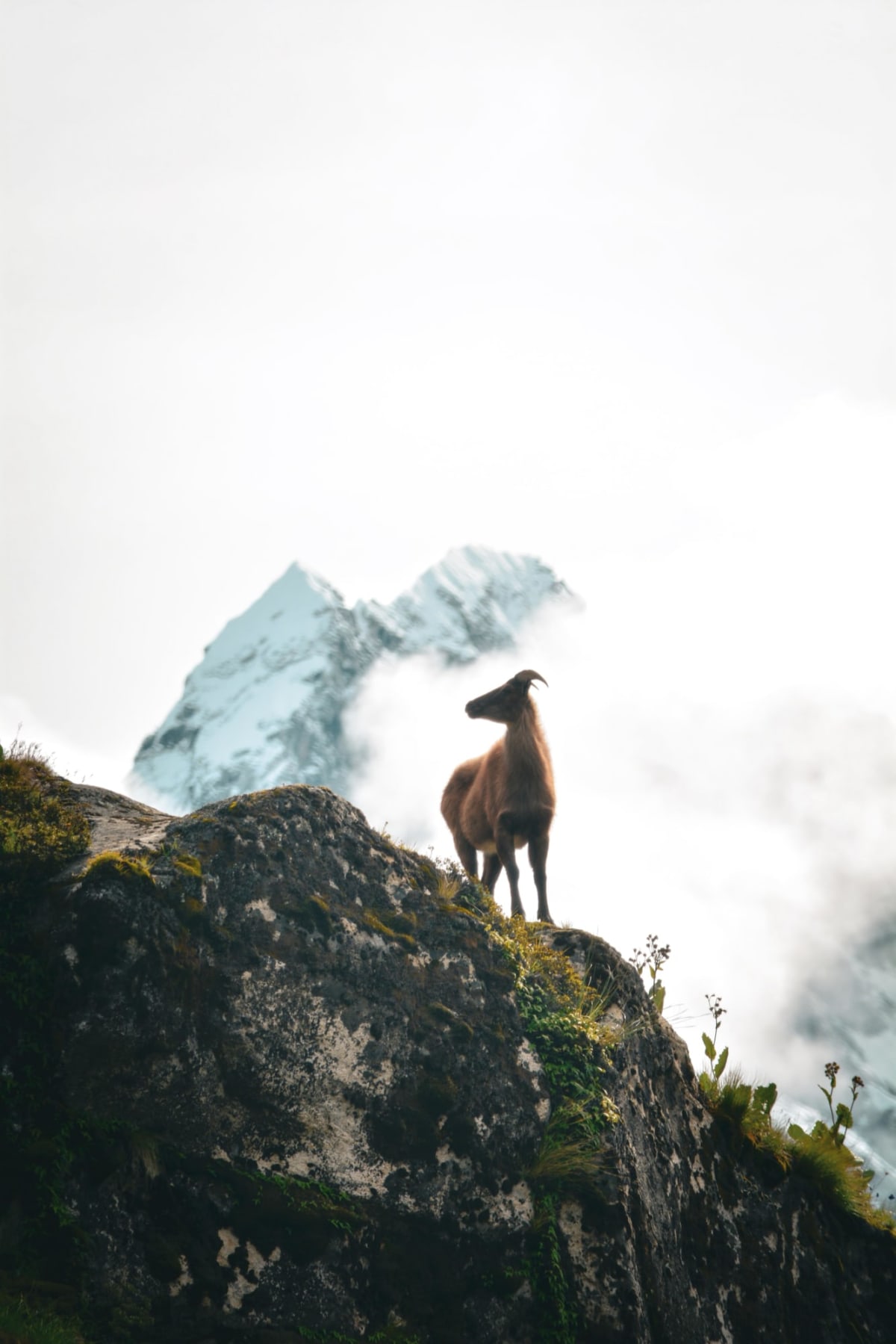
Most trekkers see the Himalayan tahr, a wild goat-antelope with a shaggy coat, grazing on steep slopes near the trail, along with far more birds than mammals across a typical 12-day itinerary. Musk deer and Himalayan black bear live in the park's lower forested zones but stay genuinely hard to spot, since both are shy and mostly active at dawn or dusk when trekking groups are usually still in their teahouse. Setting realistic expectations matters here: a trekker who books expecting frequent close wildlife encounters is planning around a safari, not a Himalayan trekking route.
Red panda live in the rhododendron and bamboo forest at lower elevations, roughly between Lukla and Namche Bazaar, but sightings are rare enough that most guides who have worked the route for years have seen only a handful in their entire career. The snow leopard, the park's most famous resident predator, is present across the region but is one of the most elusive large cats in the world, and almost no trekker on a standard itinerary ever sees one, guide included.
Which birds do trekkers actually spot on the trail?
Trekkers see far more birds than mammals on the Everest Base Camp route, with the Himalayan monal, Nepal's brightly colored national bird, and the lammergeier, a huge bearded vulture, both commonly spotted from the trail itself. The lammergeier in particular is easy to identify even for a first-time birdwatcher: a wingspan approaching 2.8 m, soaring rather than flapping, most often seen riding thermals near high passes and exposed ridgelines above Namche.
Smaller birds, including various finches and the occasional Himalayan griffon vulture, appear at almost every elevation on the route, and a pair of binoculars adds real value to the trip for trekkers who enjoy spotting them, more so than for the rarer mammals covered above.
How does vegetation change with altitude on the trek?
Forest cover on the Everest Base Camp trek runs from pine and fir near Lukla through rhododendron stands that bloom heavily each spring, giving way to juniper and dwarf shrub above the treeline around 3,500 to 4,000 m. Above that line, the landscape shifts to alpine scrub and then bare rock and glacial moraine by the time the trail reaches Base Camp itself at 5,364 m, where almost nothing grows.
This vegetation shift roughly tracks where wildlife sightings drop off too: the forested lower stages near Lukla and Phakding carry the most animal and bird activity, while the exposed high country above Dingboche supports far less visible life beyond the occasional lammergeier overhead.
When during the trek are wildlife sightings most likely?
Early morning and late afternoon give the best odds of spotting a Himalayan tahr or catching a lammergeier riding the first thermals of the day, since both periods coincide with when animals are most active and trail traffic is lightest. A group that leaves camp at first light, the standard departure time on most days of this company's itineraries, passes through forested sections while wildlife is still feeding rather than resting through the warmer midday hours.
Spring departures, March through May, add another layer: rhododendron forest between Lukla and Namche blooms heavily through April, and the flowering season draws more insect and bird activity than the quieter post-monsoon months of October and November, even though autumn remains the more popular trekking season overall for weather reasons rather than wildlife ones.
Is Sagarmatha National Park actually protected, and does that affect the trek?
Yes, Sagarmatha National Park has held UNESCO World Heritage status since 1979, and every trekker entering it pays a park entry fee as part of the standard permit set covered in the Everest region permits guide. The protection covers both the mountain landscape and its ecosystem in a single designation, one of the reasons wildlife populations like the snow leopard persist in the region at all despite decades of increasing trekking and expedition traffic.
Trekkers on this company's Everest Base Camp trek walk entirely within the park's boundaries from Monjo onward, and guides carry an expectation to report wildlife sightings and any signs of poaching to park authorities, a real operational practice rather than a marketing claim.
How should trekkers behave around wildlife on the trail?
Keep distance and don't feed anything, tahr included, since animals that learn to expect food from passing trekkers change their behavior in ways that put both the animal and future hikers at risk. A tahr that approaches a teahouse looking for scraps is a tahr that has stopped avoiding people, which rarely ends well for the animal once it starts wandering closer to villages, roads, and dogs than its instincts would otherwise allow.
Photography is welcome and encouraged; flash photography at close range and chasing an animal for a better angle are not, since both stress wildlife unnecessarily for a shot that a longer lens or a bit of patience usually gets anyway. Passang Dawa Sherpa's own rule on group departures is simple: if an animal changes its behavior because a trekker is approaching, that trekker is already too close, and the guide will say so on the spot rather than after the fact.
FAQ
Common questions
Will I see a snow leopard on the Everest Base Camp trek?+
Almost certainly not. The snow leopard is present in Sagarmatha National Park but is one of the most elusive large cats in the world, and sightings by trekkers are extremely rare even among guides who have worked the route for years.
What animal do trekkers most commonly see on the trail?+
The Himalayan tahr, a wild goat-antelope often spotted grazing on steep slopes near the trail, is the animal trekkers most commonly see. Birds, particularly the lammergeier and Himalayan monal, are seen even more often than any mammal on a standard itinerary.
Is Sagarmatha National Park a UNESCO World Heritage Site?+
Yes, UNESCO designated Sagarmatha National Park a World Heritage Site in 1979, citing both its mountain landscape and its ecosystem. Every trekker entering the park pays an entry fee as part of the region's standard permit set.
Where on the trek is wildlife most visible?+
The forested lower stages between Lukla and Namche Bazaar carry the most visible wildlife and birdlife, since tree cover supports more species than the exposed high country above Dingboche. Above the treeline around 3,500 to 4,000 m, sightings drop off sharply aside from birds like the lammergeier riding thermals near the passes.