
This is an interview-style client story about Maren Solberg of Norway, a first-time trekker who worried yoga and trekking would clash on her October 2026 Annapurna Yoga Trek, followed through Ghandruk (1,940 m) with a daily ascent capped at 600 m. Maren, 34, had practiced yoga for six years but had never trekked above a Norwegian hillside before this 8-day departure with Ajay Shrestha, and she nearly cancelled twice in the two weeks before flying to Kathmandu. What changed her mind, and what she found at Ghandruk, where Ajay's family runs a lodge, forms the center of this account.
The group of seven reached Poon Hill's 3,210 m viewpoint on day 3 and spent two full nights at Ghandruk from day 5, with twice-daily yoga sessions running the entire route. Maren's own words on the 600 m ascent cap and what it meant for her practice sit below.
In this guide 6
Why she almost didn't book
Maren works as a physiotherapist in Bergen and found the Annapurna Yoga Trek through a search for retreats that combined movement with mountains. "I read the FAQ on the trip page maybe ten times," she said, "the line about worrying the trekking and yoga would clash. That was exactly my fear, word for word, and seeing it addressed directly is honestly what got me to keep reading instead of closing the tab." Her hesitation was specific: six years of a consistent home practice, and a worry that eight days of unfamiliar physical exertion at altitude would either wreck her joints or leave her too exhausted most evenings to get on a mat. She cancelled her first booking attempt in August, rebooked in September, and cancelled again three days later before finally confirming a spot on the October 12 departure.
Days 1 to 3: Nayapul to Poon Hill, the ascent cap in practice
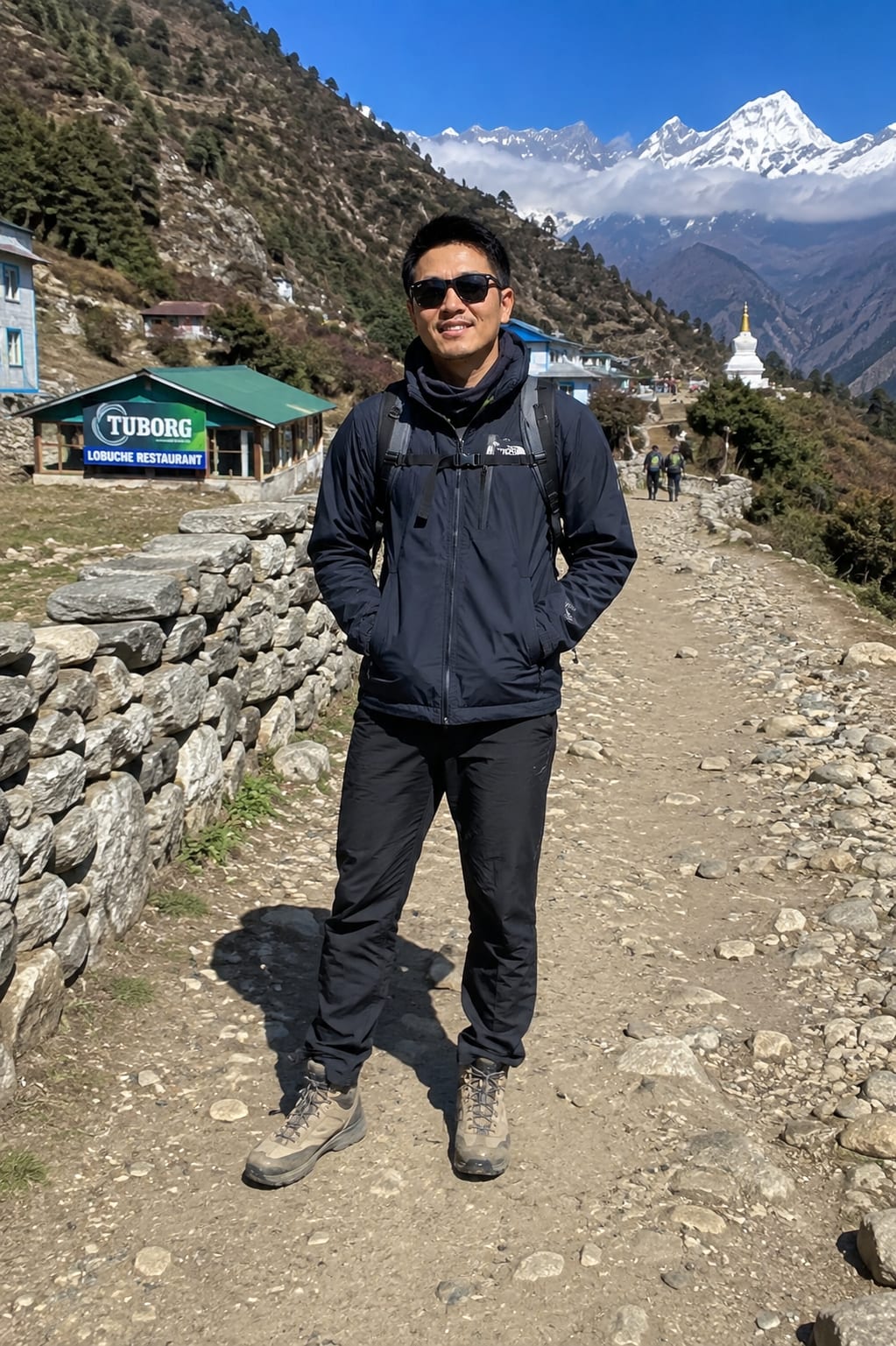
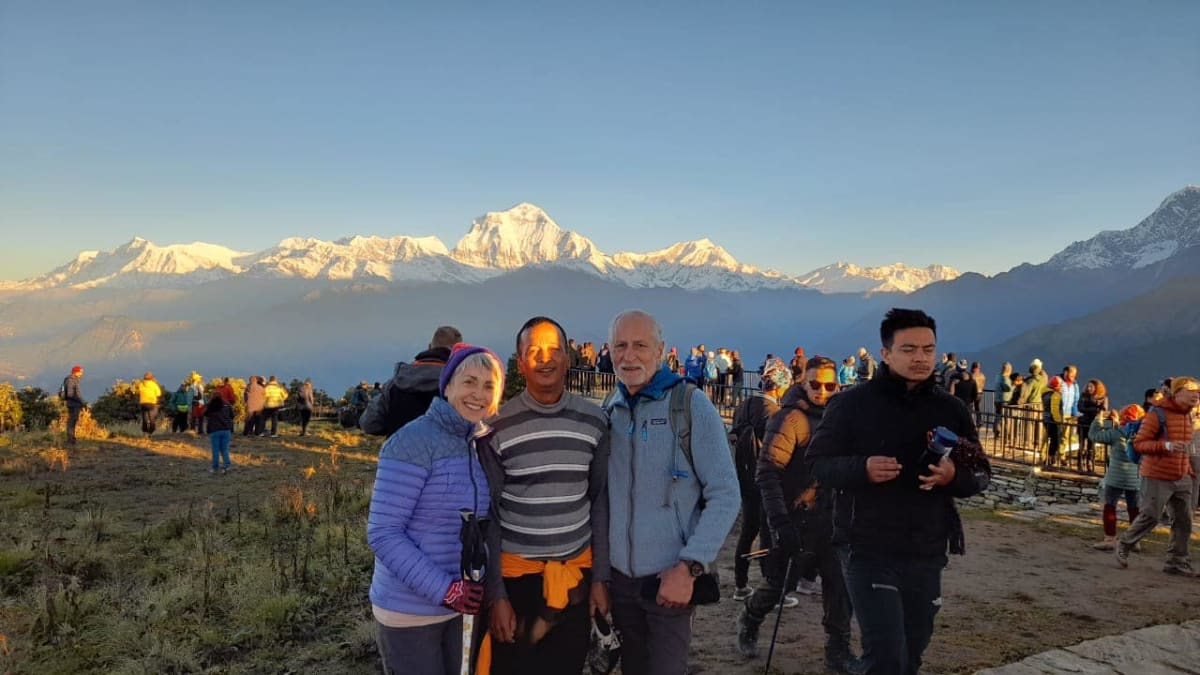
The trek opened at Nayapul (1,070 m) on October 12 with a gentle riverside walk to Tikhedhunga, and Maren says the first surprise was how little the walking resembled her mental image of trekking. "I expected something closer to a forced march," she said. "Day one was three hours and a proper yoga session waiting at the end of it." The Ulleri staircase on day 2, the trip's single hardest climbing section, still respected the 600 m daily ascent cap, paced slowly with rest breaks Ajay called without being asked. The dawn climb to Poon Hill's 3,210 m viewpoint on day 3 delivered the Annapurna and Dhaulagiri panorama Maren had seen in the trip photos, and the group returned to Ghorepani for a longer practice session rather than pushing onward the same day.
Why the 600 m cap made the practice sustainable
Maren's clearest reflection concerns the mechanics of the ascent cap itself. "In my own training I know the difference between a session where my legs are fresh and one where I'm running on fumes," she said. "Every evening session on this trek felt like the first kind, which told me the walking distances weren't an accident." She points to day 4, the forest traverse to Tadapani, as the moment she stopped worrying entirely: a 5-hour walking day bracketed by a sunrise vinyasa and an evening restorative session, with enough left in her body for both. "That's when I understood what the FAQ meant. It's not a marketing line. The cap is the whole design."
Ghandruk: two nights at Ajay's home village
The group reached Ghandruk at 1,940 m on day 5, the village where Ajay Shrestha grew up and where his family still runs a lodge on the wider Poon Hill route. Maren describes the two nights there as the emotional center of the trip. "Ajay pointed out his family's terraces during the walk in, very matter-of-fact, and then that evening's session was on a rooftop with the Annapurna range and Machhapuchhre right there," she said. The full practice day at Ghandruk on day 6 combined morning vinyasa, a walk through the Gurung village itself, and an evening yin session, with no further altitude gain to manage. "Having a teacher who is teaching you in his own home village is a different thing entirely from a studio retreat abroad. It changed how I thought about the whole week."
What she wished she had known beforehand
Asked what she would tell a version of herself deciding whether to book, Maren returns to the ascent-cap question first. "I wish I'd trusted the FAQ instead of needing eight days to prove it to myself," she said. "I would also tell her that six years of yoga experience means nothing about how your body handles a staircase at altitude, and that's fine, because the sessions scale to whoever's in the room, not to some assumed fitness level." She now recommends the Annapurna Yoga Trek to two friends back in Bergen who raised the identical worry she had, sending them the same FAQ line that talked her down in September.
The closing session at Phewa Lake
The trek ended on day 7 with a drive from Nayapul to Pokhara and a final session beside Phewa Lake, which Maren calls "the first time in the whole week I actually felt sad it was over rather than relieved." The group practiced facing the lake toward the Annapurna range at sunset, and Maren says it was the only session all week where nobody was thinking about the next day's walking distance. She flew home on October 19 and has since restructured her own physiotherapy clinic's outdoor programming around a version of the same principle: movement paced to what the body has left, not to a fixed schedule. "I run a walking group for patients now with a distance and elevation cap," she said. "I took that home directly from Ghandruk." She's since recommended the trip to three more colleagues at the clinic, two of whom have since booked their own October departures. "Tell them the FAQ isn't hiding anything," she added, laughing, as we wrapped up the call. "Tell them to just believe it the first time."