Nepal Travel Packages
Annapurna Yoga Trek

Annapurna Yoga Trek

★★★★★ 4.9 (34 reviews)
Yoga Treks, Nepal 8-10 days Easy Max 3,210 m
Duration
8-10 days
Max altitude
3,210 m
Difficulty
Easy
Group size
Up to 10
Total distance
~45 km
Elevation gain
2,400 m
Best season
October to December, March to May
Avg daily walk
3-5 hours
Starts in
Nayapul (1,070 m)
Ends in
Pokhara
Accommodation
Teahouse lodges with practice space
✓ TAAN & NMA licensed guides ✓ Permits included, no hidden fees ✓ Small group departures
Group departure · per person
USD1,150
Permits, guide, porter, lodging & food included
Departure date
Email Nepal
Permits and logistics fully arranged
Licensed guide included on every departure
Direct WhatsApp line to your guide

The Annapurna Yoga Trek is an 8 to 10 day teahouse trek in the Annapurna foothills built around twice-daily yoga practice, reaching the 3,210 m Poon Hill viewpoint with daily ascent capped at 600 m. A 2026 group departure costs USD 900 to 1,350 per person including the Annapurna Conservation Area Permit (NPR 3,000), a TIMS card (NPR 2,000), and a certified yoga teacher. It pairs morning vinyasa and evening restorative sessions with moderate walking days, so the practice stays consistent rather than being crushed by hard climbs.

Ajay Shrestha, who holds a 500-hour Yoga Alliance certification earned in Rishikesh in 2019, designed and leads this trek. The sections below cover the two permits, a cost breakdown against the USD 900 to 1,350 range, the daily practice schedule at altitude, and who the trek is built for.

Highlights

What our guides know that others don't.

1

Daily practice schedule at altitude

Sunrise vinyasa, walk, evening restorative; sessions ~75 min

2

Experience needed

None; practice scales to mixed-ability groups

Live from the trail

Updated 2 Jul 2026

Monsoon status: green foothills, practice indoors on wet days

Monsoon rain is falling on the foothills, and while the route is walkable the sunrise views are unreliable and lodge terraces are often wet for practice. We schedule yoga trek departures for the drier autumn and spring windows. Next scheduled departure: mid-October.

Who is the Annapurna Yoga Trek built for?

This trek suits travellers who want daily yoga practice paired with Himalayan foothill walking, not a race to a high pass, and it works for all practice levels. The 600 m daily ascent cap is the design choice that makes it possible, because a hard climbing day leaves no energy for an evening restorative session. Prior yoga experience is not required; Ajay scales each session to a mixed-ability group, and prior trekking experience is not required either given the easy grading.

The route stays below 3,210 m, so altitude is a non-issue and the focus stays on the practice and the villages. Trekkers who want the practice without any walking should look at the wellness retreats instead, and those wanting the sunrise without the yoga at the standard Poon Hill trek.

What does the Annapurna Yoga Trek cost in 2026?

A group departure runs USD 900 to 1,350 per person in 2026, above a standard Poon Hill trek because the trip carries a certified yoga teacher and chooses lodges with room to practice. The table shows the breakdown, and the teacher-guide line is the main premium: an RYT 500 teacher who also guides costs more than a standard trekking guide. Mats and props are carried for the group.

The trek's low altitude and short walking days keep the porter and food lines modest, so the practice-related costs are what set the price. A private departure for a couple sits at the upper end because the teacher's cost spreads across fewer people. This is a specialist trip, priced for the specialist leadership it needs.

Where the price goes · per person
Permits (ACAP + TIMS)NPR 5,000 total at 2026 rates$38
Pokhara-Nayapul/Pokhara transfersPrivate or shared jeep$35–80
Certified yoga teacher and guide (shared)Teacher-guide at a premium over a standard guide$260–400
Porter, one per two trekkersUSD 25/day, 20 kg shared load$150–220
Teahouse rooms with practice space, 7-9 nightsLodges chosen for a room to practice in$60–130
Food and drinking waterDal bhat and lighter practice-day meals$180–300
Company margin, logistics, mats and props$120–220

What is the daily practice schedule at altitude?

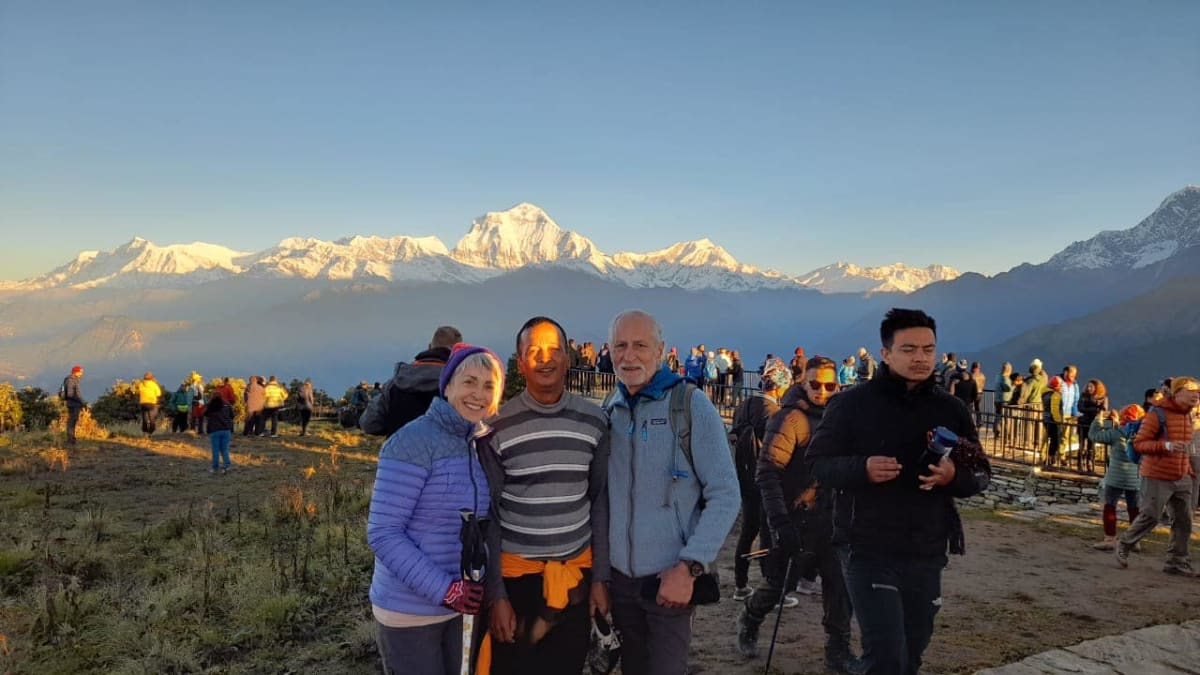
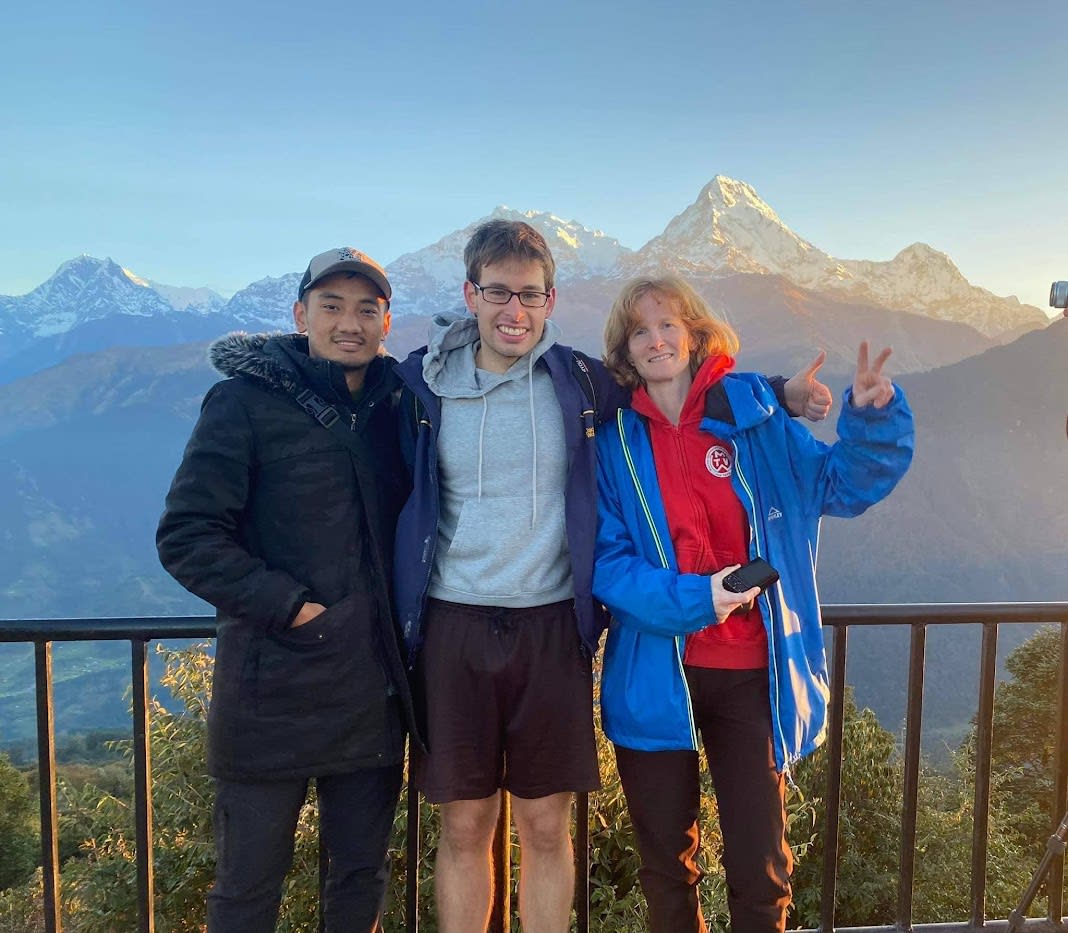
Each day opens with a sunrise vinyasa session of about 75 minutes on a lodge terrace facing the mountains, followed by breakfast and a moderate walk of three to five hours, then an evening restorative or yin session before dinner. The 600 m ascent cap keeps the walking gentle enough that the evening practice restores rather than exhausts, the rare-attribute rhythm that defines this trek. At the foothill altitudes here, up to 3,210 m, practice is comfortable and breathing is unaffected.

Ajay adjusts each session to the day's walking and the group's energy, and rest days at Ghandruk or Ghorepani carry longer sessions and pranayama work. The consistency of two sessions a day, protected by the gentle walking profile, is what separates this from a trek that happens to offer occasional yoga.

Who teaches the Annapurna Yoga Trek?

Ajay Shrestha leads every departure personally rather than handing the trek to a rotating instructor roster. He holds a 500-hour Yoga Alliance teaching certification completed in Rishikesh in 2019, on top of nine years guiding in the Annapurna foothills and TAAN guide registration G-1098, so he carries both the teaching credential and the trekking-guide licensing a moving yoga trip actually needs rather than one or the other. He has led 38 departures in the Annapurna foothills since 2017, including this specific route.

Ajay is from Ghandruk itself, the Gurung village the trek passes through and stays in on days 5 and 6, and his family still runs a lodge on the Poon Hill route. That local grounding shows up in small, real ways: the practice terraces he chooses are ones he has used for years, and the village stop at Ghandruk is his own home rather than a generic overnight stop. He also holds a Wilderness First Aid certificate, renewed in 2025, relevant on a trek where the yoga and the trekking both need managing at once.

How does yoga practice interact with trekking physically?

Trekking and yoga complement each other more than they compete, when the walking stays within the gentle profile this trek uses. Morning practice opens the hips, hamstrings, and shoulders before a day of walking, which measurably reduces the stiffness that builds up on multi-day treks without any movement break, and evening restorative or yin sessions target exactly the muscle groups a walking day loads: calves, quadriceps, and the lower back from a daypack. Breath-focused practice also has a direct, practical use at altitude: pranayama techniques taught on rest days build the same diaphragmatic breathing habit that helps manage exertion on the Ulleri staircase and the Poon Hill dawn climb.

This only works because the trek's ascent stays capped at 600 m a day. A harder trekking day, the kind found on the Annapurna Circuit or Everest Base Camp, leaves too little energy and too much muscle fatigue for a genuine evening practice, which is exactly why those routes don't carry a yoga component on this site. The pairing is deliberate engineering, not a yoga class added on top of an existing trek itinerary.

How does this compare to the site's other yoga treks?

This site runs three yoga treks, and the Annapurna Yoga Trek sits in the middle of the group on both altitude and duration. The Poon Hill Yoga Trek is the gentlest of the three, a shorter 6-7 day version reaching the same 3,210 m viewpoint with less total walking. The Everest Foothills Yoga Trek reaches higher, to Tengboche at 3,860 m, and costs more given the Lukla flight and Khumbu logistics, but deliberately stops short of Everest Base Camp itself to keep the same practice-protecting ascent cap. This Annapurna route reaches Poon Hill via a longer, more varied path through Ghorepani, Tadapani, and Ghandruk than the Poon Hill Yoga Trek's more direct line, adding two extra villages and a rest day at Ajay's home village that the shorter option doesn't include.

Trekkers choosing between the three should weigh time available and destination interest more than fitness, since all three share the same 600 m daily ascent cap and easy grading. Someone with limited time who mainly wants the Poon Hill sunrise fits the shorter option better; someone who wants the fuller Annapurna foothill experience, Gurung villages included, fits this route; and someone drawn to the Everest region's scenery over the Annapurna's fits the Everest Foothills option.

Who shouldn't book the Annapurna Yoga Trek?

This trek isn't the right fit for two kinds of traveller: those who want serious trekking mileage or a high-altitude objective, since the 600 m ascent cap and 3,210 m ceiling are deliberately modest compared with routes like the Annapurna Circuit or Everest Base Camp, and those who want a wellness trip with zero walking, for whom the Pokhara Wellness Retreat is the better match. It's also not built around advanced or highly specific yoga styles; Ajay teaches a general vinyasa and restorative practice suited to mixed groups, not an intensive style-specific training.

It suits, clearly, travellers who want daily practice alongside genuine Himalayan foothill walking and Gurung village culture, at a pace gentle enough to protect the yoga rather than exhaust it. The full comparison against the fixed-base retreat option is in Annapurna Yoga Trek vs Pokhara Retreat.

What should you pack for the Annapurna Yoga Trek?

Packing here splits into trekking gear and practice gear, and neither list needs to be extensive given the trek's gentle grading and low altitude. Trekking gear follows a lighter version of the Nepal trekking packing list: broken-in walking shoes rather than heavy mountaineering boots, 2-3 light layers, a warm layer and hat for the pre-dawn Poon Hill climb specifically, and a light rain shell given the route's foothill forest sections. A sleeping bag rated to around 0 C is enough at this trek's altitudes, well short of the -15 C bags a high-altitude teahouse trek needs.

Practice gear is minimal since mats and basic props travel with the group: bring light, breathable layers you can move in, a lightweight practice top for the warmer lower-altitude days at Ghandruk, and a scarf or shawl for the cool sunrise sessions before the sun clears the ridgelines. A journal is worth packing too; several past groups have used the evening sessions and village stops for reflective writing alongside the physical practice, something Ajay encourages but never requires.

What is Ajay's teaching approach on this trek?

Ajay builds each session around what the group actually needs that day rather than running a fixed sequence regardless of conditions, a teaching habit he developed over 38 departures leading trekkers with wildly different practice backgrounds. A group that arrived tired off an overnight flight gets a gentler opening sunrise session; a group energized after a good rest day at Ghandruk gets a longer, more dynamic vinyasa flow. This responsiveness is only possible because he leads every departure himself rather than following a rotating-instructor script, and it's the same instinct that shapes his walking pace decisions on the trail.

His approach treats the yoga and the trekking as one integrated practice rather than two separate activities sharing an itinerary. Village stops become part of the session planning, not just overnight logistics: the two nights at his home village of Ghandruk carry extended pranayama work specifically because the fixed base and family setting support longer, calmer sessions than a one-night trail stop allows. Clients consistently describe this as the trek's differentiator from a generic "yoga plus trekking" itinerary assembled by an operator without a teacher genuinely embedded in the route.

Elevation profile High point 3,210 m
1,0001,5002,0002,5001,540 m12,860 m23456822 m7DAY
Acclimatization night High point

Day by Day

7-day itinerary, every detail planned.

Day1
Trip Day
Drive Pokhara to Nayapul, trek to Tikhedhunga (1,540 m)
~3h walking9 km
1,540m alt.

A short jeep ride along the Modi Khola valley reaches the Nayapul trailhead, followed by a gentle riverside walk through terraced farmland and small Magar villages to Tikhedhunga. An arrival practice session on the lodge terrace that evening, kept short and grounding after a travel day, sets the trip's unhurried rhythm before the first real climbing begins tomorrow.

1,540 m9 km~3h
Day2
High Point
Tikhedhunga to Ghorepani (2,860 m)
~5h walking12 km
2,860m alt.
Day3
Acclimatization
Poon Hill sunrise (3,210 m), practice day at Ghorepani
~3h walking
2,860m alt.
Day4
Trip Day
Ghorepani to Tadapani (2,630 m)
~5h walking12 km
2,630m alt.
Day5
Trip Day
Tadapani to Ghandruk (1,940 m)
~4h walking9 km
1,940m alt.
Day6
Acclimatization
Practice day at Ghandruk
~2h walking
1,940m alt.

What's Included

Transparent, all-in pricing.

Included in your price

Permits (ACAP + TIMS)
Pokhara-Nayapul/Pokhara transfers
Certified yoga teacher and guide (shared)
Porter, one per two trekkers
Teahouse rooms with practice space, 7-9 nights
Food and drinking water
Company margin, logistics, mats and props

Not included

Nepal entry visa fee (USD 30-125, paid on arrival)
Travel insurance with helicopter evacuation cover
Personal trekking gear and equipment
Tips for your guide and porter
Bottled drinks, wifi, and device charging at teahouses
Meals in Kathmandu outside the itinerary

Dates & prices

Upcoming departures.

Start dateEnd datePrice / personAvailability
12 Oct 202618 Oct 2026USD 1,150Guaranteed · 5 leftEnquire
2 Nov 20268 Nov 2026USD 1,150Open · 7 leftEnquire
23 Nov 202629 Nov 2026USD 1,100Open · 8 leftEnquire
15 Mar 202721 Mar 2027USD 1,100Open · 8 leftEnquire

Verified reviews

What travellers say.

4.9/5 from 34 reviews on TripAdvisor, checked July 2026

★★★★★

Two practices a day with the Annapurnas as a backdrop, and walking gentle enough that I actually had energy for the evening session. Ajay is a wonderful teacher and being in his home village of Ghandruk made it special.

IM
Isabelle Moreau · France
14 Apr 2026
★★★★★

I was worried the trekking and yoga would clash but the pacing was perfect. The 600 m cap is not a gimmick, it genuinely keeps you fresh for practice. A beautiful, restorative week.

GB
Grace Bennett · United States
22 Mar 2026

Why Nepal Travel Packages

Built on published proof, not adjectives.

A named, licensed guide before you book

Full name, photo, NMA or TAAN license number, and a direct WhatsApp line. The guide on the page is the guide on the trail.

Itemized pricing, not a lump sum

Permits, guide, porter, lodging, and food broken out on every trip page. You see exactly where the price comes from.

Trail conditions updated monthly

Dated field reports from the guides running the route this season, not boilerplate written once and left to go stale.

Permits handled, not hidden

Every permit fee, checkpoint, and paperwork rule is filed for you and published in the guides — no surprise admin at Lukla.

FAQ

Common questions

Do I need yoga experience for this trek?+

No, the practice scales to all levels and mixed-ability groups, and Ajay adjusts each session to the people present. Complete beginners and experienced practitioners both fit on the same departure. Prior trekking experience is not needed either, since the route is graded easy with a 600 m daily ascent cap.

How is this different from a wellness retreat?+

A yoga trek moves each day, pairing practice with foothill walking and mountain villages, while a retreat stays at a fixed base. This trek reaches the 3,210 m Poon Hill viewpoint and passes through Gurung villages, which a lakeside retreat does not. Compare the fixed-base option on the wellness retreats pages.

Is the walking hard on a yoga trek?+

No, walking days are moderate at three to five hours with the ascent capped at 600 m, deliberately gentle so the evening practice restores rather than exhausts. The one genuinely climbing-heavy section is the Ulleri staircase, walked slowly with regular rests. The trek is graded easy overall and stays well below the altitude where sickness becomes a realistic planning concern.

What yoga equipment is provided?+

Mats and basic props are carried for the group, so you need only bring your own if you prefer a specific mat. Lodges are chosen for having a room or terrace suitable for practice. Bring layers for the sunrise sessions, which can be cool before the sun clears the ridges.

Who teaches the Annapurna Yoga Trek?+

Ajay Shrestha leads every departure personally. He holds a 500-hour Yoga Alliance certification from Rishikesh (2019), TAAN guide registration, and nine years guiding in the Annapurna foothills, including 38 departures since 2017. He is from Ghandruk, the village the trek stays in on days 5 and 6.

How is this different from the Poon Hill Yoga Trek or Everest Foothills Yoga Trek?+

All three share the same 600 m daily ascent cap and easy grading. The Poon Hill Yoga Trek is shorter and more direct to the same viewpoint; the Everest Foothills Yoga Trek reaches higher, to Tengboche at 3,860 m, via Khumbu logistics and a Lukla flight. This Annapurna route takes a longer path through Ghorepani, Tadapani, and Ghandruk, including a rest day at Ajay's home village.

Does yoga practice actually help with the trekking?+

Yes. Morning practice loosens hips, hamstrings, and shoulders before walking, evening sessions target the muscle groups a walking day loads, and pranayama breathing techniques taught on rest days build the same breathing habit that helps on the Ulleri staircase and Poon Hill's dawn climb. This only works because the trek's gentle ascent profile leaves enough energy for real practice.

What should I pack for a yoga trek versus a standard trek?+

Less than a high-altitude trek needs: a 0 C-rated sleeping bag instead of a -15 C bag, light breathable layers for practice alongside standard trekking layers, and a warm layer specifically for the pre-dawn Poon Hill sunrise. Mats and props are provided, so you only need your own if you have a strong preference.

Can solo travellers join this trek?+

Yes, solo travellers are common on this departure and there is no group-size minimum, unlike restricted-area treks elsewhere in Nepal. Groups run up to 10 people, and Ajay's mixed-ability approach to both the walking pace and the practice level makes solo bookings straightforward to fit alongside couples and small groups.

What happens if it rains during the trek?+

Sunrise and evening practice moves indoors to a lodge dining room or covered terrace on wet days, and the walking itself is straightforward in light rain given the route's easy grading and lower altitude. Heavier monsoon-season rain (June-September) is why departures run in the drier October-December and March-May windows instead, where clear mornings for both the walking and the Poon Hill sunrise are far more reliable.

How does the Ulleri staircase fit with a yoga-focused itinerary?+

It's the trek's one genuinely demanding climbing day, roughly 3,200 stone steps, and it's deliberately placed early, on day 2, before the practice rhythm is fully underway, and walked slowly with rests so it stays within the 600 m ascent cap despite the steep terrain. An evening restorative session at Ghorepani specifically targets the hips and calves the staircase loads, treating it as a one-off exception the itinerary is built to absorb rather than a preview of the trek's normal pace.

What's the group size on the Annapurna Yoga Trek?+

Groups run up to 10 people, small enough that Ajay can genuinely adjust each session to who's actually on the departure rather than teaching to a generic average across a much larger class. Couples, solo travellers, and small friend groups all book this trek regularly, and mixed-ability groups are the norm rather than the exception on nearly every scheduled departure.

Is this trek suitable for a honeymoon or couples trip?+

Yes, it's a common booking for couples specifically because the gentle grading and consistent daily rhythm leave energy for connection rather than exhaustion, and the two-night stay at Ghandruk gives a longer, unhurried stop mid-trip. Private departures are available for couples who prefer a dedicated session schedule rather than joining a mixed group, priced at the trek's private rate.

What's the best time of year to book the Annapurna Yoga Trek?+

October to December and March to May are the two recommended windows, both offering clear mountain views for the Poon Hill sunrise and dry lodge terraces for outdoor practice. Late autumn (October-November) tends to be the most popular booking window, coinciding with Nepal's clearest post-monsoon skies, while spring adds rhododendron blooms along the Ghorepani-Tadapani forest section.

How far in advance should I book this trek?+

Four to six weeks ahead is typically enough, shorter than the lead time a restricted-area trek needs, since this route requires only the standard ACAP and TIMS permits rather than a Department of Immigration filing. Booking earlier widens the choice of departure dates during the popular October-November window and improves the odds of joining Ajay's own preferred autumn or spring dates rather than a later date on the calendar.

Does the trek visit any sites beyond the trail villages?+

Yes, day 6 at Ghandruk includes a visit to the village's Gurung Museum, which documents Gurung culture and the region's Gurkha military history, alongside Ajay's own family lodge. This is folded into the practice day rather than treated as a separate sightseeing excursion, consistent with the trek's approach of integrating culture, walking, and yoga into one rhythm rather than three competing activities, not an add-on stop bolted onto an otherwise unrelated schedule.