Island Peak and Mera Peak are Nepal's two most-climbed NMA trekking peaks, differing chiefly in technical demand: Island Peak's 6,189 m summit requires a fixed-rope headwall, while Mera Peak's 6,476 m summit, the highest trekking peak in Nepal, is a long snow-slope altitude test with no comparable technical crux. Island Peak runs 14 days for USD 2,400 to 3,300 in 2026 and approaches via the classic Khumbu trail through Namche and Dingboche. Mera Peak runs 17 days on a quieter route through the Hinku valley, and both peaks carry the same NMA royalty tier: USD 250 in spring, USD 125 in autumn, and USD 70 in winter or monsoon. Passang Dawa Sherpa, who guides Island Peak climbs, wrote this comparison to match climbers to the right first Himalayan peak.
The sections below compare summit-day technical difficulty, altitude, approach-route crowding, and cost, then give a direct recommendation by climbing goal.
In this guide 8
- 01 How do the two peaks compare at a glance?
- 02 How technical is each summit day?
- 03 Which peak is the bigger altitude test?
- 04 How do the approach routes differ in crowding?
- 05 How should training and gear preparation differ between the two?
- 06 Our recommendation
- 07 Does the best season differ between the two peaks?
- 08 How does the cost actually break down for each peak?
How do the two peaks compare at a glance?
Island Peak (6,189 m, 14 days, USD 2,400-3,300) is the more technical of the two, with a fixed-rope headwall; Mera Peak (6,476 m, 17 days) is Nepal's highest trekking peak and a longer altitude test with far less rope work. Full route and permit detail sits on the Island Peak Climb and Mera Peak climb pages.
| Island Peak | Mera Peak | |
|---|---|---|
| Summit altitude | 6,189 m | 6,476 m (Nepal's highest trekking peak) |
| Duration | 14 days | 17 days |
| Technical grade | Technical; fixed-rope headwall, jumar ascent | Strenuous; largely non-technical, altitude is the test |
| Approach | Khumbu/EBC trail via Namche and Dingboche | Quieter Hinku valley via the Zatrwa La |
| Group cost (2026) | USD 2,400-3,300 | USD 2,500-3,400 |
| NMA permit tier | USD 250 spring / 125 autumn / 70 winter-monsoon | Same tier as Island Peak |
How technical is each summit day?
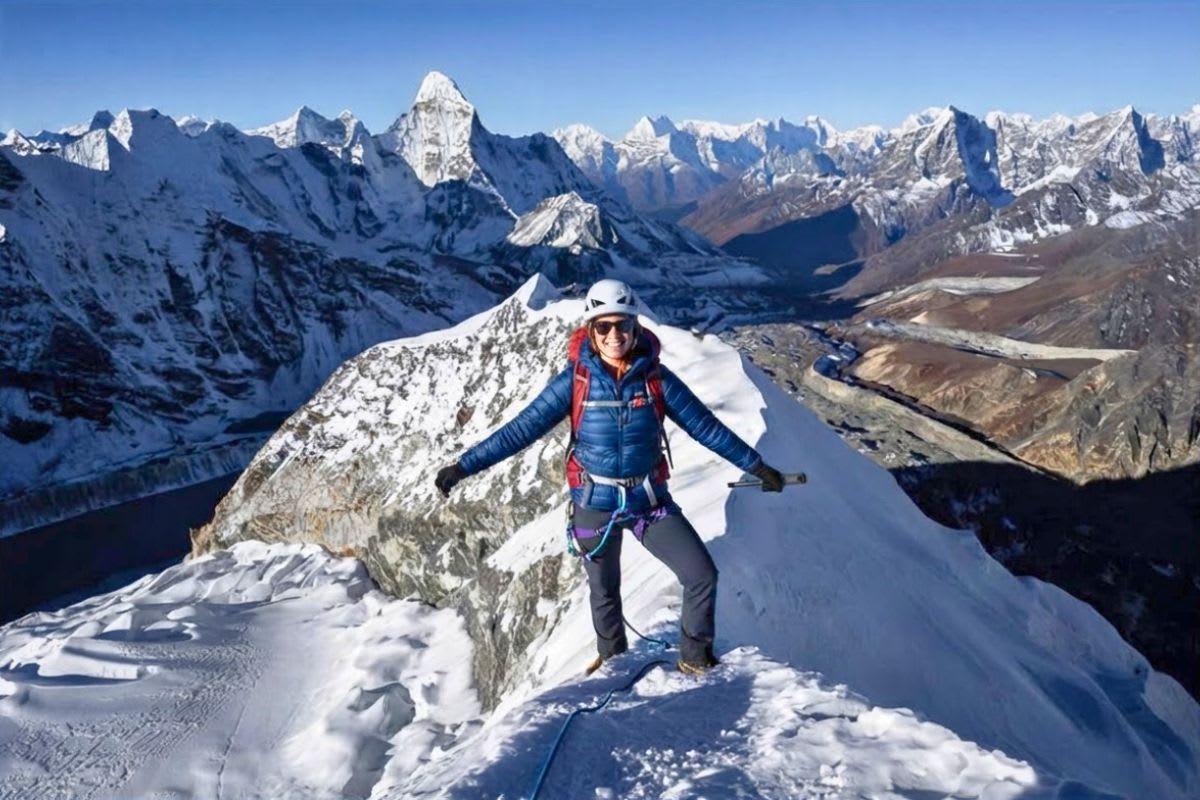
Island Peak's crux is a 100 to 150 m fixed-rope headwall on 45 to 50 degree snow and ice, climbed with a jumar, followed by a corniced summit ridge, the section that makes the climb genuinely technical rather than a hard walk. Mera Peak's summit day is a long, sustained snow slope to the summit ridge, with a short fixed line only in the final stretch, so the technical bar sits well below Island Peak's headwall. Both expeditions run a base-camp skills day covering crampon technique, ice-axe use, and jumar ascending, but Island Peak's training earns its keep on summit day in a way Mera's does not.
Climbers who want to leave with real rope-climbing competence choose Island Peak for exactly this reason.
Which peak is the bigger altitude test?
Mera Peak's 6,476 m summit sits 287 m above Island Peak's 6,189 m, and it holds the title of Nepal's highest trekking peak, a distinction that draws climbers who want the altitude record over the technical challenge. The approach through the Hinku valley crosses the Zatrwa La (4,610 m) out of Lukla before a high camp near the Mera La (5,415 m), giving a longer sustained stretch of thin air on summit day than Island Peak's shorter push from its own high camp. Altitude, not rope work, decides most Mera Peak turnbacks, which is why prior nights above 5,000 m matter more for this peak than technical preparation does.
Both summits sit well above the altitude where acute mountain sickness becomes a real factor, covered in general terms in the altitude sickness prevention guide.
How do the approach routes differ in crowding?
Island Peak's approach shares the Everest Base Camp trail through Namche Bazaar, Tengboche, and Dingboche, busy, well-supplied villages that also serve the base camp trekking crowd, so the walk-in itself carries the traffic of Nepal's most popular trek. Mera Peak's Hinku valley route branches away from the Khumbu at Lukla through Paiya and Panggom rather than following the base camp trail, and its teahouses are fewer and further apart, giving a genuinely quieter approach. The trade is infrastructure: Mera's lodges carry less variety and capacity than the Khumbu's, so groups plan supplies more carefully.
How should training and gear preparation differ between the two?
Island Peak preparation should weight rope skills more heavily: practicing jumar ascending, fixed-line transitions, and basic ice-axe arrest before arrival shortens the base-camp skills day from a first-time lesson to a refresher, and climbers who arrive with even a single prior via-ferrata or indoor ice-climbing session summit day with more confidence on the headwall. Mera Peak preparation should weight cardiovascular endurance and cold tolerance more heavily, since the summit push is a long, sustained slog at extreme altitude rather than a technical crux; stair-climbing with a loaded pack and multi-hour hikes are the more useful training investment than rope drills. The how to train for a first Himalayan climb guide covers the shared fitness baseline both peaks need.
Gear lists overlap heavily, crampons, an ice axe, a climbing harness, and a helmet are standard for both and usually rented in Kathmandu rather than bought, but Island Peak climbers should expect to actually use the jumar and fixed-line gear for a longer, more technical stretch, while Mera Peak climbers carry the same kit mostly as a safety margin for the final approach.
Our recommendation
Choose Island Peak if you want to learn real climbing skills on a fixed-rope headwall and prefer the busier, better-supplied Khumbu approach shared with Everest Base Camp trekkers. Choose Mera Peak if the goal is standing on Nepal's highest trekking summit and you are willing to trade technical engagement for a longer, quieter altitude test through the Hinku valley. Climbers building toward bigger objectives often take Island Peak first for the rope-work grounding, then Mera Peak on a later trip for the altitude record; either makes a sound first Himalayan climb on its own.
Does the best season differ between the two peaks?
Both peaks share the same two climbing windows, spring (March-May) and autumn (September-November), and both carry the identical NMA royalty step-up in spring, USD 250 against autumn's USD 125, so neither peak offers a seasonal cost advantage over the other. The practical difference is conditions underfoot: Mera Peak's long snow slopes climb more predictably in stable post-monsoon autumn snow, while Island Peak's shorter, steeper headwall is more forgiving of the firmer, colder ice that either season can produce.
Winter and monsoon climbs are technically permitted on both at the lowest NMA royalty tier, USD 70, but neither is commonly run: Mera's exposed Hinku approach gets genuinely difficult in winter snow, and Island Peak's headwall conditions become less predictable outside the two main windows. Our own departures for both peaks run in spring and autumn only, for this reason.
How does the cost actually break down for each peak?
| Line item | Island Peak | Mera Peak |
|---|---|---|
| NMA peak royalty | USD 250 (spring) / 125 (autumn) | Same tier |
| Climbing guide (1:2 ratio typical) | Included in group rate | Included in group rate |
| Technical gear (rope, harness, crampons) | Included | Included |
| Approach trek days (Khumbu vs Hinku) | 8-10 days | 12 days |
| High-camp logistics | Simpler, closer to established EBC infrastructure | More remote, higher porter cost per day |
Mera Peak's slightly higher price band despite its lower technical demand comes from its longer duration and the higher cost of supplying a more remote high camp, not from any extra technical service. A climber comparing the two purely on the headline price range should look at what's driving the small gap rather than assume price tracks difficulty directly, since here it doesn't.
FAQ
Common questions
Is Mera Peak easier than Island Peak?+
Technically yes: Mera Peak has no headwall comparable to Island Peak's 100 to 150 m fixed-rope section, only a short fixed line near the summit. Altitude-wise Mera is harder, since its 6,476 m summit sits 287 m above Island Peak's 6,189 m and demands a longer stretch at extreme altitude. Which peak feels harder depends on whether rope work or thin air is your bigger concern.
Do I need prior climbing experience for either peak?+
No, both expeditions run a base-camp skills day covering crampon technique, ice-axe use, and jumar ascending before the summit push, and neither peak requires prior mountaineering experience. Good hillwalking fitness and a tolerance for altitude matter more than technical background on either climb.
Which peak has better summit views?+
Both give genuine Himalayan panoramas: Island Peak's summit stands close to Everest, Lhotse, and Nuptse, while Mera Peak's greater height and more isolated position give a wider sweep that on a clear day takes in five 8,000 m peaks, including Everest, Kanchenjunga, and Makalu.
Can I climb both Island Peak and Mera Peak on separate trips?+
Yes, this is a common progression: climbers who summit Island Peak first for the rope-work foundation often return for Mera Peak once they want the higher, quieter altitude test, or the reverse if Mera came first and Island Peak's technical grade is the remaining goal. Neither peak requires the other as a prerequisite.