Nepal Travel Packages
Island Peak Climb (Imja Tse)

Island Peak Climb (Imja Tse)

★★★★★ 4.9 (41 reviews)
climbing, Nepal 14-16 days Technical Max 6,189 m
Duration
14-16 days
Max altitude
6,189 m
Difficulty
Technical
Group size
Up to 8
Total distance
~100 km
Elevation gain
7,200 m
Best season
April to May, October to November
Avg daily walk
5-8 hours
Starts in
Lukla (2,860 m)
Ends in
Lukla (2,860 m)
Accommodation
Teahouse lodges, tented high camp
✓ TAAN & NMA licensed guides ✓ Permits included, no hidden fees ✓ Small group departures
Group departure · per person
USD2,800
Permits, guide, porter, lodging & food included
Departure date
Email Nepal
Permits and logistics fully arranged
Licensed guide included on every departure
Direct WhatsApp line to your guide

Island Peak, known locally as Imja Tse, is a 6,189 m trekking peak in Nepal's Khumbu region climbed on a 14 to 16 day expedition that combines Everest-region acclimatization with a fixed-rope headwall and a summit ridge. A 2026 group departure costs USD 2,400 to 3,300 per person including the Nepal Mountaineering Association climbing permit (USD 250 in spring, USD 125 in autumn), the Khumbu municipality permit (NPR 2,000), and Sagarmatha National Park entry (NPR 3,000). It is the most popular first Himalayan climb, and we teach crampon and jumar skills at base camp before the summit push.

Passang Dawa Sherpa, who has summited Island Peak 23 times as a climbing guide, leads these expeditions. The sections below cover the NMA permit, a cost breakdown against the USD 2,400 to 3,300 range, the acclimatization approach through the Everest valley, and the summit-day turnaround times and fixed-rope etiquette that keep the climb safe.

Highlights

What our guides know that others don't.

1

Summit-day turnaround times

12-1 am start; hard turnaround by set time on the headwall

2

Fixed-rope etiquette

One climber per rope section; jumar clip-past protocol at anchors

Live from the trail

Updated 2 Jul 2026

Monsoon status: climb on hold, unstable snow

The summit headwall carries wet, unstable monsoon snow through the summer, and we do not run Island Peak departures in the monsoon. The route reopens for scheduled climbs in early October once the snowpack firms after the first cold spells. Next scheduled departure: early October.

What permits does the Island Peak climb require?

Island Peak needs three permits in 2026: the Nepal Mountaineering Association climbing permit (USD 250 in spring, USD 125 in autumn), the Khumbu Pasang Lhamu Rural Municipality permit at NPR 2,000, and the Sagarmatha National Park entry at NPR 3,000. The NMA permit is the climbing authorization, priced by season, and it must be arranged by a registered agency with a licensed climbing guide. The two trekking permits are the same pair the Everest Base Camp trek uses on the approach.

Because Island Peak is graded a trekking peak rather than an expedition peak, its NMA permit is far cheaper than the royalty for a mountain like Ama Dablam. The permit and checkpoint mechanics for the Khumbu approach are in the Everest Base Camp permit costs guide.

A registered agency files all three permits together before the expedition starts, and none is available to an individual climber acting alone: Nepal law requires a licensed climbing guide for any NMA peak, the same rule covered in full in the climbing permits and NMA royalties guide. Alongside the royalty, the NMA also holds a refundable garbage deposit, returned once the expedition proves it carried its waste out, which our office reclaims on the climber's behalf after the trip.

How much does the Island Peak climb cost in 2026?

TAAN-registered operators quoted USD 2,400 to 3,300 for a group Island Peak expedition in 2026, above any Everest trek because of the climbing guide, tented high camp, and technical gear. The table shows the breakdown, and the climbing-guide and group-gear lines are what separate a climb from a trek: a qualified climbing guide costs more than a trekking guide, and fixed ropes and hardware are carried for the group. Oxygen is kept on standby though rarely needed at 6,189 m.

A quote well below the band on Island Peak usually means an underqualified guide or thin safety gear, which is exactly the wrong economy on a technical peak. The season sets the permit cost, and spring departures pay the higher USD 250 NMA fee. This is a climb, priced for the qualified leadership it demands.

Private departures run USD 2,900 to 4,200, a larger premium over the group rate than a standard teahouse trek carries, because the climbing guide's attention and the fixed-rope logistics don't scale down cleanly for a smaller party the way trekking costs do. A private group of two still needs close to the same climbing-crew presence at the headwall as a group of six, so the fixed cost concentrates onto fewer people. Climbers comparing this against a private Everest Base Camp departure, USD 1,500 to 2,200 with no climbing component, should expect Island Peak's premium to reflect the guide and gear a technical summit genuinely requires, not markup.

A deposit secures a scheduled departure date and the NMA permit filing slot, with the balance due before the expedition starts; the full mechanics of how that works, including why a filed climbing permit can't simply be refunded if plans change, are covered in the Nepal travel package deposit and payment schedule guide. Booking at least six to eight weeks ahead of a peak-season date gives the widest choice of departures and the most comfortable runway for the fitness training this climb rewards.

Where the price goes · per person
NMA climbing permitUSD 250 spring, USD 125 autumn$125–250
Khumbu municipality + Sagarmatha NP permitsNPR 5,000 total$38
Kathmandu/Ramechhap-Lukla flights, round tripFixed USD fare band$360–440
Climbing guide plus support (shared)IFMGA-standard climbing guide at a premium$700–1000
Porters and high-camp support crewTented camp, cook, kitchen crew$300–450
Teahouse rooms, food, high-camp catering13-15 nights plus tented camp$380–600
Group climbing gear, ropes, oxygen standbyFixed ropes, hardware, safety kit$300–520

How does the acclimatization approach work?

The Island Peak approach walks the Everest Base Camp trail through Namche, Tengboche, and Dingboche, giving the same proven acclimatization profile before the group turns up the Imja valley to Chhukung and base camp. Many of our climbers reach Everest Base Camp and Kala Patthar as part of the acclimatization, so the expedition doubles as a full EBC trek with a summit at the end. This shared approach is why Island Peak is the standard first Himalayan climb: the altitude preparation is well understood and the summit is technical but not extreme.

At base camp we run a training day on crampon technique, ice-axe use, and jumar ascending on fixed rope before the summit push. Climbers with no prior mountaineering experience can complete Island Peak on this preparation, though prior nights at altitude help, as covered in the altitude sickness prevention guide.

Two dedicated rest days anchor the schedule, one at Namche (3,440 m) and one at Dingboche (4,410 m), following the same 500 m-per-day sleeping-altitude guideline used on every high route we operate. Oxygen saturation is checked twice daily with a pulse oximeter from Dingboche onward, a routine our guides run regardless of how well a climber feels, since AMS symptoms don't always track subjective wellness. Fitness matters alongside acclimatization: summit day itself runs 10 hours or more at altitude, and the training block that prepares a climber for that demand, roughly three to four months of endurance hiking with a loaded pack, is covered in full in the climbing fitness preparation guide.

Climbers arrive at Island Peak base camp already having spent nine days above 3,000 m by the time the training day starts, which is a meaningfully longer acclimatization runway than a direct-approach climb would give. This is a deliberate design choice, not an accident of the trail: the Khumbu's dense village network lets us build in altitude exposure gradually across genuinely different terrain each day, rather than repeating the same acclimatization loop in one place.

What are the summit-day turnaround times and rope etiquette?

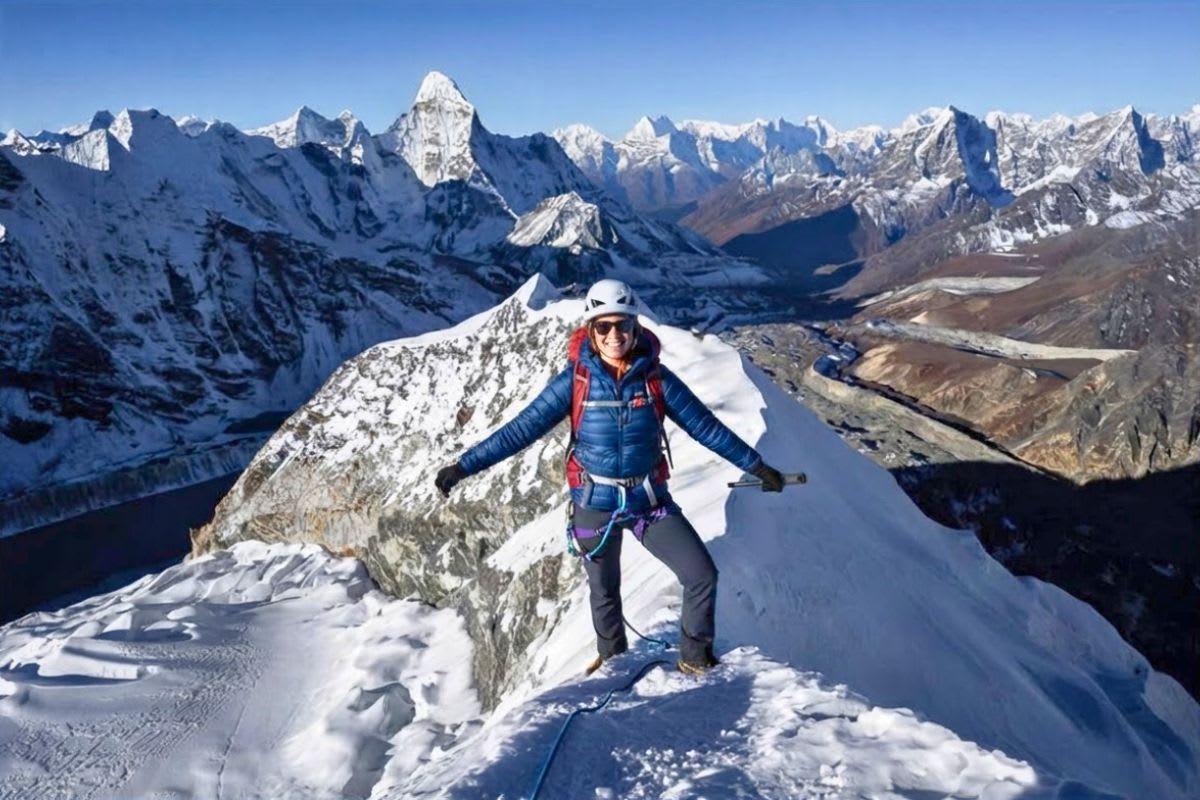
Summit day starts at midnight to 1 am so the group climbs the headwall on firm snow and stands on the 6,189 m summit around dawn, and it carries a hard turnaround time: if we are not up the fixed-rope headwall by the set hour, we descend and reassess. On the fixed ropes, one climber occupies a rope section at a time and clips past each anchor with a jumar in a set protocol, the rare-attribute discipline our base-camp training drills. Crowding a rope section is how accidents happen on trekking peaks, so the etiquette is enforced.

The headwall is a 100 to 150 m fixed-rope climb on 45 to 50 degree snow and ice, followed by a corniced summit ridge, and it is the one genuinely technical section. Turning back short of the summit is a normal outcome when conditions or timing do not line up, and Pemba makes that call without negotiation. For those weighing an easier first climb, the beginner climbing peaks in Nepal comparison sets Island Peak against Mera and Yala.

The headwall queue is the detail most first-timers underestimate: Island Peak is Nepal's most popular first Himalayan climb, and on a clear peak-season morning several operators' groups converge on the same fixed lines. Our guide-to-client ratio on summit day runs one guide to two or three climbers, tighter than the standard trekking ratio, specifically so a client is never left waiting alone mid-rope while a queue clears ahead. Climbers who want the same technical grade with far fewer people on the ropes should read the Lobuche East vs Island Peak comparison before booking.

What's the best season to climb Island Peak?

Spring (April to May) and autumn (October to November) are the two windows for Island Peak, and each trades against the other on cost and conditions rather than one being simply better. Spring carries the higher USD 250 NMA royalty but gives longer daylight hours and generally more settled snow on the headwall after the winter freeze; autumn drops the royalty to USD 125 and gives the clearest mountain views of the year, though the days are shorter and the first cold spells can leave the headwall icier than a spring ascent.

Winter and monsoon climbs exist on paper (the royalty drops further, to USD 70) but we do not schedule them: monsoon leaves the headwall under wet, unstable snow through the summer, and winter cold plus short daylight push the risk profile past what we consider reasonable for a beginner technical peak. The climbing permits and NMA royalties guide has the full seasonal fee table, and our own condition update below states the current status.

What happens if the weather doesn't cooperate on summit day?

Every Island Peak itinerary carries a built-in contingency day at base camp specifically for a weather delay, so a cloudy or high-wind forecast on the scheduled summit date doesn't automatically end the expedition. Pemba makes the go/no-go call the evening before based on wind speed and snow stability at the headwall, not on how the weather looks from base camp itself, since conditions on a fixed-rope pitch at 6,000 m can differ sharply from what's visible 1,000 m below. A postponed summit push simply moves to the contingency day, and the itinerary's return schedule already absorbs that shift without threatening the Lukla flight connection.

If the contingency day also proves unworkable, we don't force a summit attempt in marginal conditions. Climbers who don't summit still complete the acclimatization approach and the base-camp skills training, and many return on a later departure specifically for another summit attempt at a preferential rate, since the harder logistics (permits, approach, training) don't need repeating from scratch. This is a genuine possibility worth planning for financially and emotionally before booking, not a remote edge case: Himalayan weather at 6,000 m is unpredictable enough that even a well-run expedition sometimes doesn't get a clean summit window.

What should you pack for an Island Peak climb?

Island Peak needs the standard high-altitude trekking kit covered in the Nepal trekking packing list plus a distinct climbing layer: a mountaineering boot rated for crampon use (not a standard trekking boot), a climbing harness, an ascender (jumar), and a helmet, all of which climbers commonly rent in Kathmandu rather than buy for a single expedition. Fixed ropes, snow anchors, and the group safety kit are supplied and carried by the climbing crew, so personal gear stays limited to what a climber wears and clips onto their own harness.

A four-season sleeping bag rated to at least -20 C comfort is worth the extra margin over a standard trekking bag, since the tented high camp at 5,100 m runs colder overnight than a teahouse room at equivalent altitude. Sun protection matters more on summit day than anywhere else on the route: several hours of pre-dawn headlamp climbing give way to intense glare off the snow by mid-morning, so glacier glasses, not standard sunglasses, are part of the kit list our guides check at base camp.

Gloves deserve more attention than most first-time climbers give them: a thin liner glove for the jumar-handling dexterity the headwall demands, plus a heavier insulated outer mitt for the pre-dawn cold, covers the full range of conditions summit day throws at a climber's hands. A spare pair of each is standard advice, since a lost or soaked glove at 6,000 m is a genuine problem with no easy fix mid-climb.

Elevation profile High point 6,189 m
3,0003,5004,0004,5005,0002,610 m12345675,100 m891011122,860 m13DAY
Acclimatization night High point

Day by Day

14-day itinerary, every detail planned.

Day1
Trip Day
Fly to Lukla (2,860 m), trek to Phakding (2,610 m)
~3h walking8 km
2,610m alt.

The mountain flight and gentle descent open the Everest-valley approach, the same first day as our standard Everest Base Camp trek. The acclimatization profile matches that trek exactly through Namche, which is deliberate: Island Peak's approach doubles as a proven altitude-adaptation route rather than a peak-specific one.

2,610 m8 km~3h
Day2
Trip Day
Phakding to Namche Bazaar (3,440 m)
~6h walking11 km
3,440m alt.
Day3
Acclimatization
Acclimatization day in Namche
~4h walking
3,440m alt.
Day4
Trip Day
Namche to Tengboche (3,860 m)
~5h walking10 km
3,860m alt.
Day5
Trip Day
Tengboche to Dingboche (4,410 m)
~5h walking11 km
4,410m alt.
Day6
Acclimatization
Acclimatization day in Dingboche
~4h walking
4,410m alt.

What's Included

Transparent, all-in pricing.

Included in your price

NMA climbing permit
Khumbu municipality + Sagarmatha NP permits
Kathmandu/Ramechhap-Lukla flights, round trip
Climbing guide plus support (shared)
Porters and high-camp support crew
Teahouse rooms, food, high-camp catering
Group climbing gear, ropes, oxygen standby

Not included

Nepal entry visa fee (USD 30-125, paid on arrival)
Travel insurance with helicopter evacuation cover
Personal trekking gear and equipment
Tips for your guide and porter
Bottled drinks, wifi, and device charging at teahouses
Meals in Kathmandu outside the itinerary

Dates & prices

Upcoming departures.

Start dateEnd datePrice / personAvailability
8 Oct 202621 Oct 2026USD 2,800Guaranteed · 3 leftEnquire
25 Oct 20267 Nov 2026USD 2,800Open · 5 leftEnquire
12 Apr 202725 Apr 2027USD 2,950Open · 6 leftEnquire
3 May 202716 May 2027USD 2,950Open · 7 leftEnquire

Verified reviews

What travellers say.

4.9/5 from 41 reviews on TripAdvisor, checked July 2026

★★★★★

My first 6,000 m peak and Pemba's base-camp training made the fixed ropes manageable. The midnight start and the headwall were hard but the dawn summit with Everest and Lhotse right there was unforgettable. Strict on the turnaround time, which I respected.

OG
Oliver Grant · United Kingdom
8 May 2026
★★★★★

Booked as a step up from EBC and it delivered. The acclimatization through the Everest valley was perfect and the climbing skills day gave me real confidence on the rope. A genuine climb with proper support.

AR
Amelia Ross · Australia
30 Apr 2026

Why Nepal Travel Packages

Built on published proof, not adjectives.

A named, licensed guide before you book

Full name, photo, NMA or TAAN license number, and a direct WhatsApp line. The guide on the page is the guide on the trail.

Itemized pricing, not a lump sum

Permits, guide, porter, lodging, and food broken out on every trip page. You see exactly where the price comes from.

Trail conditions updated monthly

Dated field reports from the guides running the route this season, not boilerplate written once and left to go stale.

Permits handled, not hidden

Every permit fee, checkpoint, and paperwork rule is filed for you and published in the guides — no surprise admin at Lukla.

FAQ

Common questions

Do I need prior mountaineering experience for Island Peak?+

No prior mountaineering experience is required, which is why Island Peak is the standard first Himalayan climb. We teach crampon, ice-axe, and jumar skills at base camp before the summit push. Prior nights at altitude help, and good hillwalking fitness is essential, but the technical skills are taught on the expedition.

How technical is the Island Peak summit day?+

The crux is a 100 to 150 m fixed-rope headwall on 45 to 50 degree snow and ice, climbed with a jumar, followed by a corniced summit ridge. It is genuinely technical but within reach of a fit trekker after our base-camp training. Turning back short of the summit is a normal outcome when timing or conditions do not align, and the guide makes that call.

What insurance do I need for Island Peak?+

You need a policy that covers mountaineering to 6,500 m with helicopter evacuation, not just trekking cover, because standard trekking policies exclude roped climbing. Evacuation from the upper Khumbu can cost USD 3,000 to 6,000. Coverage tiers and the climbing exclusion to check are in the helicopter evacuation insurance coverage guide.

Is Island Peak harder than Mera Peak?+

Island Peak is more technical than Mera Peak, with a steeper fixed-rope headwall, though Mera is slightly higher at 6,476 m and more of an altitude test. Both are NMA trekking peaks suited to first-time climbers. The beginner climbing peaks in Nepal comparison sets them side by side to help you choose.

When is the best time to climb Island Peak?+

April to May and October to November are the two windows. Spring costs the higher USD 250 NMA royalty but gives longer daylight and more settled headwall snow; autumn drops to USD 125 and gives the clearest views, though the days are shorter. We don't schedule winter or monsoon departures for safety reasons even though the royalty drops further.

How crowded is Island Peak's summit day?+

Genuinely busy in peak season: Island Peak is Nepal's most popular first Himalayan climb, and multiple operators' groups can converge on the same fixed ropes on a clear morning. Our one-guide-to-two-or-three-client ratio on summit day exists specifically to manage that queue safely. Climbers who want the same technical grade with far fewer people should read the Lobuche East comparison.

What climbing gear do I need to bring versus rent?+

Bring your own mountaineering boots if you have them, since fit matters most for comfort on a long summit day; a harness, ascender, and helmet are commonly rented in Kathmandu rather than bought for a single expedition. Fixed ropes, snow anchors, and group safety kit are supplied by the climbing crew and never a personal purchase.

What if I don't summit on the first attempt?+

Every itinerary carries a contingency day at base camp for a weather delay, and if that day also doesn't work out, the expedition doesn't force a marginal-conditions attempt. Climbers still complete the acclimatization approach and skills training regardless, and many book a later departure specifically for a second summit attempt without needing to redo the harder logistics.

How big is a typical Island Peak group?+

Our departures cap at 8 climbers, small enough that the guide-to-client ratio described above holds on summit day without splitting into sub-groups the crew can't properly supervise. A smaller group also moves faster through the base-camp training day, since each climber gets more individual attention on crampon and jumar technique before the summit push.