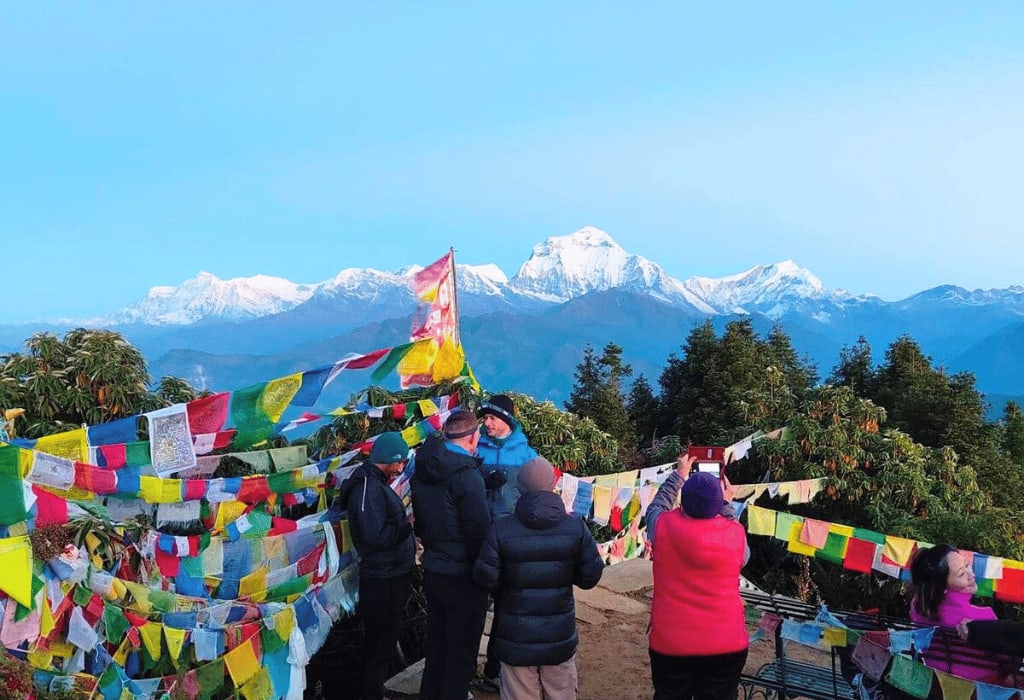


Poon Hill and Mardi Himal are the Annapurna foothills' two short teahouse treks, Poon Hill an easy 4 day classic to a 3,210 m sunrise viewpoint and Mardi Himal a moderate 5 day ridge walk to 4,200 m that opened as a marked route only in 2012. A 2026 group departure costs USD 350 to 600 on Poon Hill and USD 550 to 900 on Mardi Himal, both including the Annapurna Conservation Area Permit and a TIMS card. Ajay Shrestha, whose family runs a lodge on the Poon Hill route in Ghandruk and who leads Poon Hill and Mardi departures, wrote this comparison from both trails.
The sections below compare difficulty, crowding, and altitude and cost, then give a direct recommendation by traveller type.
In this guide 9
- 01 How do the two treks compare at a glance?
- 02 Which trek is easier?
- 03 Which trek is quieter?
- 04 How do altitude, duration, and cost compare?
- 05 Does the best season differ between the two treks?
- 06 How do group size and booking flexibility compare?
- 07 Our recommendation
- 08 Why did Mardi Himal only open as a route in 2012?
- 09 How does the food and lodge experience differ day to day?
How do the two treks compare at a glance?
| Poon Hill | Mardi Himal | |
|---|---|---|
| Duration | 5 days | 5 days |
| Max altitude | 3,210 m | 4,200 m |
| Difficulty | Easy | Moderate |
| Group cost (2026) | USD 350-600 | USD 550-900 |
| Trail character | Busiest classic Annapurna short trek | Opened 2012; quieter ridge walk |
| Signature test | Ulleri staircase, about 3,200 stone steps | Water scarcity above Low Camp; limited High Camp beds |
Which trek is easier?
Poon Hill stays below the altitude-sickness threshold at 3,210 m and grades easy overall, with the roughly 3,200-step Ulleri staircase as its one hard section, a 500 m climb most groups clear in two to three hours. Mardi Himal climbs 990 m higher to 4,200 m and grades moderate, with a sustained ridge ascent above Low Camp rather than one concentrated staircase, plus a genuine logistics test: no natural water above Low Camp, so every litre is carried up and sold at lodge prices that climb toward High Camp. Neither trek demands technical skill, and both run on maintained teahouse trails.
Families with children from about age eight manage the Poon Hill trek comfortably with a porter, a benchmark that does not extend to the Mardi Himal trek's higher, more sustained ridge day.
Which trek is quieter?
Poon Hill is Nepal's classic short trek, and the viewpoint platform fills with trekkers by dawn through October, so guides set early starts to claim a clear spot. Mardi Himal opened as a marked teahouse route only in 2012, more than a decade after Poon Hill became a fixture of Annapurna itineraries, and it still carries a fraction of the traffic, with High Camp's handful of lodges the only real capacity constraint in peak season. Trekkers who have done Poon Hill before and want a similar short trip with far fewer other trekkers consistently choose Mardi.
How do altitude, duration, and cost compare?
Mardi Himal's extra 990 m of altitude and one to two extra days over Poon Hill add roughly USD 200 to a 2026 group departure, driven mostly by additional guide and porter wage days and the cost of carrying water up a dry ridge. Poon Hill's shorter engagement and lower altitude keep it the cheapest of the classic Annapurna routes at USD 350 to 600. Both prices include the same NPR 5,000 permit pair, so the gap sits entirely in duration, altitude, and logistics rather than paperwork.
Does the best season differ between the two treks?
Both treks favor the same October-to-November and March-to-May windows as the rest of the Annapurna region, but the margin for error differs. Poon Hill's lower ceiling means an off-season departure, say a clear week in late September or early December, still delivers the sunrise view reliably, since cloud cover rather than cold is the main risk at 3,210 m. Mardi Himal's High Camp at 4,200 m is more exposed to early snowfall and late-season cold, so operators hold a tighter shoulder-season window and are quicker to flag a departure as marginal if a cold front is forecast.
Packing differs by degree rather than kind: both need the same four-season sleeping bag and layered clothing covered in the Nepal trekking packing list, but Mardi Himal's higher, more exposed High Camp calls for a warmer bag rating and better wind protection than Poon Hill's lower, more sheltered teahouse stops ever require.
How do group size and booking flexibility compare?
Poon Hill's popularity means departures fill from a wider pool of travellers booking independently, so joining an existing group date is usually straightforward even on short notice. Mardi Himal's lower booking volume means group departures sometimes need a few more days' notice to confirm a fixed date, though our smaller minimum-group threshold on this route keeps that wait shorter than it would be on a restricted-area trek. Private departures are available on both with no minimum notice beyond standard permit processing, and both can be arranged as a solo booking without waiting to be paired into a larger group.
Our recommendation
Choose Poon Hill if you are travelling with family, want the classic sunrise over Dhaulagiri and Annapurna in the shortest possible trip, or are trekking in Nepal for the first time with limited days. Choose Mardi Himal if you have done a foothill trek before, want closer views of Machhapuchhre from a quieter ridge, and can handle a moderate day above 4,000 m. Trekkers choosing between the two for a single short trip should default to Poon Hill; those adding a second short trek on a repeat visit should default to Mardi. Both pair well with a few extra days in Pokhara before or after the trek, since the trailheads for each route sit within an hour or two of the lakeside.
Why did Mardi Himal only open as a route in 2012?
Mardi Himal's ridge was known to local shepherds and Ghandruk lodge owners long before it existed as a trekking route, but it lacked marked trail and teahouse infrastructure until local operators and the Annapurna Conservation Area Project developed it as a dedicated route in 2012, decades after Poon Hill and the Annapurna Sanctuary trails were established. This late opening is exactly why it still carries lighter traffic than routes with a longer trekking history: word of a new route spreads slowly against decades of established recommendation for the classics.
Ajay Shrestha's own family lodge in Ghandruk predates Mardi Himal's opening by years, having served Poon Hill and Annapurna Sanctuary trekkers since well before Mardi existed as a bookable itinerary, which is part of why our Poon Hill departures run with such direct local grounding.
How does the food and lodge experience differ day to day?
Poon Hill's teahouses, concentrated in long-established villages like Ghorepani, Tadapani, and Ghandruk, offer wider menus and more reliable hot showers, a direct result of decades of steady trekking traffic supporting better lodge investment. Mardi Himal's High Camp and Low Camp lodges are simpler by comparison, since the route's shorter operating history and the logistics of carrying water and supplies up a dry ridge limit what a Mardi lodge can practically stock or offer. Neither route asks trekkers to camp, but a trekker used to Poon Hill's bakery-adjacent comfort should expect a more basic set of options on Mardi's higher camps.
This gap narrows each season as Mardi's route matures, and lodge owners along the ridge have steadily added rooms and menu variety since 2012, but it remains a real, checkable difference a trekker should factor in alongside the altitude and crowding trade-offs covered above.
FAQ
Common questions
Which trek is better for children?+
Poon Hill is the clear choice for families: it stays below 3,210 m, runs only 4 days, and has been done comfortably by children from about age eight with a porter to carry packs. Mardi Himal's 4,200 m ridge and water-carrying logistics suit older, more experienced young trekkers better.
Is Mardi Himal much harder than Poon Hill?+
Mardi is a step up rather than a leap: it climbs 990 m higher, to 4,200 m against 3,210 m, and involves a sustained ridge ascent instead of one staircase, so it grades moderate against Poon Hill's easy. Neither trek involves technical terrain, and a trekker fit enough for Poon Hill's Ulleri staircase generally has the fitness base for Mardi with a bit more conditioning.
Which trek has better mountain views?+
Mardi Himal gives closer views of Machhapuchhre's east face from High Camp and the Upper Viewpoint, a more intimate perspective than Poon Hill's wider panorama. Poon Hill's 360-degree dawn view takes in Dhaulagiri (8,167 m), Annapurna I (8,091 m), and the fishtail summit of Machhapuchhre in one sweep. Poon Hill wins on breadth, Mardi on proximity.
Can I do Poon Hill and Mardi Himal on the same trip?+
Yes, some itineraries combine both into a single 8 to 10-day trip through the Annapurna foothills, since the two trailheads sit close enough together to link without a long transfer. Most clients on a first visit choose one or the other rather than combining them, and save the second for a return trip.