Nepal Travel Packages
Poon Hill Trek

Poon Hill Trek

★★★★★ 4.7 (96 reviews)
Annapurna, Nepal 4-5 days Easy Max 3,210 m
Duration
4-5 days
Max altitude
3,210 m
Difficulty
Easy
Group size
Up to 14
Total distance
~42 km
Elevation gain
2,600 m
Best season
October to December, March to May
Avg daily walk
4-6 hours
Starts in
Nayapul (1,070 m)
Ends in
Pokhara
Accommodation
Teahouse lodges throughout
✓ TAAN & NMA licensed guides ✓ Permits included, no hidden fees ✓ Small group departures
Group departure · per person
USD480
Permits, guide, porter, lodging & food included
Departure date
Email Nepal
Permits and logistics fully arranged
Licensed guide included on every departure
Direct WhatsApp line to your guide

The Poon Hill Trek is a 4 to 5 day teahouse trek in the Annapurna foothills that climbs to a 3,210 m sunrise viewpoint over the Annapurna and Dhaulagiri ranges through Gurung and Magar villages. A 2026 group departure costs USD 350 to 600 per person including the Annapurna Conservation Area Permit (NPR 3,000) and a TIMS card (NPR 2,000). It is the gentlest of the classic Annapurna routes, staying below the altitude-sickness threshold, which makes it the standard choice for families and first-time trekkers.

Ajay Shrestha, whose family runs a lodge on this route in Ghandruk, has led 21 Poon Hill departures. The sections below cover the two permits, a cost breakdown against the USD 350 to 600 range, and the Ulleri staircase that is the trek's one real physical test.

Highlights

What our guides know that others don't.

1

Ulleri staircase

Roughly 3,200 stone steps climbing 500 m from Tikhedhunga

2

Poon Hill summit timing

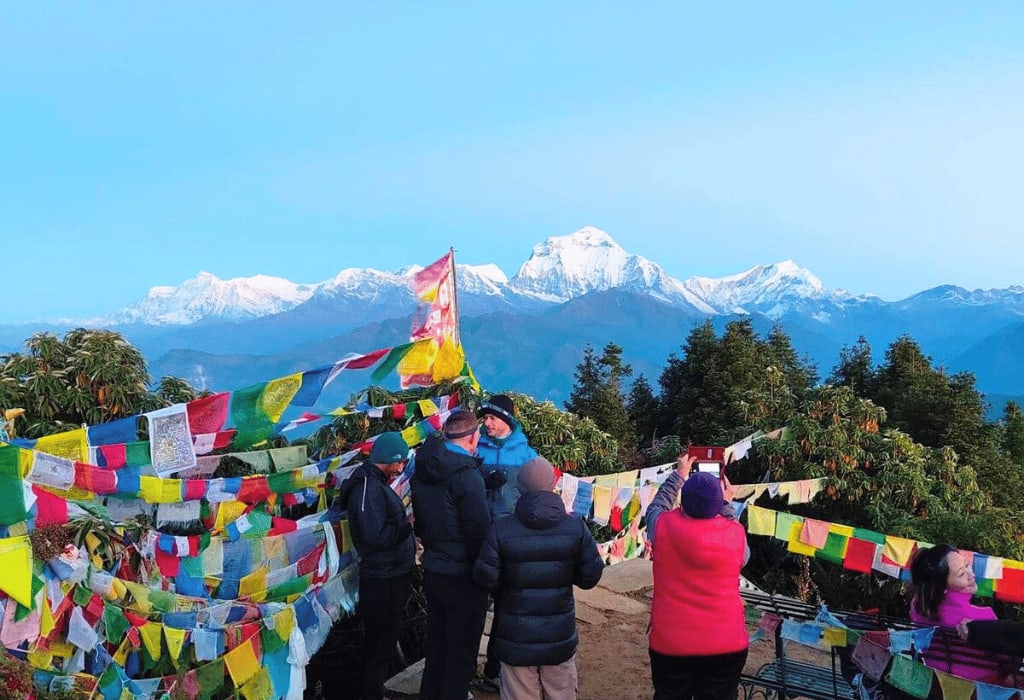
5 am start from Ghorepani for a 3,210 m sunrise

Live from the trail

Updated 2 Jul 2026

Monsoon status: green and wet, clear dawns possible

Monsoon rain is falling daily on the foothills with leeches active below Ghorepani. Poon Hill can still deliver a clear dawn between systems, and a few trekkers run it in monsoon, but we schedule departures for the drier windows. Next scheduled departure: early October.

What permits does the Poon Hill Trek need?

Two permits cover Poon Hill in 2026: the Annapurna Conservation Area Permit at NPR 3,000 and a TIMS card at NPR 2,000, the same pair as every Annapurna route. Both are issued in Pokhara or Kathmandu with cash and photographs and checked at the Ghandruk and Birethanti ACAP posts. The short route and low altitude do not change the paperwork.

The full permit map for Nepal, including the licensed-guide rule that applies here, is in the Nepal trekking permits master guide. Poon Hill combines with Annapurna Base Camp on a single ACAP and TIMS.

How much does the Poon Hill Trek cost in 2026?

TAAN-registered operators quoted USD 350 to 600 for a group Poon Hill departure in 2026, the lowest of the classic Annapurna treks because it runs only 4 to 5 days with no mountain flight. The table shows the breakdown, dominated by the short guide and porter engagement. A private departure or a family group with a dedicated porter sits at the upper end.

The trek's brevity keeps every line small: three or four teahouse nights, a handful of dal bhat meals, and a Pokhara jeep at each end. This is the route where a budget quote rarely means corners cut, because there are few corners to cut. Its short duration and low permit cost make it one of the site's Budget Nepal Travel Packages and a common pick among Family Nepal Travel Packages.

Where the price goes · per person
Permits (ACAP + TIMS)NPR 5,000 total at 2026 rates$38
Pokhara-Nayapul/Pokhara transfersPrivate or shared jeep, both ends$30–70
Licensed guide (shared in group)USD 35-40/day, 4-5 days$100–180
Porter, one per two trekkersUSD 25/day, 20 kg shared load$75–130
Teahouse room, 3-4 nightsNPR 300-800/night$20–50
Food and drinking waterDal bhat NPR 450-800$90–160
Company margin, logistics, staff equipment$50–120

How hard is the Ulleri staircase?

The Ulleri staircase is roughly 3,200 stone steps that climb 500 m from Tikhedhunga to Ulleri in a single relentless ascent, and it is the one genuinely hard section of an otherwise easy trek. Most groups take two to three hours over it with rests, and a porter carrying the packs makes a large difference to how it feels. Trekking poles help the knees on the descent version of the same steps.

Beyond Ulleri the trail eases into rolling village walking, which is why the trek stays graded easy overall despite the staircase. Families with children from about age eight complete it comfortably with a porter and an unhurried schedule.

What is the Poon Hill sunrise actually like?

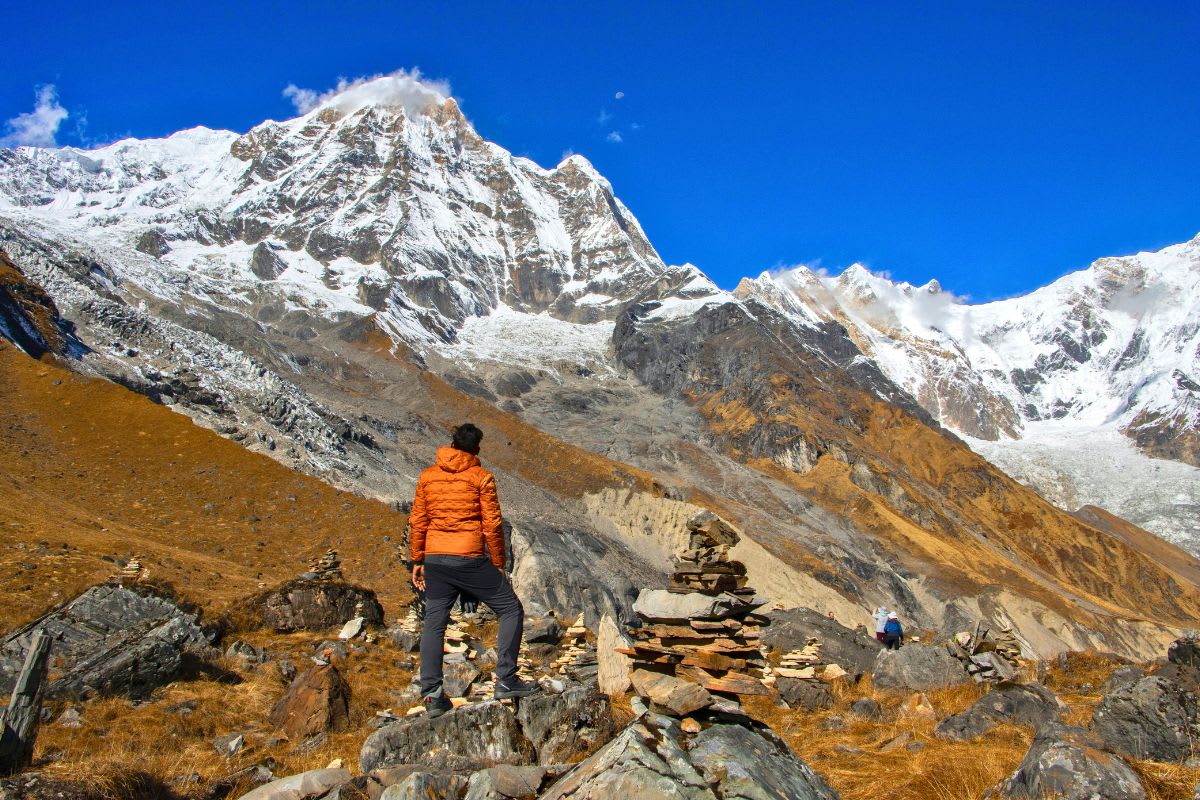
Poon Hill at 3,210 m gives a 360-degree dawn panorama over Dhaulagiri (8,167 m), Annapurna I (8,091 m), and the fishtail summit of Machhapuchhre, reached by a 5 am climb from Ghorepani. The viewpoint fills with trekkers in October, so our guides set an early start to claim a clear spot on the platform. On a cloudy morning the light show can still be worth the climb, but the route's flexibility means a second attempt is rarely possible on a 4-day schedule.

The sunrise is the fixed highlight, but the Gurung and Magar villages of Ghandruk and Ghorepani are the trek's quieter reward. Ghandruk in particular is worth an unhurried afternoon, which the 5-day version allows.

How crowded does the Poon Hill viewpoint actually get?

Poon Hill's viewing platform holds a genuinely large crowd on clear October and November mornings, easily 200 to 300 trekkers standing shoulder to shoulder along the railing by 5:45 am, since it's the single most popular short viewpoint in the Annapurna region and every teahouse on the route sends its guests up the same trail on the same schedule. Our guides leave Ghorepani by 5 am rather than the 5:15 am most groups target, a 15-minute head start that consistently gets clients a spot on the platform's upper tier rather than jostling at the back rail once the light show starts. This crowding detail rarely appears on competitor pages, but it's the single biggest factor in whether a Poon Hill sunrise feels serene or crowded.

Shoulder-season mornings, early October or late November, thin the crowd by roughly half without sacrificing much clarity, and a March or April departure often has the platform two-thirds empty by comparison. Trekkers who specifically want a quieter sunrise experience should ask about scheduling around the October-November peak rather than during it; the mountain views themselves are comparable across the whole autumn window, but the atmosphere on the platform is not.

Is the Poon Hill Trek a good first trek with no experience?

Poon Hill is this site's most common first-trek recommendation for someone with zero prior high-altitude experience, precisely because its 3,210 m ceiling sits below where altitude becomes a real planning concern and its daily walking, 4 to 6 hours, is achievable for anyone in reasonably regular exercise habit without a dedicated training block. Compare this to a flagship route like the Everest Base Camp trek or the Annapurna Circuit, both of which need real acclimatization planning and multi-month fitness preparation; Poon Hill needs neither in any serious sense.

What a first-timer should still expect honestly: the Ulleri staircase is a real physical test regardless of experience level, and four days of teahouse living, shared bathrooms, cold mornings, simple food, is a genuine adjustment for someone used to hotel travel. Our guides brief every first-time client on both points before departure so nobody arrives expecting a resort experience. Trekkers who complete Poon Hill comfortably and want to progress typically move to Mardi Himal or Annapurna Base Camp next, both a meaningful step up in altitude and duration rather than a repeat of the same profile.

How does Poon Hill compare to Mardi Himal and Annapurna Base Camp?

Poon Hill is the shortest and lowest-altitude of the three classic short Annapurna treks: 4-5 days to 3,210 m against Mardi Himal's 5-7 days to 4,200 m and Annapurna Base Camp's 7-11 days to 4,130 m. Price follows the same order, USD 350-600 for Poon Hill against USD 550-900 for Mardi and USD 750-1,200 for ABC, since each additional trekking day adds a guide day, a porter day, and a teahouse night to the group cost. All three use the same Annapurna Conservation Area Permit and TIMS pairing, so permit cost isn't a factor in the comparison.

The real decision point isn't price, it's what each route delivers: Poon Hill trades summit proximity for accessibility and a guaranteed sunrise payoff on day 3 of a short trip; Mardi Himal trades a longer, quieter ridge walk for genuine 4,200 m altitude exposure with real acclimatization stakes; Annapurna Base Camp trades both for the amphitheater payoff of standing inside the Sanctuary itself, ringed by 7,000 m and 8,000 m peaks on every side. A trekker choosing between Poon Hill and Mardi specifically should read the Mardi Himal trek page for its water-scarcity and High Camp bed-availability details, both genuine planning factors that don't apply to Poon Hill's shorter, better-served route.

What should you pack for the Poon Hill Trek?

Poon Hill's short duration and low altitude ceiling mean a lighter version of the standard Nepal trekking packing list works fine: a three-season rather than four-season sleeping bag is usually adequate outside the December-February window, since teahouse nights here rarely drop below -5 C even in cold months. Layered clothing for the pre-dawn Poon Hill climb matters more than most first-timers expect, since 3,210 m before sunrise is genuinely cold even when the afternoon before was warm at Ghandruk's lower elevation.

One packing detail specific to this route: a headlamp is non-negotiable, not optional, since the entire group departs Ghorepani in full darkness for the viewpoint climb, and the trail's stone steps are uneven enough that a phone flashlight isn't a reasonable substitute. Trekking poles help on the Ulleri staircase's descent version more than the climb, protecting knees on roughly 500 m of steep downhill stone steps.

What altitude and acclimatization does the Poon Hill Trek actually require?

Poon Hill's 3,210 m high point sits at the edge of where altitude effects can begin, but well below the range where they become a serious planning factor; the altitude sickness prevention guide puts the real risk threshold at sustained time above 3,500-4,000 m, terrain this trek never reaches. No dedicated acclimatization day sits in the itinerary because the trek's sleeping-altitude progression, 1,540 m to 2,860 m to 2,630 m across the four days, never demands the 500 m-per-day discipline that higher routes need.

Our guides still watch for mild symptoms even at this altitude; a slight headache or tiredness at Ghorepani is common and not cause for concern, and they carry the same basic protocol used everywhere on the site: hydration reminders, a measured pace on the Ulleri climb, and an honest conversation if anyone genuinely struggles. Trekkers coming directly from sea level with no altitude exposure at all sometimes notice Ghorepani's 2,860 m more than expected on the first night; this settles by morning for the large majority of clients and rarely affects the following day's sunrise climb.

What's the best season for the Poon Hill Trek?

October to December and March to May are Poon Hill's two reliable windows, the same core Annapurna season as every other route in the region, with October specifically delivering the clearest post-monsoon air and the highest odds of an unobstructed sunrise panorama. Spring adds rhododendron blooms along the Ghorepani-to-Tadapani ridge, a real visual draw from late March through April that autumn departures don't get, though spring mornings run slightly hazier than the crisp post-monsoon air of October and November.

Winter, December through February, is genuinely viable here in a way it isn't on higher routes: Poon Hill's 3,210 m ceiling stays below where deep snow regularly closes trails, and cold, clear mornings often deliver the year's sharpest mountain visibility, detailed further in the trekking Nepal in winter guide. Monsoon, June through September, is the one season we don't schedule fixed departures for, since daily rain turns the stone steps slick and cloud cover routinely erases the Poon Hill panorama entirely by mid-morning; a monsoon Poon Hill attempt is possible but the sunrise payoff is genuinely unreliable enough that we steer clients toward the reliable windows instead.

Should you book Poon Hill as a private departure or join a group?

A private Poon Hill departure costs USD 500 to 800 per person against the group rate's USD 350 to 600, a smaller premium than on longer routes because there are only 4 to 5 guide-days and porter-days to split differently. The real reason to book privately isn't cost, it's pacing control: a fixed group departure runs to the schedule that suits its average member, while a private booking lets a family with young children, an older traveler, or anyone uncertain of their fitness set their own daily rhythm without holding up or being held up by strangers.

Groups do have a genuine upside beyond price on this specific route: the shared 5 am walk to the viewpoint has a social energy that solo or family groups sometimes miss, and meeting other trekkers at the Ghorepani teahouses is part of what many first-timers remember fondly. Ajay Shrestha's guidance to clients weighing this choice is straightforward: book group if schedule flexibility isn't a priority and the cost difference matters, book private if any member of the party has a real reason, age, fitness uncertainty, a preferred slower pace, to need it.

Why do so few operators mention Poon Hill's real crowding pattern?

Most competitor pages describe Poon Hill's sunrise as a highlight without mentioning that the viewpoint's actual capacity, roughly a 40 m wide platform with a single main railing, gets tested hard on peak October mornings when four or five hundred trekkers converge from Ghorepani's dozen-plus teahouses at once. This is the kind of operational detail that only shows up from guides who've actually stood on that platform repeatedly across many Octobers, not from a generic route description written once and left standing.

Ajay Shrestha's 21 Poon Hill departures inform the specific timing advice in this guide: leaving Ghorepani 10-15 minutes before the crowd's typical 5:15 am departure, and picking a viewing spot on the platform's northern edge where the crowd thins fastest once photos start. This kind of specific, checkable operational knowledge, not just "arrive early," is what separates a guide who knows this exact trail from one reciting a general itinerary template.

Elevation profile High point 3,210 m
2,0002,5001,540 m12,860 m231,940 m4DAY
Acclimatization night High point

Day by Day

4-day itinerary, every detail planned.

Day1
Trip Day
Drive Pokhara to Nayapul, trek to Tikhedhunga (1,540 m)
~4h walking9 km
1,540m alt.

A 1.5-hour jeep from Pokhara's lakeside follows the Baglung highway to Nayapul, the trailhead where the ACAP and TIMS permit checkpoint sits beside the Modi Khola river. From there a gentle riverside walk through terraced rice fields and small Magar villages climbs steadily to Tikhedhunga, positioned deliberately below the Ulleri staircase so the group starts tomorrow's big climb fresh rather than finishing it on tired legs. A short first day like this is standard practice on our departures, easing anyone new to teahouse trekking into the daily rhythm before the trip's hardest section.

1,540 m9 km~4h
Day2
High Point
Tikhedhunga to Ghorepani (2,860 m) via Ulleri
~6h walking12 km
2,860m alt.
Day3
Trip Day
Poon Hill sunrise (3,210 m), trek to Tadapani (2,630 m)
~6h walking12 km
2,630m alt.
Day4
Trip Day
Tadapani to Ghandruk, drive to Pokhara
~4h walking9 km
1,940m alt.

What's Included

Transparent, all-in pricing.

Included in your price

Permits (ACAP + TIMS)
Pokhara-Nayapul/Pokhara transfers
Licensed guide (shared in group)
Porter, one per two trekkers
Teahouse room, 3-4 nights
Food and drinking water
Company margin, logistics, staff equipment

Not included

Nepal entry visa fee (USD 30-125, paid on arrival)
Travel insurance with helicopter evacuation cover
Personal trekking gear and equipment
Tips for your guide and porter
Bottled drinks, wifi, and device charging at teahouses
Meals in Kathmandu outside the itinerary

Dates & prices

Upcoming departures.

Start dateEnd datePrice / personAvailability
8 Oct 202611 Oct 2026USD 480Guaranteed · 5 leftEnquire
22 Oct 202625 Oct 2026USD 480Open · 9 leftEnquire
19 Nov 202622 Nov 2026USD 460Open · 10 leftEnquire
27 Dec 202630 Dec 2026USD 460Open · 11 leftEnquire

Verified reviews

What travellers say.

4.7/5 from 96 reviews on TripAdvisor, checked July 2026

★★★★★

Perfect first trek with two kids aged 10 and 12. The Ulleri steps were a challenge but the porters and Ajay kept everyone going. The sunrise was worth the 5 am start and the kids still talk about it.

TH
The Harrison family · United Kingdom
8 Apr 2026
★★★★

Lovely short trek with big mountain views for the effort. Ghorepani was busy but the villages and forest were beautiful. Four days was just right for a first taste of the Himalaya.

SA
Sofia Andersson · Sweden
18 Mar 2026

Why Nepal Travel Packages

Built on published proof, not adjectives.

A named, licensed guide before you book

Full name, photo, NMA or TAAN license number, and a direct WhatsApp line. The guide on the page is the guide on the trail.

Itemized pricing, not a lump sum

Permits, guide, porter, lodging, and food broken out on every trip page. You see exactly where the price comes from.

Trail conditions updated monthly

Dated field reports from the guides running the route this season, not boilerplate written once and left to go stale.

Permits handled, not hidden

Every permit fee, checkpoint, and paperwork rule is filed for you and published in the guides — no surprise admin at Lukla.

FAQ

Common questions

Is the Poon Hill Trek suitable for children?+

Yes, Poon Hill runs comfortably with children from about age eight on an unhurried schedule with a porter to carry the packs. It stays below 3,210 m, so altitude sickness is not a real concern, and the teahouses are family-friendly. The Ulleri staircase is the one section where children benefit from a slow pace and encouragement.

Do I need to worry about altitude on Poon Hill?+

Barely: the high point of 3,210 m is at the edge of where mild altitude effects begin, and you sleep lower than that every night. Serious acute mountain sickness is very rare on this route. Trekkers who want to understand the general thresholds can read the altitude sickness prevention guide, but Poon Hill needs no special acclimatization.

Can I do Poon Hill in winter?+

Yes, Poon Hill is one of the best winter treks in Nepal because it stays low enough to avoid deep snow and gives crisp, clear dawn views. December to February nights are cold at Ghorepani, around -5 C, but the trail rarely closes. Winter route options across Nepal are in the trekking Nepal in winter guide.

How does Poon Hill compare to Annapurna Base Camp?+

Poon Hill is a fraction of the commitment: 4-5 days to 3,210 m against ABC's 7-11 days to 4,130 m, and USD 350-600 against USD 750-1,200. Poon Hill delivers a single dawn viewpoint payoff on a short trip; ABC delivers a multi-day amphitheater experience inside the Annapurna Sanctuary itself. Trekkers with limited time or a preference for an easy grading should choose Poon Hill; those wanting to stand inside the Sanctuary should budget the extra days for ABC.

What is the shortest realistic Poon Hill itinerary?+

Four days is the practical minimum from Pokhara, covering the drive in, the Ulleri climb, the sunrise, and the descent to Ghandruk. A very fast three-day version exists but skips Ghandruk and rushes the descent. The 5-day version adds a night at Ghandruk for a proper look at the village.

Is Poon Hill a good first trek with no experience?+

Yes, it's this site's most common recommendation for a genuine first-timer: the 3,210 m ceiling stays below where altitude becomes a real concern, and 4-6 hour daily walks need no dedicated training block. The Ulleri staircase is still a real physical test regardless of experience, so expect that one section to be genuinely hard even on an otherwise easy trek.

How crowded is the Poon Hill sunrise viewpoint?+

Very, on clear October-November mornings, often 200-300 trekkers on the platform by 5:45 am since every teahouse on the route sends guests up the same trail on the same schedule. Our guides leave Ghorepani by 5 am, 15 minutes earlier than most groups, to secure a better viewing position. Shoulder-season departures (early October, late November, or spring) see roughly half the crowd.

How does Poon Hill compare to Mardi Himal?+

Poon Hill is shorter (4-5 vs 5-7 days), lower (3,210 m vs 4,200 m), and cheaper (USD 350-600 vs USD 550-900), and it's graded easy against Mardi's moderate. Both use the same ACAP and TIMS permits. Poon Hill suits first-timers and families most; Mardi suits trekkers wanting real altitude exposure on a still-short trip. See the Mardi Himal trek page for its specific planning factors.

Should I book Poon Hill privately or join a group departure?+

Book privately (USD 500-800) if pacing control matters, families with young children, older travelers, or anyone uncertain of their fitness benefit most. Join a group (USD 350-600) if the cost difference matters more than schedule flexibility; the shared 5 am walk to the viewpoint is also a genuine social highlight for many first-timers that a private booking misses.

Do I need any acclimatization days on the Poon Hill Trek?+

No dedicated acclimatization day sits in the itinerary, since the trek's altitude progression never demands the 500 m-per-day pacing higher routes need. Mild symptoms, a slight headache at Ghorepani's 2,860 m, are common and settle by morning for most clients. The 3,210 m summit sits below where altitude becomes a serious planning concern.