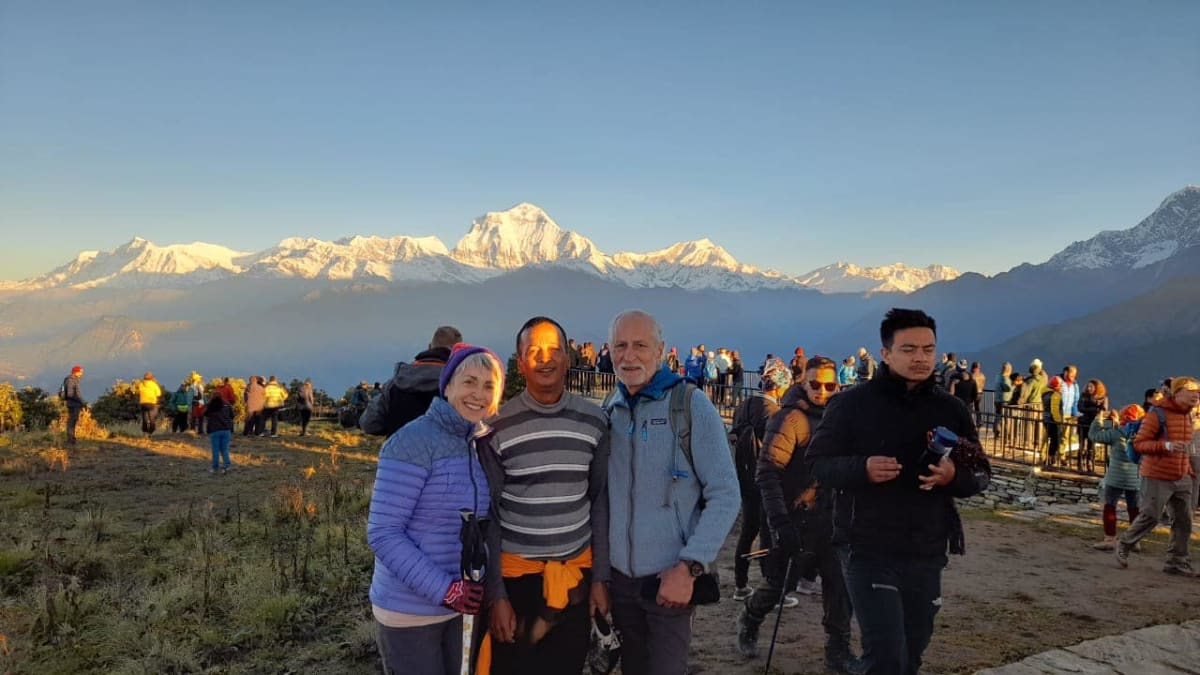
The Annapurna Yoga Trek and the Pokhara Wellness Retreat are this site's two wellness programs: a 7-day moving trek pairing twice-daily yoga with foothill walking, and a 5-day fixed-base retreat beside Phewa Lake at 822 m with no walking commitment. The yoga trek reaches the 3,210 m Poon Hill viewpoint with daily ascent capped at 600 m and costs USD 900 to 1,350 in 2026; the retreat stays at 822 m throughout, needs no trekking permits, and costs USD 600 to 1,100. Ajay Shrestha, an RYT 500 certified teacher who designed both programs, leads each on alternating spring and autumn dates.
The sections below compare physical demand, what a typical day looks like, and who each option suits, then give a direct recommendation.
In this guide 10
- 01 How do the two programs compare at a glance?
- 02 How physically demanding is each option?
- 03 What does a typical day look like?
- 04 Who does each option suit?
- 05 Why does the yoga trek cost more than the retreat?
- 06 How far in advance should I book either program?
- 07 Do both programs use the same style of yoga practice?
- 08 Our recommendation
- 09 How does food and diet differ between the two programs?
- 10 How does group size and privacy compare?
How do the two programs compare at a glance?
The Annapurna Yoga Trek is a 7-day moving trek to 3,210 m with daily walking, costing USD 900-1,350; the Pokhara Wellness Retreat is a 5-day fixed-base program at 822 m with no walking requirement, costing USD 600-1,100. The choice comes down to whether movement or rest fits the trip better.
| Annapurna Yoga Trek | Pokhara Wellness Retreat | |
|---|---|---|
| Format | Moving; teahouse trek plus practice | Fixed base; lakeside lodge |
| Duration | 7 days | 5 days |
| Max altitude | 3,210 m (Poon Hill) | 822 m; 1,600 m on the optional Sarangkot walk |
| Daily walking | 3-5 hours, 600 m ascent cap | 0-3 hours, entirely optional |
| Permits | ACAP + TIMS | None required |
| Group cost (2026) | USD 900-1,350 | USD 600-1,100 |
How physically demanding is each option?
The Annapurna Yoga Trek carries a real, if deliberately gentle, physical load: daily walks of 3 to 5 hours with ascent capped at 600 m, including one harder climb up the roughly 3,200-step Ulleri staircase early in the trip. The Pokhara Wellness Retreat carries almost none, since the lakeside base sits at 822 m and the only elevation gain comes from an optional sunrise walk to Sarangkot at 1,600 m, which several guests skip entirely without affecting the program. Neither option requires prior yoga or trekking experience, and both scale sessions to mixed-ability groups.
Trekkers recovering from a previous trip, or clients who specifically do not want walking days, are better matched to the retreat's near-zero physical demand.
What does a typical day look like?
A yoga trek day opens with a sunrise vinyasa session of about 75 minutes on a lodge terrace, moves into 3 to 5 hours of foothill walking through Gurung and Magar villages, and closes with an evening restorative or yin session before dinner. A retreat day at Phewa Lake has no walking block by default: sunrise practice, a leisurely morning, an optional low-key activity like lake boating or the World Peace Pagoda walk, and an evening session, all built around rest rather than movement. The 600 m ascent cap on the trek exists specifically so the evening practice restores rather than exhausts, a design constraint the retreat does not need because it never climbs that far in a day.
Who does each option suit?
Travellers who want daily movement through mountain villages alongside their practice fit the yoga trek in the Annapurna foothills, since the trip is built around walking as much as it is around yoga.
Those wanting rest, recovery, or a gentler introduction to Nepal with zero walking commitment fit the wellness retreats instead, particularly clients arriving straight off a hard trek like the Annapurna Circuit who want their body to reset before flying home. A travelling partner who does not want to trek pairs naturally with the retreat while the rest of a group does a harder route.
Why does the yoga trek cost more than the retreat?
The USD 300-per-person gap at the top of each range comes mostly from trek-specific costs the retreat never carries: a licensed trekking guide in addition to Ajay's yoga instruction, porters for the walking sections, and the ACAP and TIMS permit fees. The retreat's fixed lakeside base needs none of this, so its cost sits closer to a standard wellness-lodge stay than to a trekking-operator day rate. Both prices include full board and twice-daily practice; the difference is entirely in what moving through the mountains on foot requires versus what staying in one place does not.
How far in advance should I book either program?
Both programs run on a limited number of dates each spring and autumn, since Ajay leads every session personally rather than rotating instructors, so the group calendar fills faster than a standard trek's does. Booking 2 to 3 months ahead gives the widest choice of dates on either program; the Annapurna Yoga Trek in particular fills earlier for the October-November window, when its Poon Hill sunrise coincides with the region's clearest mountain views. The retreat has slightly more flexibility since it doesn't depend on trail-season weather the way the trek's exposed sections do.
Do both programs use the same style of yoga practice?
Yes, Ajay teaches the same core vinyasa-and-restorative structure on both programs, adjusted for context: trek sessions run shorter in the morning to leave walking time and longer in the evening to aid recovery, while retreat sessions have more room to run at full length since there's no walking day to plan around. Neither program is built on a single rigid tradition; both blend accessible vinyasa flow with breathwork and yin-style restorative poses suited to beginners and experienced practitioners alike.
Our recommendation
Choose the Annapurna Yoga Trek if you want movement, mountain villages, and the Poon Hill sunrise built around a consistent twice-daily practice. Choose the Pokhara Wellness Retreat if you want rest, post-trek recovery, or a wellness trip with no walking commitment at all. Clients combining both get the most out of a Nepal wellness trip: the yoga trek first for movement and villages, the retreat after for recovery, sequenced through Pokhara with a short drive rather than a return to Kathmandu.
How does food and diet differ between the two programs?
Both programs serve a largely vegetarian menu built around fresh, seasonal ingredients, but the retreat has more control over it: its fixed lakeside kitchen plans meals daily around what's available in Pokhara's markets that morning, so dietary requests, vegan, gluten-sensitive, low-spice, are easier to accommodate consistently across the full stay. The yoga trek's meals follow the teahouse system once the group leaves Pokhara, still vegetarian-friendly and coordinated with lodge kitchens in advance, but with less day-to-day menu control once the trail begins, since teahouse kitchens have fixed core ingredients rather than a market-sourced daily plan.
Both programs skip alcohol and heavy, hard-to-digest food as a matter of course, since neither pairs well with an early sunrise practice, and Ajay sets this expectation with guests before departure on either program.
How does group size and privacy compare?
Both programs run in small groups, typically six to twelve guests, since Ajay teaches every session personally and a larger group would dilute the individual attention that's part of what clients pay for on either option. The retreat's fixed base gives slightly more built-in privacy, since guests can skip an optional activity and simply stay at the lodge without affecting the group's movement the way stepping back from a trekking day would. The yoga trek's shared teahouse rooms and moving itinerary create more natural group bonding over the trip's length, which some clients specifically want and others find less restful than the retreat's more self-directed pace.
Private or semi-private bookings are available on both programs for guests who want to skip the group format entirely, at a cost premium similar to private trekking departures elsewhere on this site.
FAQ
Common questions
Which option is better for a first-time visitor to Nepal?+
The Pokhara Wellness Retreat is the gentler first visit: no permits, no altitude, and no walking commitment, so jet lag and unfamiliarity matter less. The Annapurna Yoga Trek suits a first visit too if you want mountain villages and the Poon Hill sunrise alongside the practice, since it stays graded easy throughout.
Can I combine the yoga trek and the retreat on one trip?+
Yes, this is a common pairing: the yoga trek first for movement, villages, and the sunrise, then the retreat after for a lakeside reset, sequenced through Pokhara with a short drive rather than a return to Kathmandu. Our team arranges the transfer and can adjust each program's length to fit.
Do I need yoga experience for either program?+
No, both scale to all levels and mixed-ability groups, and Ajay adjusts each session to the people present on the day. Complete beginners and experienced practitioners both fit comfortably on either the trek or the retreat.
How far in advance should I book?+
Book 2 to 3 months ahead for the widest choice of dates, since Ajay leads every session personally rather than rotating instructors and group sizes are kept small. The Annapurna Yoga Trek's October-November dates fill earliest, when the Poon Hill sunrise coincides with the region's clearest mountain views.