
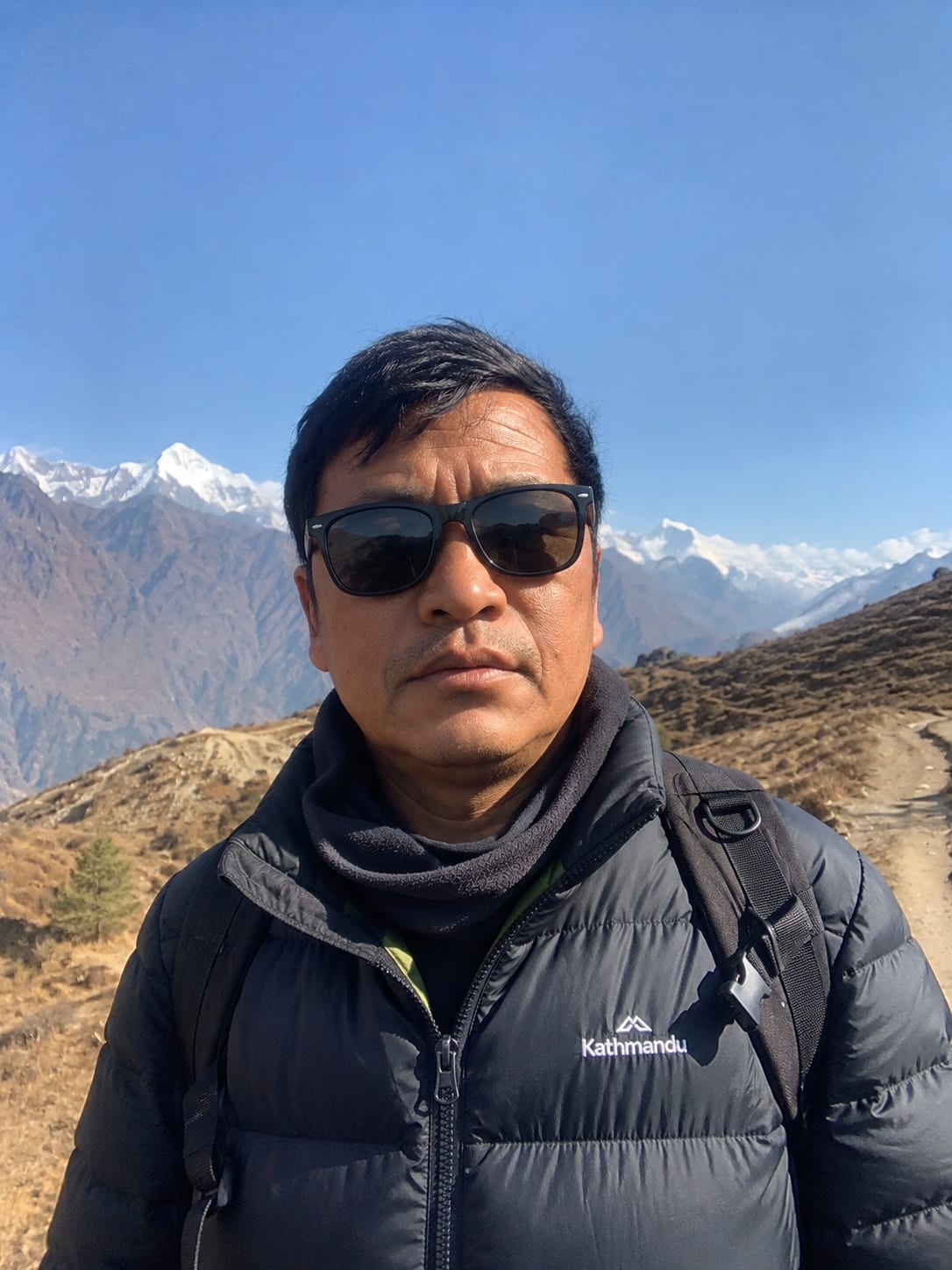
The best season to trek Dolpo runs May through October, wider than the standard Nepal trekking calendar, because Dolpo sits in the Himalayan rain shadow behind the Dhaulagiri massif and stays trekkable through the June to September monsoon months that wash out routes further south. Daytime temperatures at Ringmo (3,600 m) run 12 to 18 C from May to September, and the high passes, Numa La and Baga La, both above 5,100 m, hold their most reliable snow-free window from July through mid-October. Mingma Tendi Sherpa, our Senior Guide and Safety Lead, tracks route conditions across every rain-shadow region we operate in and wrote this guide from that seasonal data.
The sections below cover why the rain shadow extends Dolpo's season, the pass-crossing window specifically, what winter closes, and how Dolpo's calendar compares to standard Everest and Annapurna timing.
In this guide 5
Why does Dolpo trek well during the monsoon?
Dolpo sits behind the Dhaulagiri massif, and that wall of 7,000 and 8,000 m peaks blocks most of the monsoon moisture moving north from the Bay of Bengal before it reaches the region. The same rain-shadow effect that keeps Upper Mustang dry through June to September applies to Dolpo, so trails that turn to mud and leeches in the Annapurna or Langtang region during monsoon stay walkable and often clear-skied in Dolpo across the same months.
This is the single biggest reason to consider Dolpo outside the conventional October-November and March-May windows most Nepal trekking advice repeats. A July or August departure into Dolpo avoids the domestic flight delays that monsoon cloud cover causes on routes running through Lukla or Pokhara, since the Nepalgunj-Juphal flight sector sits largely outside the heaviest monsoon band.
When can the high passes be crossed?
Numa La (5,190 m) and Baga La (5,070 m), the two passes on the standard Upper Dolpo circuit, hold their most reliable snow-free window from July through mid-October. Early-season attempts in May or June can still find winter snowpack lingering on the northern approach to Numa La, and a late-October or November crossing risks the first heavy snowfall of the following winter closing the route without warning.
A July to September departure gives the widest safety margin on both passes, with August typically the driest month inside the rain shadow even though it sits in the heart of Nepal's national monsoon season. Trekkers should still budget one flexible day around each pass crossing, since even a rain-shadow region gets occasional weather systems strong enough to push through the Dhaulagiri barrier.
Guides on our Dolpo departures check the Numa La and Baga La snow line by radio contact with Ringmo and Saldang in the days before a scheduled crossing, and a departure can be resequenced, spending an extra day at Phoksundo Lake, for instance, if either pass looks unstable. This flexibility is easier to build into a July or August itinerary, when the wider rain-shadow window gives more room to shift days around, than into a late-October departure pushing against the season's edge.
What does winter close in Dolpo?
Winter, November through March, closes both Numa La and Baga La to standard trekking, and Ringmo itself drops to nighttime lows near -15 C by January. The passes hold deep, unstable snow through the coldest months, and the villages beyond Shey Gompa toward Saldang become difficult to resupply once the first heavy snow settles in November.
Lower Dolpo, the Phoksundo Lake area around Ringmo, stays more forgiving in winter than the high passes, with day trips and short itineraries still possible into early December before the cold becomes severe. This mirrors the pattern on other rain-shadow routes, covered in the rain-shadow treks during monsoon guide, where lower elevations inside a rain shadow extend further into the calendar than the high crossings ever do.
How does Dolpo's rain shadow compare to Upper Mustang's?
Both Dolpo and Upper Mustang sit behind major Himalayan massifs, Dhaulagiri for Dolpo and the Annapurna range for Mustang, and both stay trekkable through a monsoon that shuts down central Nepal's standard routes. The difference is elevation and terrain: Mustang's plateau character keeps most of its trail below 4,000 m, so its dry season runs nearly year-round outside the coldest winter weeks, while Dolpo's Numa La and Baga La push above 5,100 m, adding a genuine winter closure that Mustang's lower routes mostly avoid.
A trekker choosing between the two rain-shadow regions for a July departure gets a similar dry-trail experience either way, but Dolpo's higher passes mean the weather margin for error is narrower, and a poorly timed early or late-season departure carries more consequence on Dolpo's terrain than on Mustang's gentler profile.
How does Dolpo's season compare to Everest or Annapurna?
Dolpo's May-to-October window runs roughly opposite to the emphasis most Everest and Annapurna advice gives, since those regions peak in October-November and March-May and see their worst conditions during the June-September monsoon. Dolpo inverts that relationship for its mid-summer months: July and August, the low season everywhere else in Nepal, are strong Dolpo months precisely because the rain shadow keeps the trail dry while competitor destinations are muddy.
| Season | Dolpo | Everest / Annapurna standard routes |
|---|---|---|
| March-May | Passes still holding winter snow in early spring | Peak season |
| June-September | Best window, rain-shadow effect | Monsoon, worst conditions |
| October-mid-November | Good, passes still open | Peak season |
| December-February | Passes closed, Lower Dolpo only | Growing winter season on lower routes |
This inversion is a genuine planning advantage for anyone trying to build a longer Nepal itinerary across two regions in one trip: a June Everest trek would hit the monsoon, but a June Dolpo trek can be one of the best departures of the year. A trekker with a fixed mid-summer travel window who assumed Nepal was off the table entirely often has Dolpo as the answer, once the rain-shadow calendar is understood rather than defaulted to the standard October-November and March-May advice repeated for the country as a whole.
FAQ
Common questions
Can you trek Dolpo during the monsoon?+
Yes. Dolpo sits behind the Dhaulagiri massif in a rain shadow, so June to September stays largely dry and clear while routes further south turn muddy under the monsoon. This makes Dolpo one of the few Nepal regions where a mid-summer departure is a genuine strength, not a compromise.
When are the Dolpo passes open?+
Numa La (5,190 m) and Baga La (5,070 m) hold their most reliable snow-free window from July through mid-October. Attempts in May or June can hit lingering winter snow, and late-October or November departures risk early winter snowfall closing the route.
Is Dolpo trekkable in winter?+
The high passes close from November through March under deep, unstable snow. Lower Dolpo around Phoksundo Lake stays accessible for shorter itineraries into early December, but a full Upper Dolpo circuit needs the May-to-October window.