
Nepal Travel Packages
Kathmandu Valley Heritage Day Tour

Kathmandu Valley Heritage Day Tour

★★★★★ 4.8 (47 reviews)
Kathmandu Valley Tours, Nepal 1 days Easy Max 1,400 m
Duration
1 days
Max altitude
1,400 m
Difficulty
Easy
Group size
Up to 15
Total distance
~5 km
Elevation gain
100 m
Best season
Year-round; clearest mornings October to April
Avg daily walk
3-4 hours
Starts in
Hotel pickup in Thamel, Kathmandu (1,400 m)
Ends in
Hotel drop-off in Thamel, Kathmandu (1,400 m)
Accommodation
Day tour only; no overnight stay
✓ TAAN & NMA licensed guides ✓ Permits included, no hidden fees ✓ Small group departures
Group departure · per person
USD55
Permits, guide, porter, lodging & food included
Departure date
Email Nepal
Permits and logistics fully arranged
Licensed guide included on every departure
Direct WhatsApp line to your guide

The Kathmandu Valley Heritage Day Tour is a 1-day guided tour of four UNESCO World Heritage Sites, Kathmandu Durbar Square, Swayambhunath, Boudhanath, and Pashupatinath, run with a licensed city guide and private vehicle. A 2026 tour costs USD 40 to 70 per person for a shared small group, or USD 90 to 140 per person for a private departure, and needs no trekking permit since every site sits within Kathmandu's 1,400 m valley floor. The day covers roughly 3 to 4 hours of actual walking across the four sites, split by a midday break for lunch.

Ramesh Rai, who has coordinated Kathmandu logistics for the company since 2014 and processes the arrival and departure schedule for every trekking client, put together this tour to fill the idle arrival and buffer days already built into most trek bookings. The sections below cover Pashupatinath's cremation-ghat etiquette, what the day actually includes site by site, a cost breakdown of the guide, vehicle, and entry tickets, and the chance to see Kathmandu's living goddess, the Kumari.

Highlights

What our guides know that others don't.

1

Pashupatinath cremation-ghat etiquette

Photography restrictions and respectful-distance viewing across the Bagmati River

2

Kumari sighting odds

Kathmandu's living goddess appears at her Durbar Square window unpredictably, not on a schedule

Live from the trail

Updated 2 Jul 2026

Site status: Durbar Square restoration ongoing at one temple, other sites normal

Scaffolding remains around the Trailokya Mohan temple at Kathmandu Durbar Square as part of ongoing post-2015 earthquake reconstruction, which affects photo angles from one corner of the square but not general access. Swayambhunath, Boudhanath, and Pashupatinath are all operating normally with no closures. Monsoon rain occasionally shortens the Swayambhunath hilltop stop, and guides carry a covered alternative viewpoint on wet days.
What is the etiquette for visiting Pashupatinath's cremation ghats?

Pashupatinath is a working Hindu cremation site on the Bagmati River, and its Arya Ghat cremation platforms are reserved for Hindu funeral rites, not a viewing attraction, even though visitors are permitted to observe respectfully from the opposite riverbank. Photography of the cremation platforms themselves is discouraged and, at grieving families' request, our guides ask clients not to photograph individual mourners or the deceased at any distance. Standing quietly, speaking softly, and following the guide's lead on where to walk are the basic expectations that keep a visit respectful rather than intrusive.

Non-Hindu visitors cannot enter the main Pashupatinath temple itself, a restriction that applies at the temple gate regardless of nationality, but the surrounding temple complex, ghats, and forested hillside above the river remain open to everyone. Our guides explain the site's religious function in Hinduism, the Sadhu holy men who gather near the entrance, and why this stop tends to be the most emotionally striking part of the day rather than the most photographed.

What does a Kathmandu Valley heritage day tour include?

Four sites anchor the standard itinerary: Kathmandu Durbar Square in the morning, Swayambhunath at midday, then Boudhanath and Pashupatinath in the afternoon, a sequence timed to match each site's own best light and crowd pattern. Durbar Square holds the Hanuman Dhoka royal palace complex and dozens of temples dating from the Malla period, most rebuilt or reinforced since the 2015 earthquake. Swayambhunath, reached by climbing 365 stone steps up its hill, gives the single best panoramic view over the Kathmandu Valley alongside its landmark stupa and painted Buddha eyes.

Boudhanath, the largest stupa in Nepal, anchors a Tibetan Buddhist community built up around it since the 1959 refugee influx, and the afternoon visit usually includes a slow clockwise walk around its base among monks and pilgrims. Pashupatinath closes the day, covered in etiquette detail above. Ask your guide about half-day add-ons to Bhaktapur or Patan Durbar Square if your schedule allows a second day in the valley.

How much does the Kathmandu Valley Heritage Day Tour cost in 2026?

TAAN-registered city guides quoted USD 40 to 70 per person for a shared small-group tour in 2026, or USD 90 to 140 per person for a fully private departure with just one travel party in the vehicle. The table below breaks down the four cost lines: the guide fee, the vehicle and driver, the four site entry tickets, and lunch, which is not included in the base price. Entry tickets alone run about USD 18 to 20 per person at foreigner rates across all four sites combined.

Group tours split the guide and vehicle cost across however many people join that day, typically two to six travelers, which is why the per-person price varies more here than on a multi-day trek where group size is fixed at booking. A private tour costs more per person but sets its own start time and pace, useful for clients on a tight pre-flight schedule or arriving with a party larger than six. Its single-day length and low cost put it among the site's Family Nepal Travel Packages and Short Nepal Travel Packages.

Where the price goes · per person
Licensed city guide, full day$25–40
Private vehicle and driver, full daySedan or van for up to 6 passengers; larger groups split into two vehicles$30–45
Site entry tickets (4 sites, foreigner rate)Durbar Square ~NPR 1,000, Pashupatinath ~NPR 1,000, Boudhanath ~NPR 400, Swayambhunath ~NPR 200$18–20
Lunch in Thamel or PatanNot included in the group price; paid on the day$6–12

When is the best time to visit these UNESCO sites?

Year-round is the honest answer since none of the four sites close for season, though October through April gives the clearest mornings for Swayambhunath's valley panorama, before pre-monsoon haze builds from April onward. Morning starts around 8:30 am beat the tour bus crowds at Durbar Square and Swayambhunath, both of which fill with domestic and international visitors by mid-morning.

Boudhanath and Pashupatinath carry their own festival calendars independent of trekking season, including major Buddhist and Hindu observances that bring dramatically larger crowds on specific dates. Clients arriving during a major festival should ask in advance, since the day's pacing and photo opportunities change substantially when the sites are at capacity.

Can you see the Kumari, Kathmandu's living goddess?

The Kumari is a young girl worshipped as a living manifestation of the goddess Taleju, selected through a traditional process from the Newar Shakya clan and housed at the Kumari Ghar building on Kathmandu Durbar Square. Visitors are not permitted inside her residence, and photography of the Kumari herself is prohibited by tradition, but she occasionally appears briefly at her carved wooden window overlooking the courtyard, drawing a hush from anyone present at that moment. There is no published schedule for these appearances, so seeing her is a matter of chance rather than something a tour can guarantee.

Our guides explain the Kumari tradition and its history at the Durbar Square stop regardless of whether she appears that day, since the building and courtyard carry significance on their own. Clients specifically hoping for a sighting should know it adds no certainty to the itinerary, only the possibility.

What is the history and architecture of Kathmandu Durbar Square?

Kathmandu Durbar Square is the former royal palace complex of the Malla kings, who ruled the Kathmandu Valley from the 12th century until the Gorkha conquest of 1768-69 unified Nepal under a single crown. The Hanuman Dhoka palace itself takes its name from a stone statue of the monkey deity Hanuman guarding its main gate, and the complex around it holds dozens of pagoda-style temples built and rebuilt across five centuries of Malla and later Shah-era patronage. Kasthamandap, a large three-story wooden pavilion said in local legend to be built entirely from the timber of a single sal tree, gave the city of Kathmandu its name and stood at the square's edge until the 2015 earthquake collapsed it; reconstruction using traditional joinery techniques has restored much of the structure since.

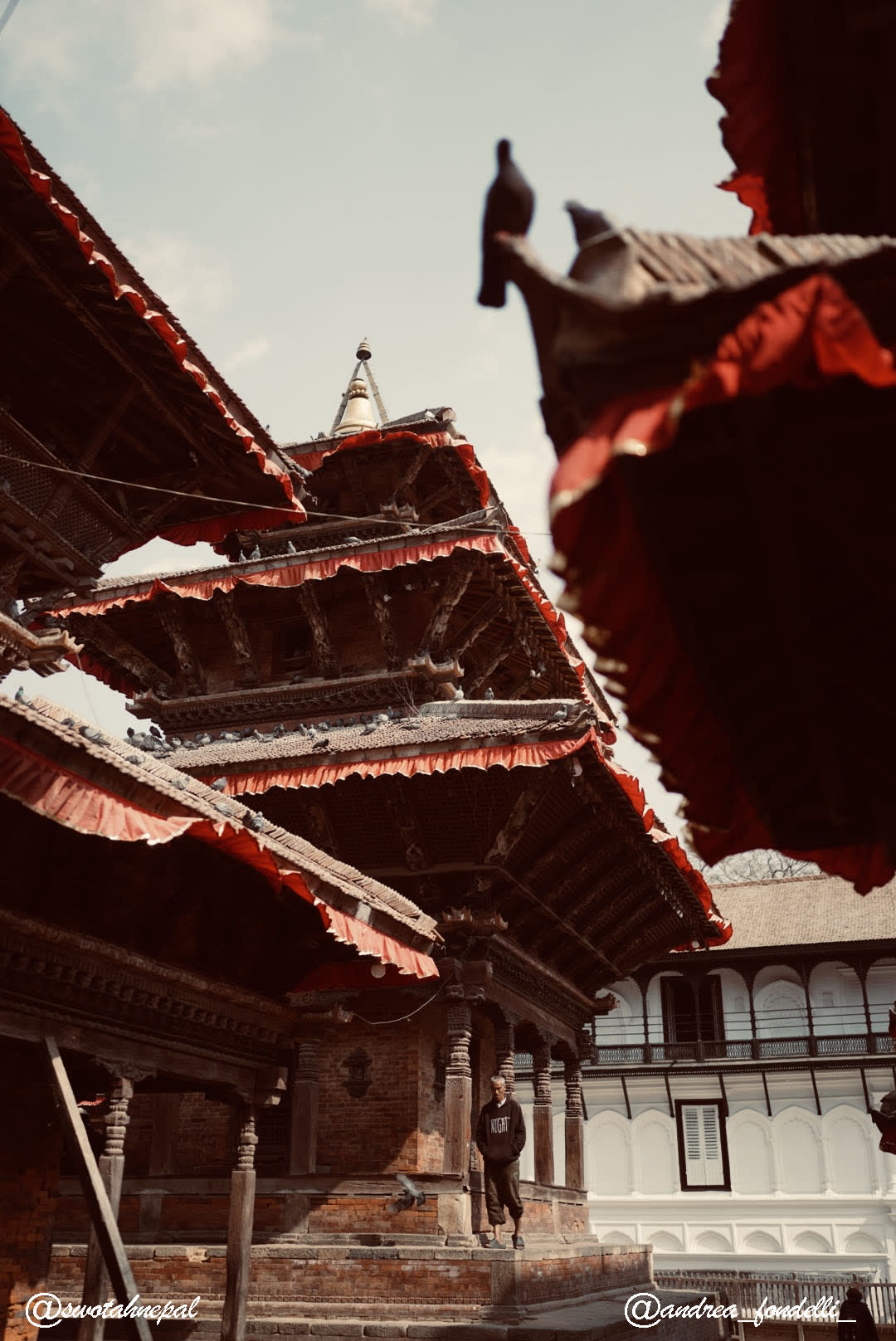
The square's architecture uses a wood-and-brick construction style unique to the Kathmandu Valley's Newar craftsmen, with elaborately carved roof struts depicting deities and, on some older temples, more explicit erotic carvings whose traditional purpose was said to ward off lightning strikes. Our guides point out the Taleju Temple, the Malla royal family's dedicated shrine to their protector goddess, visible only from the square's edge since its interior opens to the public just once a year during the Dashain festival. The square also holds the Coin Museum and the former royal palace's Nasal Chowk courtyard, once the site of coronation ceremonies for Nepal's kings and now a small museum on the monarchy's history before the country became a federal republic in 2008.

What makes Swayambhunath significant beyond the viewpoint?

Swayambhunath, commonly called the Monkey Temple for the rhesus macaques that live on its hillside, is one of the oldest Buddhist sites in the Kathmandu Valley, with the core stupa's origins connected by local tradition to the valley's founding legend and the site's documented history reaching back roughly 1,500 years. The stupa's white dome represents the earth element in Buddhist cosmology, and the gilded spire above it carries painted eyes on all four sides, Buddha's all-seeing wisdom, watching in every direction, with the question-mark-like symbol between them representing the Devanagari numeral for unity.

Thirteen tiers rise from the stupa's base to its pinnacle, symbolizing the thirteen stages a being passes through on the path to enlightenment in Buddhist teaching, and prayer wheels line the base for pilgrims to spin clockwise while circling the stupa, each rotation understood as equivalent to reciting the mantra inscribed on it. Our guides cover this symbolism at the top of the 365 stone steps, timed so clients catch both the religious context and the valley panorama in the same stop rather than treating the climb as just a viewpoint errand.

What is the Tibetan Buddhist community around Boudhanath?

Boudhanath's community grew substantially after 1959, when Tibetan refugees following the 14th Dalai Lama into exile settled around the stupa, and the neighborhood today holds one of the largest concentrations of Tibetan Buddhist monasteries outside Tibet itself, more than 50 gompas within walking distance of the stupa by various counts. The stupa's mandala-shaped base, one of the largest in the world at roughly 36 m across, draws a steady flow of monks, pilgrims, and Kathmandu residents walking the kora, a clockwise circumambulation route around its base performed as a devotional practice throughout the day but most visibly at dawn and dusk.

Butter lamps, burning juniper incense, and the low murmur of mantras recited by pilgrims give Boudhanath a different atmosphere than Durbar Square's palace grandeur or Swayambhunath's hilltop setting, and our guides time the afternoon visit to catch some of this activity rather than an empty courtyard. Rooftop cafes ringing the stupa's plaza offer a quieter vantage point for clients who want to sit with the view rather than keep moving.

How physically demanding is the Kathmandu Valley Heritage Day Tour?

Easy is the honest overall grading for three of the four stops: Durbar Square, Boudhanath, and Pashupatinath sit on flat or gently stepped ground with no sustained climbing anywhere in the visit. Swayambhunath is the one genuinely physical stop, its 365 stone steps climb roughly 80 vertical meters from the base to the stupa plateau, steep enough that clients with knee or mobility concerns should know about it before booking, though a longer vehicle-accessible side road reaches the same plateau for anyone who prefers to skip the stairs.

Kathmandu Valley's 1,400 m elevation carries no altitude risk of any kind whatsoever, so the physical limiting factor on this tour is heat and walking stamina rather than thin air. Spring and pre-monsoon afternoons, March through May, can reach the low 30s Celsius, so our guides schedule Swayambhunath's climb for the cooler late-morning slot rather than early afternoon, and carrying water between stops matters more on this tour than technical fitness. Monsoon-season visits, June through September, add the possibility of a short afternoon downpour, so our guides carry a lightweight umbrella and time the Swayambhunath stop for whichever window the day's forecast looks driest.

What if you have two days in Kathmandu instead of one?

Kathmandu Valley holds seven UNESCO World Heritage monument zones in total, and this standard tour covers four; the other three, Patan Durbar Square, Bhaktapur Durbar Square, and the Changu Narayan temple complex, make a genuinely different second day rather than a repeat of the first. Patan, just across the Bagmati River from central Kathmandu, holds its own Malla-era royal square dominated by the ornate stone Krishna Mandir and a working bronze-casting and metalwork tradition still visible in workshops near the square. Bhaktapur, roughly an hour east, is the best-preserved of the valley's three former royal cities, with the five-story Nyatapola Temple, Nepal's tallest pagoda, and a pottery square where potters still throw clay on traditional wheels in the open street.

Changu Narayan, the valley's oldest documented temple site with inscriptions dating to the 5th century, sits on a hilltop above Bhaktapur, reached by a short additional drive and a modest uphill walk, and it suits travelers with a specific interest in Nepal's earliest surviving Hindu stone and metalwork architecture over a second full day of city-square sightseeing. Ask your booking coordinator to add either as a half-day or full-day extension; both work well as a genuinely different second day precisely because Kathmandu, Patan, and Bhaktapur each developed independently as separate royal capitals with their own distinct palace and temple architecture, rather than one city's heritage simply repeated three times over.

How is this tour priced for different nationalities, and what should you know about site entry logistics?

Nepal's UNESCO-listed heritage sites charge a foreigner entry rate substantially higher than the reduced rate SAARC-nation visitors pay, and Nepali citizens enter almost all sites free, a three-tier pricing structure set by the Kathmandu Metropolitan City and the Pashupati Area Development Trust rather than by individual tour operators. Our cost breakdown above uses the foreigner rate, the one that applies to the large majority of international clients booking this tour, and tickets are purchased at each site's gate rather than pre-booked, so a passport or a photocopy of one is worth carrying for any site that spot-checks nationality at the counter.

Tickets for Durbar Square and Pashupatinath are single-entry for the day; re-entering after leaving for lunch requires either keeping the original ticket or, at Durbar Square, showing it to gate staff who recognize same-day re-entry. Swayambhunath and Boudhanath both charge a flat entry fee with no re-entry restriction in practice, since their open plazas make ticket enforcement looser than the walled Durbar Square and Pashupatinath compounds.

What should you bring for a Kathmandu Valley heritage day tour?

This tour needs none of the trekking gear covered in the Nepal trekking packing list, since it never leaves the valley floor or exposes clients to teahouse conditions. Modest clothing covering shoulders and knees is the one real requirement across all four sites, alongside slip-on footwear that comes off easily at temple entrances and stupa bases where shoes aren't permitted inside.

A sun hat and sunscreen matter more than most first-time visitors expect, since large stretches of the day, the Swayambhunath climb, the Boudhanath kora, the open Durbar Square courtyard, offer little shade at Kathmandu's midday sun angle. A small day bag for water, a camera, and any souvenirs from the craft shops near Boudhanath and Durbar Square rounds out what most clients actually carry through the day. Thangka paintings, singing bowls, and pashmina scarves are the items most clients end up buying near Boudhanath specifically, where the Tibetan community's craft shops cluster densely around the stupa's outer plaza; our guides can point out which shops sell genuinely handmade pieces versus mass-produced imports if that distinction matters to you, and bargaining respectfully is standard, expected practice at nearly every craft stall around the plaza.

Day by Day

1-day itinerary, every detail planned.

Day1
Trip Day
Full-day Kathmandu Valley heritage tour: Durbar Square, Swayambhunath, Boudhanath, Pashupatinath
~3.5h walking5 km

Hotel pickup at 8:30 am in Thamel starts the day at Kathmandu Durbar Square by 9:00 am, where the guide covers the Hanuman Dhoka palace and Malla-era temples for about 90 minutes. A short drive reaches Swayambhunath by 11:00 am, and the 365-step climb to the stupa and its valley panorama takes roughly an hour and a half including a rest at the top. After a midday lunch break, the afternoon covers Boudhanath from about 2:00 pm, including a slow walk around the stupa's base, then Pashupatinath from around 3:30 pm to 5:00 pm, closing with the cremation-ghat etiquette detailed above before the drive back to the hotel by 5:30 pm.

5 km~3.5h

What's Included

Transparent, all-in pricing.

Included in your price

Licensed city guide, full day
Private vehicle and driver, full day
Site entry tickets (4 sites, foreigner rate)
Lunch in Thamel or Patan

Not included

Nepal entry visa fee (USD 30-125, paid on arrival)
Travel insurance with helicopter evacuation cover
Personal trekking gear and equipment
Tips for your guide and porter
Bottled drinks, wifi, and device charging at teahouses
Meals in Kathmandu outside the itinerary

Dates & prices

Upcoming departures.

Start dateEnd datePrice / personAvailability
14 Sept 202614 Sept 2026USD 55Open · 9 leftEnquire
19 Oct 202619 Oct 2026USD 55Guaranteed · 4 leftEnquire
8 Mar 20278 Mar 2027USD 55Open · 12 leftEnquire
12 Apr 202712 Apr 2027USD 55Open · 10 leftEnquire

Verified reviews

What travellers say.

4.8/5 from 47 reviews on TripAdvisor, checked July 2026

★★★★★

Perfect way to spend our arrival day before flying to Lukla two mornings later. Rajesh's team paired us with a guide who explained the Kumari tradition and the Pashupatinath cremation rites with real care, never felt like a rushed checklist tour.

GK
Grace Kimani · Kenya
14 Jun 2026
★★★★

Four sites in one day sounds like a lot but the pacing worked, Durbar Square in the cool morning and Pashupatinath last when the afternoon light over the ghats was quite something. Boudhanath's stupa walk was a highlight I did not expect.

TR
Tom Reilly · Ireland
2 Nov 2026

Why Nepal Travel Packages

Built on published proof, not adjectives.

A named, licensed guide before you book

Full name, photo, NMA or TAAN license number, and a direct WhatsApp line. The guide on the page is the guide on the trail.

Itemized pricing, not a lump sum

Permits, guide, porter, lodging, and food broken out on every trip page. You see exactly where the price comes from.

Trail conditions updated monthly

Dated field reports from the guides running the route this season, not boilerplate written once and left to go stale.

Permits handled, not hidden

Every permit fee, checkpoint, and paperwork rule is filed for you and published in the guides — no surprise admin at Lukla.

FAQ

Common questions

Do I need a permit or visa document for this tour?+

No trekking permit applies to any of the four sites, since this is a valley day tour rather than a mountain route, so the only paperwork involved is your standard Nepal tourist visa, arranged on arrival at Tribhuvan International Airport or in advance. Site entry tickets are purchased on the spot and included in our cost breakdown above.

Can I combine this tour with my trek's arrival or departure day?+

Yes, this is exactly how most clients use it: the tour fits naturally into the arrival day before a trek starts or a buffer day held in Kathmandu after a flight delay, such as the spare days built into most Everest and Annapurna itineraries. Ask your booking coordinator to slot the tour into whichever day of your existing trekking schedule sits open.

What should I wear to Pashupatinath and the other temple sites?+

Modest dress covering shoulders and knees is expected at all four sites, and shoes come off before entering certain temple interiors and stupa bases, so slip-on footwear is more practical than boots. Pashupatinath in particular expects quiet, conservative behavior given its function as an active cremation site, covered in the etiquette section above.

Can the site order or itinerary be customized?+

Yes, the morning-to-afternoon sequence described above is our standard flow, but groups can request a different order, drop a site to add more time elsewhere, or extend into a half-day add-on to Bhaktapur or Patan Durbar Square. Let your guide know preferences the evening before so the vehicle and ticket logistics can adjust.

Is transport included in the price?+

Yes, a private vehicle and driver for the full day are included in both the group and private tour prices, covered in the cost breakdown above, so there is no separate taxi or ride-share cost between the four sites. The vehicle waits at each stop rather than requiring re-booking between sites.

Why does Swayambhunath have painted eyes on the stupa?+

The eyes represent Buddha's all-seeing wisdom watching in all four directions, and the Devanagari-numeral symbol between them stands for unity. The thirteen tiers rising above the dome symbolize the thirteen stages toward enlightenment in Buddhist teaching, explained by our guides at the top of the 365-step climb.

How old is Kasthamandap, the wooden pavilion that gave Kathmandu its name?+

Local tradition and inscriptions date Kasthamandap's origins to around the 12th century, built, according to legend, from the timber of a single sal tree. The 2015 earthquake collapsed the original structure, and reconstruction using traditional joinery techniques has since restored much of it at the same Durbar Square site.

Do foreigners pay the same entry fee as Nepali citizens at these sites?+

No. Nepal's UNESCO sites use a three-tier pricing structure: foreigners pay the highest rate, SAARC-nation citizens pay a reduced rate, and Nepali citizens generally enter free. Our cost breakdown uses the foreigner rate that applies to most international clients, and tickets are purchased at each site's gate on the day.

Is the Swayambhunath climb difficult?+

The 365 stone steps climb roughly 80 vertical meters and are the one physically demanding stop on this tour, steep enough to notice but not technical. A vehicle-accessible side road reaches the same stupa plateau for clients who prefer to skip the stairs, so the climb is optional rather than the only way up.

What else is there to see in Kathmandu Valley beyond this four-site tour?+

Patan Durbar Square, Bhaktapur Durbar Square, and the Changu Narayan temple complex are the valley's other three UNESCO monument zones, each a genuinely different former royal city rather than a repeat of Kathmandu's own square. Ask about adding a half-day or full-day extension to either Patan or Bhaktapur if your schedule allows more than the standard single day.