
Nepal Travel Packages
Upper Mustang Tiji Festival Trek

Upper Mustang Tiji Festival Trek

★★★★★ 4.9 (19 reviews)
Mustang, Nepal 13-14 days Moderate Max 4,230 m
Duration
13-14 days
Max altitude
4,230 m
Difficulty
Moderate
Group size
Up to 10
Total distance
~120 km
Elevation gain
5,600 m
Best season
May, dates confirmed annually by the Tibetan lunar calendar
Avg daily walk
5-7 hours
Starts in
Jomsom (2,720 m)
Ends in
Jomsom (2,720 m)
Accommodation
Teahouse lodges throughout; Lo Manthang lodges book out for the festival week
✓ TAAN & NMA licensed guides ✓ Permits included, no hidden fees ✓ Small group departures
Group departure · per person
USD2,450
Permits, guide, porter, lodging & food included
Departure date
Email Nepal
Permits and logistics fully arranged
Licensed guide included on every departure
Direct WhatsApp line to your guide

The Upper Mustang Tiji Festival Trek is a 13 to 14 day teahouse trek to Lo Manthang at 3,840 m timed around the three-day Tiji festival, a Buddhist masked-dance ceremony held in the walled capital's palace courtyard. A 2027 group departure costs USD 2,100 to 2,900 per person including the same restricted-area permit as the standard Upper Mustang route (USD 500 for 10 days, USD 50 per additional day) and the Annapurna Conservation Area Permit (NPR 3,000). The festival itself follows the Tibetan lunar calendar rather than a fixed Gregorian date, typically landing in May, and Lo Manthang's monastery office confirms the exact three days only a few months ahead each year.

Passang Dawa Sherpa has led 3 Tiji Festival departures and coordinates each year's date confirmation directly with contacts in Lo Manthang. The sections below cover how festival dates get confirmed and what that means for booking, the shared restricted permit mechanics, a cost breakdown against the USD 2,100 to 2,900 range, and what actually happens across the three days of masked dances.

Highlights

What our guides know that others don't.

1

Festival date confirmation timing

Lo Manthang's monastery confirms exact dates only 2-3 months ahead each year

2

Lo Manthang courtyard capacity

Standing room only in the palace courtyard by the second festival day

Live from the trail

Updated 2 Jul 2026

2027 Tiji festival dates: provisional windows open for booking

Lo Manthang's monastery office has not yet released the confirmed 2027 Tiji festival dates, expected two to three months before the likely May window. We have opened three provisional departure slots and will confirm the correct one to booked clients as soon as the official announcement lands. Standard Upper Mustang departures outside the festival window remain unaffected by this timing.
When is the Tiji Festival, and how do trek dates get confirmed each year?

Lo Manthang's monastery office sets the three days of Tiji by the Tibetan lunar calendar, a system that does not map onto a fixed Gregorian date, so the festival typically falls somewhere in May but shifts from year to year. Official confirmation usually arrives only two to three months before the festival, later than the booking lead time most international trekkers prefer for flights and leave from work. Our approach is to schedule three provisional May departure windows and confirm which one aligns with the official dates as soon as Lo Manthang announces them, then adjust final departure timing with booked clients directly.

This lunar-calendar uncertainty is the single planning fact that separates this trek from the standard Upper Mustang trek, which runs on a fixed-season schedule without a festival to hit. Clients who need certainty months in advance should ask about our confirmed-date policy before booking a Tiji departure specifically.

What permits does the Tiji Festival Trek require?

The Tiji Festival Trek uses the identical permit pair as the standard Upper Mustang route: the restricted-area permit at USD 500 for 10 days (USD 50 per additional day) and the Annapurna Conservation Area Permit at NPR 3,000. Both are issued through a registered agency rather than to individuals, and the restricted permit carries the same rules that govern all of Nepal's restricted zones, a minimum of two trekkers and a mandatory government-licensed guide.

Because a Tiji departure often runs the full 13 to 14 days rather than the standard 12, the daily USD 50 extra-day charge can apply if a group's schedule pushes past the 10-day permit window, a detail our office tracks when filing the paperwork. The restricted-permit system is explained in full, including how it compares with Manaslu's version, in the Manaslu restricted-area permit requirements guide, and the complete Nepal permit map sits in the Nepal trekking permits master guide.

How much does the Tiji Festival Trek cost in 2027?

TAAN-registered operators quoted USD 2,100 to 2,900 for a group Tiji departure in 2027, above the standard Upper Mustang band of USD 1,900 to 2,600 largely because Lo Manthang's teahouse rates rise during festival week when demand from pilgrims and trekkers both peak at once. The table below itemizes the breakdown, and the accommodation line is the one that moves most: rooms with any privacy in Lo Manthang can be fully booked weeks ahead of the confirmed festival dates.

The permit costs themselves match the standard Upper Mustang trek exactly, so the price difference comes entirely from lodging pressure and the extra one to two trail days most Tiji itineraries carry as a buffer against the date-confirmation uncertainty described above. Booking early, as soon as we announce which of our three provisional windows matches the confirmed dates, is the best way to secure a normal room rather than dining-hall floor space.

Where the price goes · per person
Upper Mustang restricted permitUSD 500 for 10 days, USD 50/day after$500
Annapurna Conservation Area PermitNPR 3,000$23
Pokhara-Jomsom flights or jeep, both waysFlight Pokhara-Jomsom or long jeep$160–300
Licensed guide (mandatory, shared)USD 35-40/day over 13-14 days$380–480
Porter, one per two trekkersUSD 25/day, 20 kg shared load$260–320
Teahouse rooms and food, 13-14 nightsFestival-week Lo Manthang lodge rates run above the standard Upper Mustang band$420–620
Company margin, logistics, staff equipment$200–360

What happens during the three days of Tiji dances at Lo Manthang?

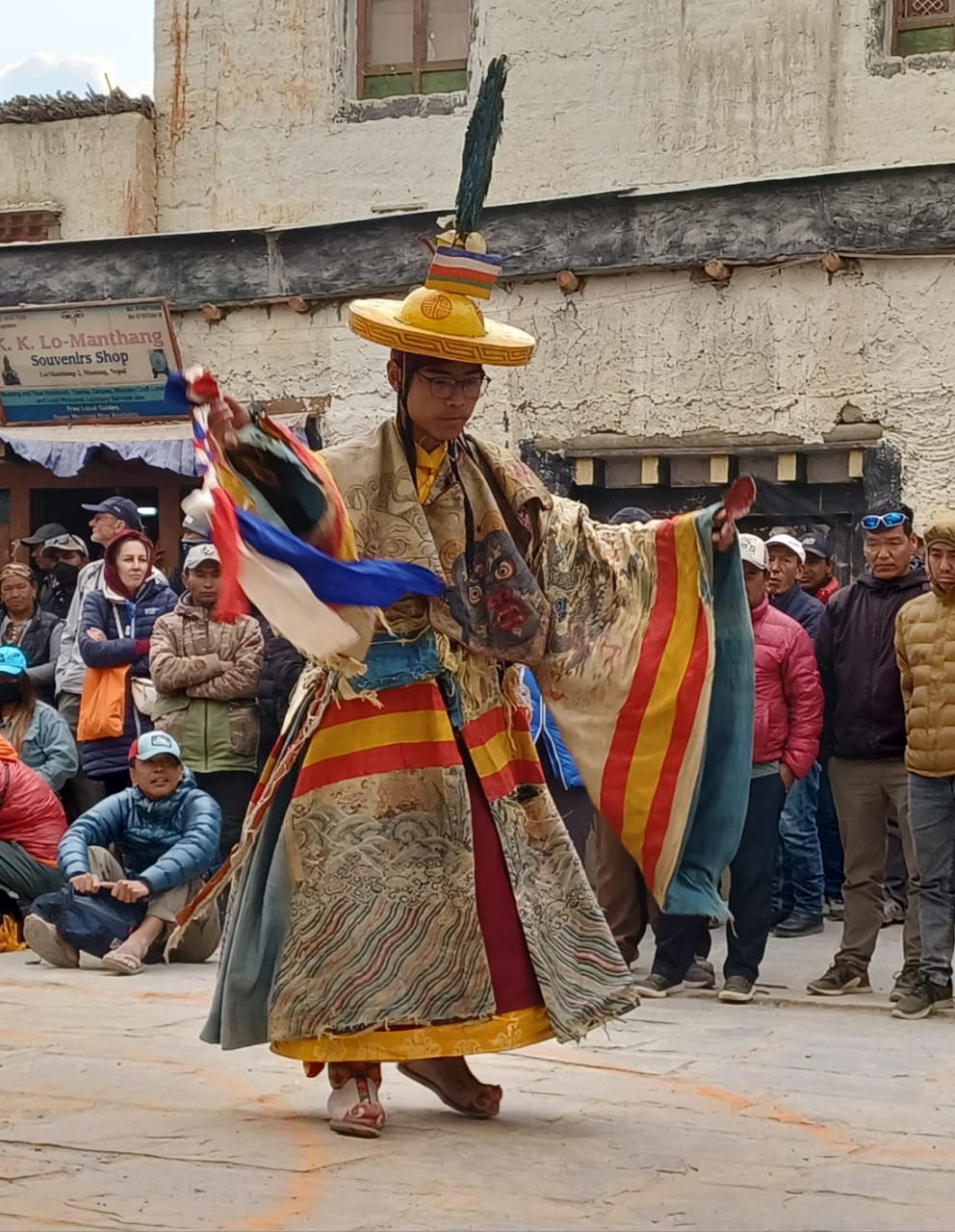
Tiji is a three-day Cham, a Buddhist ritual masked dance performed by monks of Lo Manthang's Choede monastery in the palace courtyard, dramatizing the deity Dorje Jono's defeat of a demon force threatening the kingdom. Each day builds toward the climax on the third, with monks in elaborate brocade costumes and painted wooden masks performing choreographed sequences to drums, cymbals, and long horns while the entire town and visiting pilgrims from surrounding villages fill the courtyard to watch. Photography is generally permitted from the courtyard edges, though our guides brief clients on where filming is discouraged during specific ritual moments.

The festival carries real religious weight for Lo Manthang's residents beyond its visual spectacle, and our itinerary treats the three days as the trip's fixed center rather than a single day-trip stop, arriving with a buffer day before the dances begin and staying through the full sequence. Trekkers who arrive mid-festival because of flight delays miss ritual context that only makes sense watched from the first day.

How crowded does Lo Manthang get during the festival?

Standing room only describes the palace courtyard by the second festival day, when pilgrims from villages across Upper Mustang and Tibetan border areas join the trekking crowd that has grown steadily since the route opened to foreign visitors in 1992. Good courtyard viewing positions go to those who arrive early each morning, and our guides stake out a consistent spot for the group on day one that holds for the rest of the festival.

Lo Manthang's roughly 150 households cannot absorb festival-week crowding through normal lodge capacity alone, so some visitors sleep in dining halls or overflow tents arranged by local families. Booking through a registered operator who reserves rooms well ahead, which the date-confirmation timing above makes harder than on a normal fixed-season trek, is the practical difference between a comfortable festival week and a difficult one.

What story do the Tiji masked dances actually tell?

Tiji is short for Tenchi, "the prayer for world peace," and its three days of Cham dance dramatize a single continuous myth: Dorje Jono, a deity born to subdue evil, confronts his own demon father Man Tam Ru, whose thirst for destruction was draining Mustang of water and threatening the kingdom with famine. Day one shows the demon's origin and his early acts of chaos; day two builds through a sequence of ritual confrontations as Dorje Jono's forces close in; day three ends with Dorje Jono defeating and banishing Man Tam Ru from the valley, restoring water and order, which is why the final day carries the festival's largest crowd and its most celebratory tone.

Monks of the Choede monastery train for months to perform the roles correctly, since each mask, costume color, and dance sequence encodes specific narrative meaning rather than functioning as generic spectacle. Our guides walk clients through which character is on stage and what that day's sequence represents before the dancing starts each morning, since the story is not narrated aloud during the ceremony itself and is easy to miss without that context. Knowing the myth in advance changes the festival from a striking visual event into a ritual with a legible beginning, middle, and end across the three days.

The monastery's own dungchen, long copper horns whose low tone carries across the courtyard, mark each major transition in the dance sequence alongside cymbals and hand drums, so the soundscape itself signals when a new scene of the myth is beginning even to a visitor unfamiliar with the choreography. Masks are stored at the monastery between festivals and brought out only for Tiji and a small number of other calendar observances, which is part of why the costumes appear in largely unfaded condition despite their age.

What is Lo Manthang like beyond the festival days?

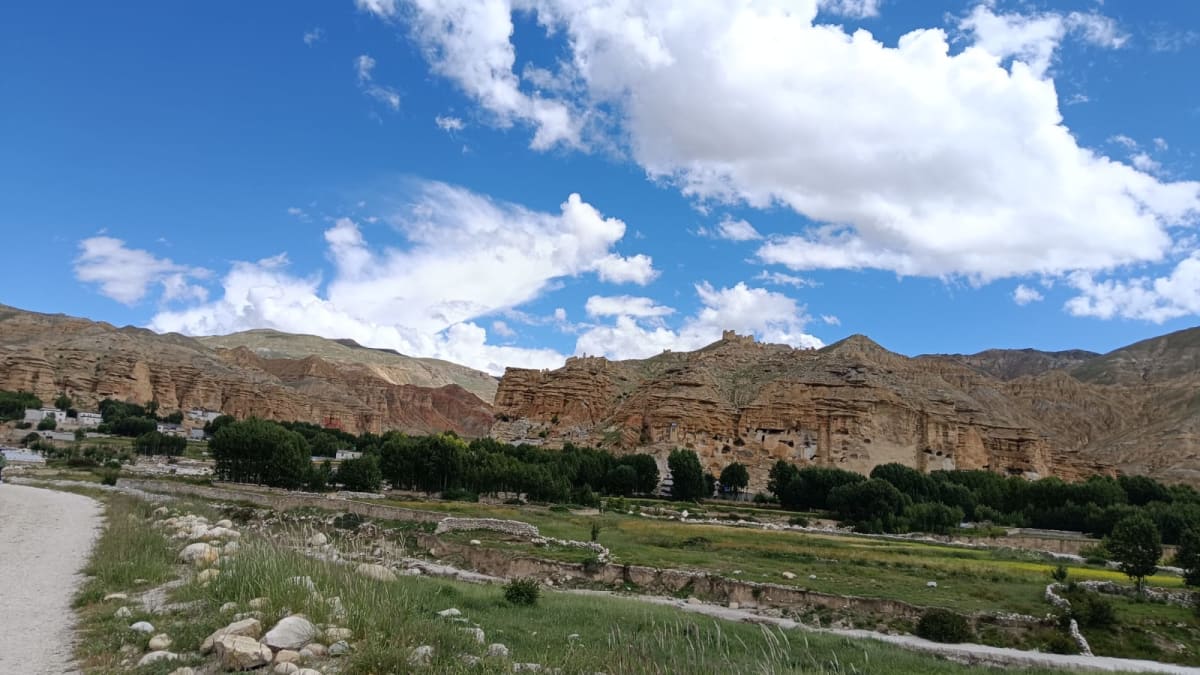
Lo Manthang is the walled former capital of the Kingdom of Lo, a Buddhist enclave that operated as a semi-independent territory into the 20th century and only opened to foreign trekkers in 1992. Inside walls that still stand largely intact, the town holds the former royal palace, four-story rammed-earth architecture unique to Upper Mustang, and three of the region's most significant gompas: Jampa Gompa (also called the God House, home to a three-story seated Maitreya Buddha statue and mandala murals dating to the 15th century), Thubchen Gompa (a large assembly hall with damaged but still-visible wall paintings from the same period), and Choede Gompa, the monastery whose monks perform the Tiji dances.

Our itinerary holds a half-day of free time after the third festival day specifically for these three sites, since the festival crowds in the courtyard make unhurried temple visits impractical during the dance days themselves. Lo Manthang's population lives largely by subsistence agriculture and increasingly by tourism income concentrated in this narrow festival window, which is part of why the town's character shifts noticeably in the days immediately after Tiji ends and the crowds disperse back down the valley.

Outside the palace and monastery walls, Lo Manthang's streets still run on the same layout the kingdom used centuries ago, narrow alleys between rammed-earth houses opening onto small courtyards where families dry barley and chili on rooftops through the dry season. Walking the town outside festival hours, early morning before the day's dances start or the half-day after they end, gives a clearer sense of Lo Manthang as a living settlement rather than only a festival backdrop.

How difficult is the Tiji Festival Trek, and what altitude risk applies?

Moderate is the honest grading here: 120 km over 13 to 14 days with 5 to 7 hour walking days, a maximum trail altitude of 4,230 m at the pass sections, and no technical terrain anywhere on the route. This matches the standard Upper Mustang trek's difficulty exactly, since both routes cover the same ground; the festival adds a fixed three-day stop at Lo Manthang rather than a harder trail.

Altitude risk is real but manageable: Lo Manthang itself sits at 3,840 m, and the itinerary's day 6 arrival, a day ahead of the festival start, doubles as an acclimatization buffer before the three static festival days at that altitude, which themselves function as rest days with light walking rather than climbing days. The 500-m-per-day sleeping-altitude guideline covered in the altitude sickness prevention guide is easier to hold on this route than on a route that climbs continuously, since Lo Manthang's three-night stay gives the body extended time at one altitude rather than pushing higher each day. Trekkers with no prior high-altitude experience have completed this route without incident, though the standard travel-insurance-with-evacuation-cover advice applies here the same as on any route crossing 4,000 m.

What should you pack for a Tiji Festival departure?

Pack from the same base list covered in the Nepal trekking packing list: a four-season sleeping bag, layered clothing, and broken-in boots, since Upper Mustang's teahouses at this altitude carry no heating and May nights at Lo Manthang can still drop close to freezing. Add wind and dust protection specifically for this route, a buff or scarf, sunglasses, and lip balm, since Mustang's afternoon wind is a daily constant on the Kali Gandaki approach and picks up dust across the exposed upper sections.

One addition specific to the festival itself: a lightweight day pack for the three static days at Lo Manthang, since the group stays put but still needs water, sun protection, and a camera or zoom lens for the courtyard rather than full trekking kit. A change of clean, presentable clothing for the festival days is worth the extra pack weight, since this is a religious and community occasion, not just another trail day. Earplugs are worth packing too; the dungchen horns and cymbals carry loudly across the courtyard and into nearby guest lodges on all three festival mornings.

Should a first-time Mustang visitor pick the Tiji departure or the standard trek?

The standard Upper Mustang trek is the better choice for a trekker who needs fixed, bookable dates months in advance or who prefers Lo Manthang without festival-week crowding, since it runs on a normal season schedule from March through November with none of the lunar-calendar uncertainty described above. The Tiji departure is the better choice for a trekker who specifically wants to witness the Cham dances and is willing to accept schedule flexibility, higher festival-week accommodation costs, and a shorter booking-confirmation window in exchange.

Both trips walk the same trail, cross the same passes, use the same restricted-area and conservation permits, and start and finish at the same Jomsom gateway, so the physical trek itself is not the deciding factor either way. The genuine trade-off is between certainty and the festival itself: clients on a fixed corporate leave schedule or with pre-booked onward international flights are usually better served by the standard trek's predictability, while travelers with a flexible May travel window who specifically want to witness the Cham dances tend to accept the later date confirmation as a fair trade for the experience. Ask your booking coordinator directly which trade-off best fits your own travel calendar before committing to either departure option.

Elevation profile High point 4,230 m
3,0003,5002,720 m123453,840 m67891011122,720 m13DAY
Acclimatization night High point

Day by Day

14-day itinerary, every detail planned.

Day1
Trip Day
Fly or drive Pokhara to Jomsom (2,720 m)
2,720m alt.

A 20-minute morning flight or a long jeep reaches Jomsom, the district gateway. Permits are checked at the Kagbeni post before entering the restricted zone.

2,720 m
Day2
Trip Day
Jomsom to Kagbeni to Chele (3,050 m)
~6h walking15 km
3,050m alt.
Day3
Trip Day
Chele to Syangboche (3,800 m)
~6h walking14 km
3,800m alt.
Day4
Trip Day
Syangboche to Ghami (3,520 m)
~5h walking12 km
3,520m alt.
Day5
Trip Day
Ghami to Tsarang (3,560 m)
~5h walking11 km
3,560m alt.
Day6
High Point
Tsarang to Lo Manthang (3,840 m), festival buffer day
~5h walking13 km
3,840m alt.

What's Included

Transparent, all-in pricing.

Included in your price

Upper Mustang restricted permit
Annapurna Conservation Area Permit
Pokhara-Jomsom flights or jeep, both ways
Licensed guide (mandatory, shared)
Porter, one per two trekkers
Teahouse rooms and food, 13-14 nights
Company margin, logistics, staff equipment

Not included

Nepal entry visa fee (USD 30-125, paid on arrival)
Travel insurance with helicopter evacuation cover
Personal trekking gear and equipment
Tips for your guide and porter
Bottled drinks, wifi, and device charging at teahouses
Meals in Kathmandu outside the itinerary

Dates & prices

Upcoming departures.

Start dateEnd datePrice / personAvailability
2 May 202715 May 2027USD 2,450Open · 6 leftEnquire
9 May 202722 May 2027USD 2,450Open · 4 leftEnquire
16 May 202729 May 2027USD 2,450Open · 8 leftEnquire

Verified reviews

What travellers say.

4.9/5 from 19 reviews on TripAdvisor, checked July 2026

★★★★★

Watched all three days of the masked dances from a spot our guide staked out early each morning, well worth arriving before the festival started rather than mid-week like some other groups. Lo Manthang itself is extraordinary even without the festival, the dances made it unforgettable.

KF
Klaus Fischer · Germany
20 May 2026
★★★★

Room availability got tight by the second festival day exactly as warned, glad our operator had booked ahead. The date confirmation only came through about ten weeks before departure, worth knowing if you need to book flights early.

AO
Amara Osei · Ghana
24 May 2026

Why Nepal Travel Packages

Built on published proof, not adjectives.

A named, licensed guide before you book

Full name, photo, NMA or TAAN license number, and a direct WhatsApp line. The guide on the page is the guide on the trail.

Itemized pricing, not a lump sum

Permits, guide, porter, lodging, and food broken out on every trip page. You see exactly where the price comes from.

Trail conditions updated monthly

Dated field reports from the guides running the route this season, not boilerplate written once and left to go stale.

Permits handled, not hidden

Every permit fee, checkpoint, and paperwork rule is filed for you and published in the guides — no surprise admin at Lukla.

FAQ

Common questions

How do I know which of the provisional Tiji departure dates is correct?+

We announce the confirmed departure as soon as Lo Manthang's monastery office releases the official lunar-calendar dates, typically two to three months before the festival, and shift booked clients onto that specific window at no extra cost. Booking any of our three provisional May slots holds your place in the group while the exact dates firm up.

Is the Tiji Festival Trek permit different from the standard Upper Mustang trek?+

No, both use the identical restricted-area permit at USD 500 for 10 days plus the Annapurna Conservation Area Permit, filed the same way through a registered agency. The only cost difference is that a Tiji itinerary sometimes runs a day or two past the 10-day permit window, which adds the USD 50 per-day extension fee, covered in the permits section above.

What if I can only travel on fixed dates and the festival shifts outside them?+

Since Tiji's exact dates are not confirmed until two to three months ahead, trekkers who need certainty for flights booked far in advance carry real risk of a mismatch. The safer option for a fixed-date trip is the standard Upper Mustang trek without the festival timing, which runs on a normal season schedule from March through November.

Can I photograph the Tiji masked dances?+

Photography is generally allowed from the courtyard edges throughout the three days, though our guides identify specific ritual moments where filming is discouraged out of respect for the monastery. A zoom lens helps given the courtyard distance from the dance area, and a local photography fee is sometimes collected at the gate, covered separately from our cost breakdown since it varies by year.

How difficult is the trek to reach Lo Manthang for the festival?+

The trekking itself matches the standard Upper Mustang route, moderate difficulty over 4,000 m-class passes with no technical sections, so physical demand is not the limiting factor. The real planning challenge is the date-confirmation timing covered above, not the trail itself.

What does the Tiji festival actually depict?+

A three-day myth cycle in which the deity Dorje Jono confronts and eventually banishes his demon father Man Tam Ru, whose destructive thirst was draining Mustang of water. Day one shows the demon's origin, day two builds through ritual confrontations, and day three ends with the demon's defeat and the valley's water and order restored.

Can I visit Lo Manthang's monasteries during the festival?+

Yes, our itinerary holds a half-day of free time after the third festival day specifically for Jampa Gompa, Thubchen Gompa, and Choede Gompa, since the courtyard crowds during the dance days themselves make unhurried temple visits impractical. All three sites are within a short walk inside Lo Manthang's walls.

Is altitude sickness a real risk on the Tiji Festival Trek?+

The risk is manageable rather than severe: Lo Manthang sits at 3,840 m, and the itinerary's buffer day before the festival plus the three static festival days function as extended acclimatization time at one altitude rather than continuous climbing. Standard altitude precautions and evacuation-inclusive travel insurance still apply, covered in the altitude sickness prevention guide.

Do the Tiji dances happen every year without exception?+

Yes, Tiji is Lo Manthang's central annual religious observance and the Choede monastery has performed it every single year on record, unlike some smaller regional festivals that can occasionally be skipped in a genuinely difficult year. The only real uncertainty on this particular trip is the exact date within the May window, not whether the festival itself happens at all.