This is a first-person trail report from Passang Dawa Sherpa's July 2026 Upper Mustang departure, his eighth Mustang trip, covering the flight delay at Jomsom, the afternoon wind, and the clear skies over Lo Manthang while the rest of Nepal sat under monsoon cloud. The group of five left Pokhara on July 15 and reached Lo Manthang at 3,840 m on July 20, with daytime temperatures of 20 to 24 C and a total of two hours of rain across eleven days. One flight delay on day 1, a 40-minute wait in Jomsom for the wind to build past 30 km/h on three separate afternoons, and a rest day at Lo Manthang under a completely cloudless sky were the details that stood out most.
What follows is the departure day by day, written to show what an actual monsoon-season Mustang trip looks like against the dry-trail claims on our own trip page.
In this guide 7
- 01 Why a July departure into Mustang is worth the flight risk
- 02 Day 1: the Pokhara-Jomsom flight delay
- 03 Days 2 to 4: Kagbeni to Ghami, the wind arrives on schedule
- 04 Days 5 and 6: Tsarang to Lo Manthang, dry trail the whole way
- 05 Day 7: a rest day at Lo Manthang under a cloudless sky
- 06 Days 8 to 11: the return, and the wind holding its pattern
- 07 What this confirms for future July Mustang planning
Why a July departure into Mustang is worth the flight risk
Kathmandu sat under heavy monsoon cloud the entire week of this departure, and clients messaged me photos of flooded streets from home before we had even left Pokhara. The Annapurna and Dhaulagiri massifs, both over 8,000 m, block that same monsoon system from reaching Mustang, and this trip is the concrete proof: eleven days inside the rain shadow, two hours of rain total, both at night. That gap between southern Nepal's weather and Mustang's is the whole case for a July trek here, and this group got to see it firsthand rather than read it on a page.
Day 1: the Pokhara-Jomsom flight delay
Our 7 am flight from Pokhara to Jomsom did not leave until 10:40 am on July 15, held by monsoon cloud sitting over the southern approach near Beni, a delay pattern I have seen on four of my last six July departures. Jomsom itself sat under blue sky the whole morning; the problem was entirely the route in, not the destination. We built a buffer day into this itinerary for exactly this reason, so the delay cost us nothing beyond a late lunch in Jomsom before the afternoon's short walk to Kagbeni. Clients who fly Mustang in July without that buffer day risk losing a full day of the eleven-day itinerary to a single morning of cloud 60 km south of where they are trying to go.
Days 2 to 4: Kagbeni to Ghami, the wind arrives on schedule
Mornings in the restricted zone ran calm and warm, 15 to 18 C at 7 am with visibility to the horizon across the eroded canyon terrain north of Kagbeni. By 11:30 or noon on each of these three days, an up-valley wind built through the Kali Gandaki corridor to 25 to 35 km/h, carrying dust that cut visibility to a few hundred meters and made the last hour of walking into each village a head-down slog behind a buff. This is not a storm system, it is the same daily mechanical wind the Kali Gandaki produces every afternoon of the trekking year, and our itinerary's early starts, walking from 6:30 am, got the group into Chele, Syangboche, and Ghami before the worst of it three days running.
Days 5 and 6: Tsarang to Lo Manthang, dry trail the whole way
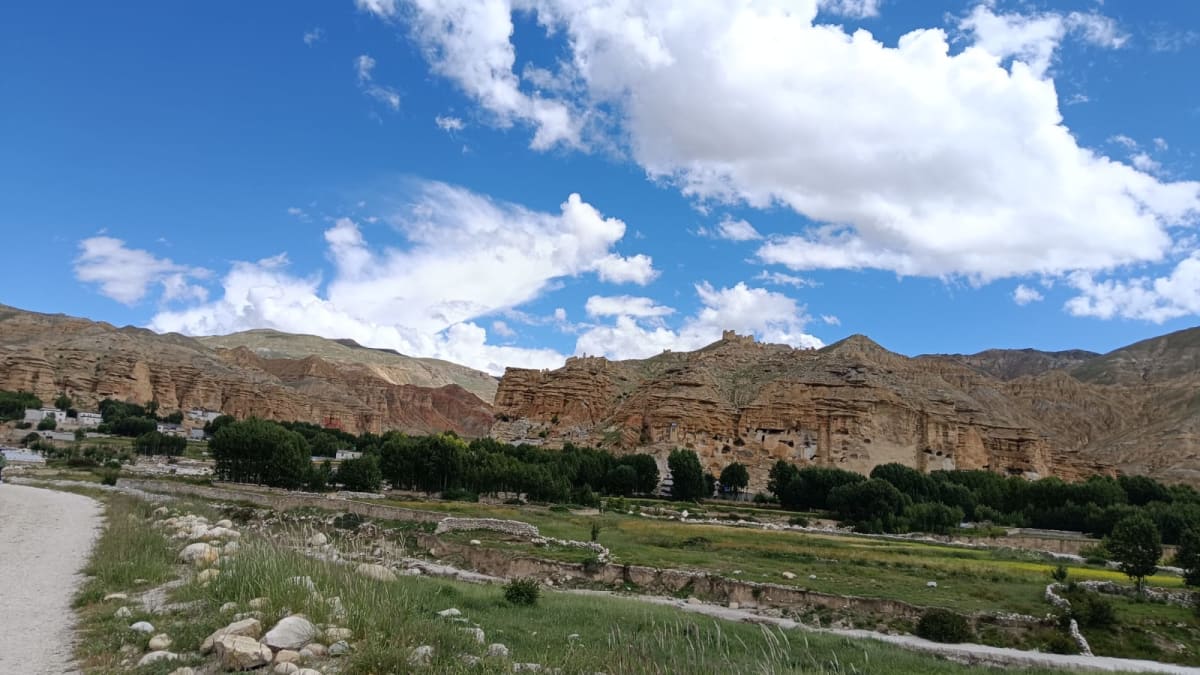
The trail from Tsarang over the Lo La to Lo Manthang on day 6 stayed completely dry underfoot, a hard-packed high-desert surface with none of the mud or leech activity the same week was producing on the Everest and Annapurna trails to the south. Temperatures at Lo Manthang's 3,840 m ran 20 C at midday and dropped to 8 C after dark, comfortable range for July and a full ten degrees warmer than a typical October night at the same elevation. The group's first view of the walled city came at 2 pm under a sky with not one cloud, the kind of visibility that only shows up in this specific season here.
Day 7: a rest day at Lo Manthang under a cloudless sky
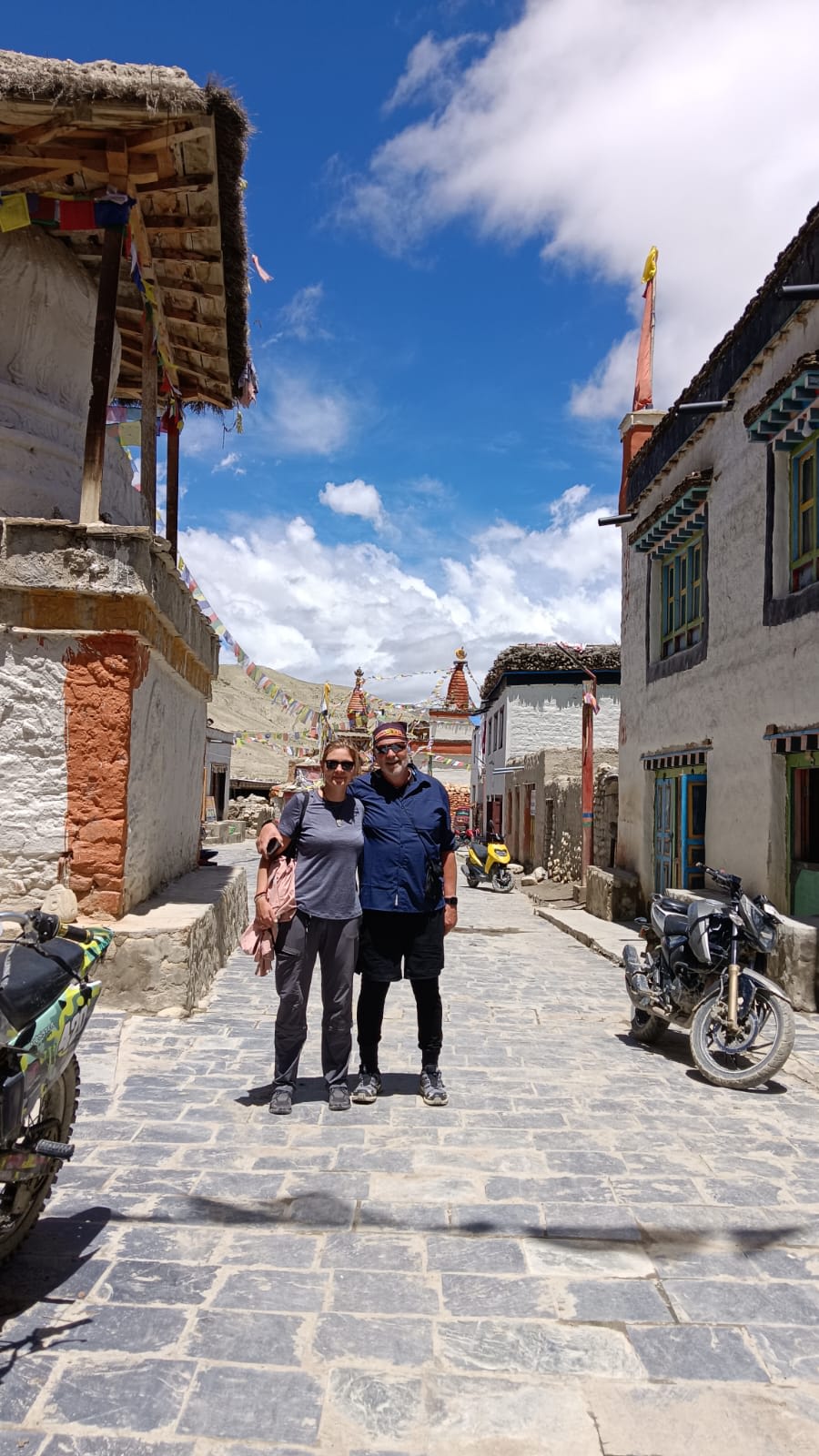
The scheduled exploration day at Lo Manthang on July 21 delivered exactly what the rain-shadow claim promises: full sun from sunrise to sunset, the 15th-century Jampa and Thubchen gompas lit clearly enough for real photography rather than flat monsoon light, and a sky-cave visit to Chhoser in the afternoon with the cliff dwellings sharp against blue sky the whole way. One client who had trekked the Annapurna Circuit in a previous July told me this was the first cloudless day she had had in Nepal in that month across two trips. That single comment is the reason I keep running July departures here rather than telling clients to wait for autumn.
Days 8 to 11: the return, and the wind holding its pattern
The return route through Dhakmar and Ghiling repeated the same rhythm exactly, calm mornings and a building afternoon wind, and by day 10 the group had stopped needing reminders to keep their buffs ready by 11 am. The Jomsom-Pokhara flight on day 11 left on time, no cloud on the northern side of the delay pattern that had caught us on day 1. Total rainfall for the trip: roughly 4 mm, both showers overnight at Ghami and Chhusang, neither reaching the trail during a walking day.
What this confirms for future July Mustang planning
One thing stands out after eight Mustang departures: the flight risk sits entirely on the Pokhara side of the mountains, not inside the restricted zone itself, and every itinerary here should keep a spare day at the start rather than the end. The Upper Mustang Trek page's rain-shadow numbers, 250 to 400 mm of annual rainfall against 2,000 mm south of the range, held up against this trip almost exactly, and Lo Manthang delivered the clear high-desert views the season promises. Clients weighing a monsoon window elsewhere in Nepal should read the rain-shadow treks during monsoon guide before assuming July means rain everywhere, and I'll keep filing one of these after each Mustang departure so the numbers stay current rather than resting on a single season's data.