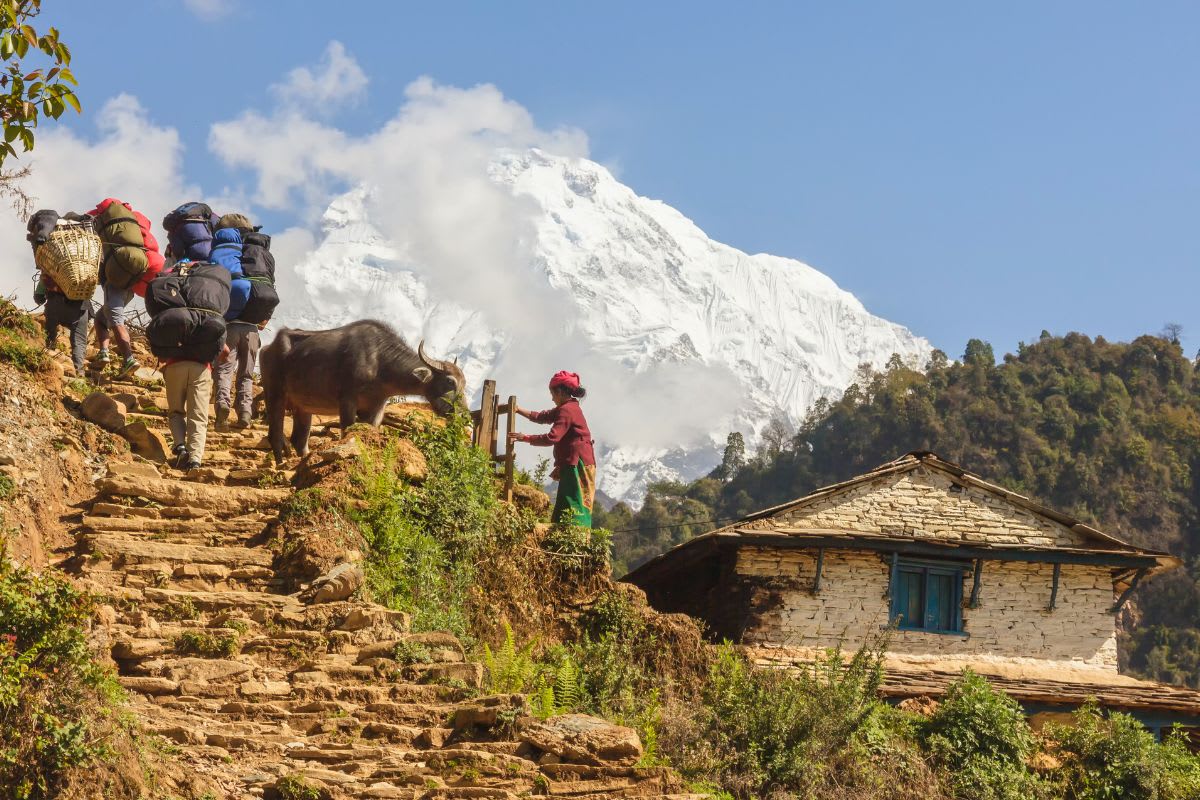
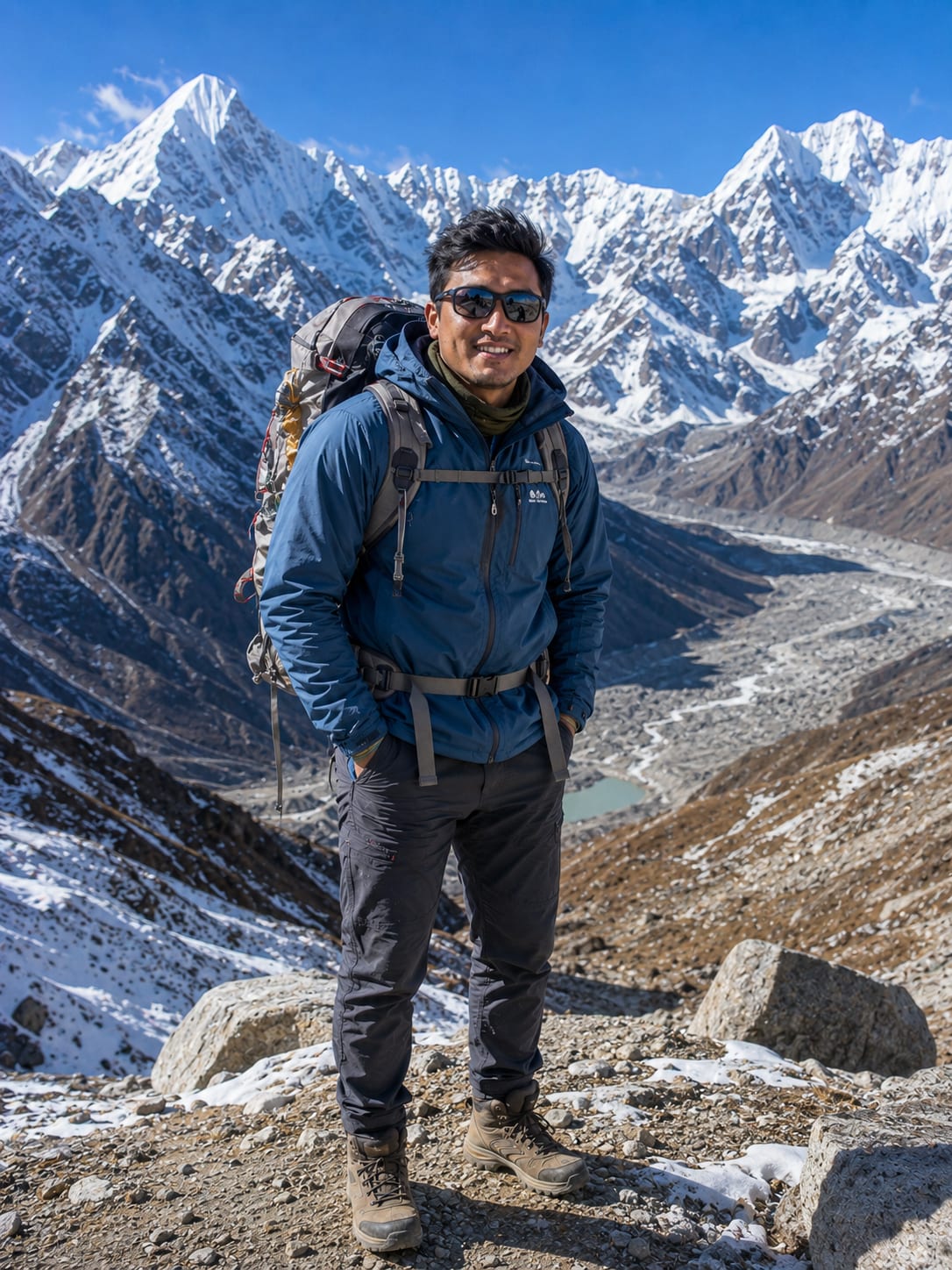

Porter wages and welfare on Nepal treks cover the daily pay, load-weight limits, insurance, and clothing an operator provides to the crew carrying trekking gear, standards that vary widely between operators and that a trekker can and should verify before booking. A fair porter daily wage in 2026 runs USD 15 to 25 depending on region and route difficulty, load limits should cap at 20 to 25 kg per porter under the International Porter Protection Group's guideline, and insurance covering high-altitude rescue is non-negotiable on any route above 4,000 m. Ramesh Rai, who manages permit and crew logistics for every departure this company runs, wrote this guide.
The sections below cover fair wage ranges, the load-weight guideline and why it matters, insurance and clothing standards, and the specific questions worth asking an operator before you book.
In this guide 7
- 01 What counts as a fair daily wage for a Nepal trekking porter?
- 02 What is the load-weight guideline, and why does it matter?
- 03 What insurance and clothing should an operator provide?
- 04 How do you verify an operator's porter standards before booking?
- 05 Why does this matter beyond the porters themselves?
- 06 What do our own porter standards look like route by route?
- 07 Does a higher trek price guarantee better porter standards?
What counts as a fair daily wage for a Nepal trekking porter?
A fair porter daily wage in 2026 runs USD 15 to 25 depending on the region and route difficulty, with restricted areas and higher-altitude routes at the top of that range because of the added risk and shorter working season. This wage covers a single trekking day and typically includes the porter's own food and lodging, which the operator arranges alongside the trekker's, rather than deducting from the daily rate.
Wages below this range are a real warning sign in Nepal's trekking industry, and an operator quoting a package price meaningfully cheaper than competitors on the same route is a common place that gap gets absorbed. Ask directly what a porter earns per day on your specific itinerary rather than accepting a general assurance that wages are "fair."
What is the load-weight guideline, and why does it matter?
The International Porter Protection Group recommends a maximum load of 20 to 25 kg per porter, a limit built around sustainable injury and altitude-illness risk over a multi-week trekking season rather than what a strong individual could carry once. Loads well above this figure, historically common before welfare standards improved industry-wide, increase both acute injury risk and the porter's own susceptibility to altitude sickness, since carrying a heavy load raises exertion and oxygen demand exactly where the margin is already thin.
On our departures, loads are weighed and split before departure so no single porter carries a client's full duffel plus shared gear alone, and the ratio of porters to trekkers is set to keep every individual load inside the IPPG range regardless of how much gear a group brings. A trekker packing light isn't just easier on themselves; it's a direct, checkable contribution to keeping porter loads inside a safe range.
What insurance and clothing should an operator provide?
Every porter on a route above 4,000 m should carry insurance covering high-altitude rescue and medical treatment, the same standard the helicopter evacuation insurance guide covers for trekkers themselves, since a porter's injury or altitude sickness risk doesn't disappear because they're crew rather than a client. This coverage should be arranged and paid by the operator, not left to the porter to self-insure on a daily wage that often doesn't stretch to cover it.
Cold-weather clothing, sunglasses, and appropriate footwear for the altitude are the second standard worth confirming: porters working the same high, cold terrain as trekkers need equivalent protection, and an operator that outfits its own clients well but sends porters up in inadequate gear isn't meeting a real welfare standard even if the wage looks fair on paper.
How do you verify an operator's porter standards before booking?
Ask three direct questions: what is the porter's daily wage on this specific route, what is the maximum load per porter, and does the operator provide rescue insurance and cold-weather gear to crew, not just trekkers. An operator with genuine standards answers these specifically and immediately; a vague or deflected answer is itself useful information.
A trekking agency that publishes its porter-to-trekker ratio and load limits as standard trip information, the way cost breakdowns and itinerary details are published, is showing the kind of operational transparency that correlates with actually following through on welfare standards rather than just claiming them. We publish ours for exactly this reason: it makes a verifiable claim rather than a marketing one.
Why does this matter beyond the porters themselves?
Fair porter treatment is a direct trust signal about how an operator runs every part of a trek, not a separate ethical add-on to evaluate independently from safety and quality. An operator willing to underpay or overload porters to cut costs is making the same kind of tradeoff that shows up elsewhere: thinner guide-to-client ratios, weaker safety protocols, and less reliable emergency response when something goes wrong on the trail.
Checking porter standards before booking is, practically, a proxy for checking the operator's overall seriousness, since welfare standards cost real money to maintain and a company cutting corners here is more likely cutting them elsewhere too.
What do our own porter standards look like route by route?
We publish route-level detail rather than a single company-wide figure, since wage and ratio genuinely vary by altitude and difficulty:
| Route | Typical daily wage (2026) | Porter-to-trekker ratio |
|---|---|---|
| Poon Hill, Ghorepani | USD 15-18 | 1 porter per 2 trekkers |
| Everest Base Camp | USD 20-25 | 1 porter per 1-2 trekkers |
| Annapurna Circuit | USD 18-22 | 1 porter per 2 trekkers |
| Manaslu Circuit (restricted) | USD 22-25 | 1 porter per 1-2 trekkers |
| Island Peak (climbing crew) | USD 25-30 | 1:1 above base camp |
Restricted-area and higher-altitude routes sit at the top of these ranges for the reasons covered above, and the ratio tightens on routes where a single porter carrying a heavier average load, colder gear, or climbing equipment isn't a fair ask. These figures are reviewed each season against the ranges the Trekking Agencies' Association of Nepal publishes, and adjusted upward, never down, when route conditions or fuel and food costs shift.
Does a higher trek price guarantee better porter standards?
Not automatically, which is why asking the three direct questions above matters more than trusting price alone as a proxy. A higher package price can reflect better porter welfare, but it can just as easily reflect a larger marketing budget, a foreign-currency processing markup, or simply a less efficient operation, none of which reach the crew. The only reliable signal is an operator that states its wage, load limit, and insurance coverage as specific, checkable numbers rather than a general claim of "fair treatment" or "ethical trekking," language that costs nothing to put on a website regardless of what it means on the trail.
FAQ
Common questions
What is a fair daily wage for a Nepal trekking porter?+
USD 15 to 25 per day in 2026, depending on region and route difficulty, with restricted areas and higher-altitude routes at the top of the range. This typically covers a single trekking day and includes the porter's food and lodging arranged by the operator. A wage well below this range on a specific itinerary is a warning sign worth asking about directly.
How much weight should a porter carry?+
The International Porter Protection Group recommends a maximum of 20 to 25 kg per porter, a limit set to manage injury and altitude-illness risk over a multi-week season rather than a single day's capability. Loads should be weighed and split before departure so no individual porter exceeds this range, regardless of how much gear a trekking group brings.
Do porters need travel insurance on high-altitude treks?+
Yes, on any route above 4,000 m a porter should carry insurance covering high-altitude rescue and medical treatment, arranged and paid by the operator rather than left to the porter's own daily wage. This is the same rescue-coverage standard trekkers themselves need, and a porter's altitude risk is not lower than a client's.
What should I ask an operator to verify their porter standards?+
Ask the porter's daily wage on your specific route, the maximum load per porter, and whether the operator provides rescue insurance and cold-weather gear to crew, not just clients. An operator with genuine standards answers these specifically; a vague or deflected response on any of the three is worth treating as a warning sign.