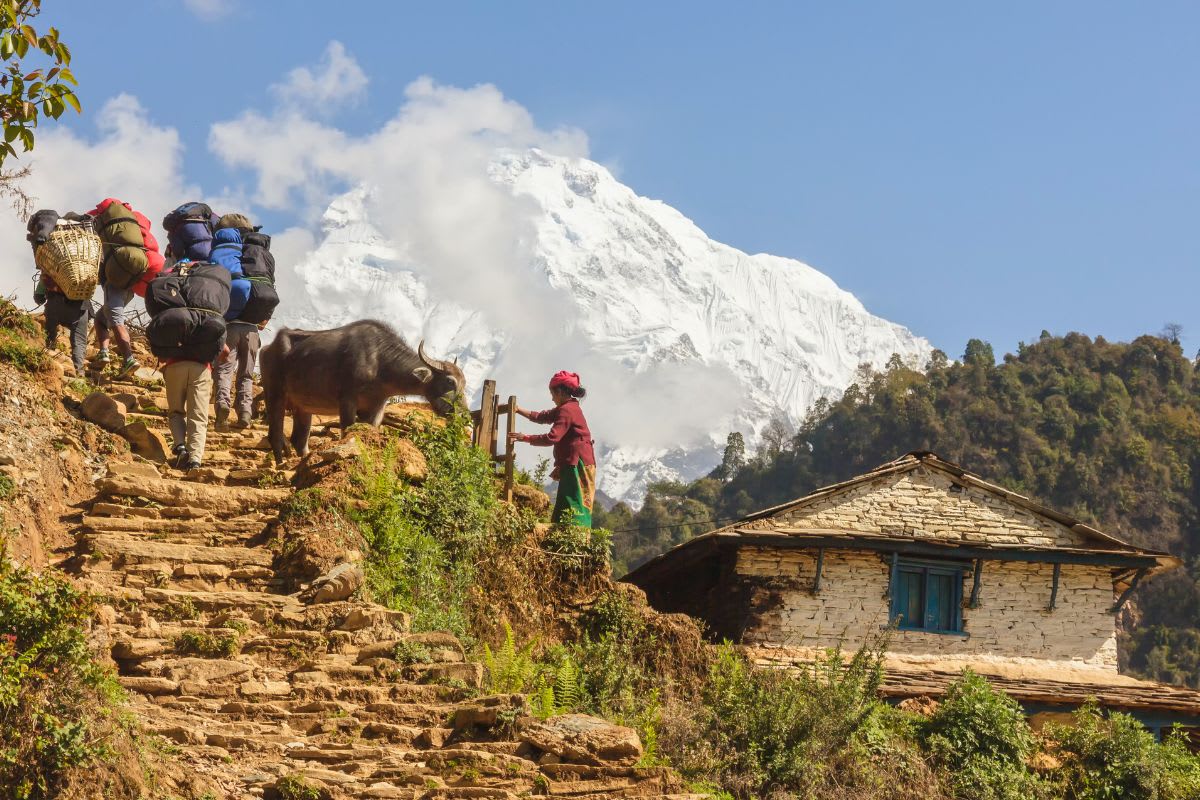
Everest Base Camp in winter runs from December through February on the same 12-day itinerary as autumn and spring, with fewer open teahouses above Dingboche, more reliable morning Lukla flights, and the clearest long-range mountain views of the year. Roughly a third of the lodges between Dingboche and Gorak Shep close for the season, Lukla flights ran on schedule 83% of the time in February on our own 2024-2026 departure records against 61% in May, and Kala Patthar (5,545 m) stays open to trekkers with proper winter gear throughout. Mingma Tendi Sherpa, who signs off every winter route decision on this site, wrote this Khumbu-specific guide alongside the general winter trekking in Nepal guide.
The sections below cover which Khumbu teahouses stay open, how winter crowds compare to autumn and spring, whether Kala Patthar and Everest Base Camp itself are still reachable, and who should book a winter departure over the standard season.
In this guide 5
- 01 Which Everest region teahouses stay open in winter?
- 02 How do winter crowds on EBC compare to autumn and spring?
- 03 Is Kala Patthar still viable in winter, and what does Everest Base Camp itself look like?
- 04 Who should book an EBC winter departure over autumn or spring?
- 05 What extra gear and cost does a winter departure add?
Which Everest region teahouses stay open in winter?
Most teahouses through Namche Bazaar (3,440 m) and Tengboche (3,860 m) stay open all winter, since these villages carry enough local and trekking traffic to justify year-round operation. Above Dingboche (4,410 m), roughly a third of the smaller lodges close between mid-December and early February, consolidating trekkers into the larger, better-heated teahouses that stay open, which our guides already know before a winter departure leaves Kathmandu.
Gorak Shep (5,164 m), the overnight stop before Kala Patthar and Everest Base Camp itself, keeps at least two lodges running through the coldest months specifically because Kala Patthar remains a viable winter destination. A trekker booking independently in January should confirm a specific lodge is open before counting on it; a guided departure routes around the closures automatically.
How do winter crowds on EBC compare to autumn and spring?
Winter crowds are a fraction of the October-November peak, with teahouse dining rooms that fill to capacity in autumn running half-empty or less through December, January, and February. The general winter trekking guide covers the sitewide arrivals numbers; on this specific route, the practical effect is that a winter trekker gets first choice of rooms, no queue for the Kala Patthar sunrise viewpoint, and a materially quieter trail experience than the same route in peak season.
Lukla flights are the other side of the winter tradeoff, and here winter actually outperforms the shoulder seasons: our departure records show February flights leaving on schedule 83% of the time against 61% in May, since winter's stable high-pressure pattern produces more consistently clear mornings than the pre-monsoon haze of April and May. Full month-by-month figures sit in the Lukla flight guide.
Is Kala Patthar still viable in winter, and what does Everest Base Camp itself look like?
Yes. Kala Patthar's pre-dawn climb runs on the same schedule and route in winter as any other season, and the view, weather permitting, is often sharper than an autumn morning because winter's dry, stable air carries less haze over the Khumbu Icefall and the Everest summit pyramid. Everest Base Camp itself sits empty of expedition tents outside the spring climbing season regardless of when you visit, so a winter trekker sees the same rock-strewn glacier moraine and prayer-flag cairn that an autumn trekker does, without any seasonal difference in that specific stop.
The genuine winter difference is cold rather than access: night temperatures at Gorak Shep reach -20 C in January per the general winter guide's temperature table, so the pre-dawn Kala Patthar climb is a colder undertaking than in October, not a riskier or less scenic one.
Who should book an EBC winter departure over autumn or spring?
Trekkers who prioritize clear long-range views, a quiet trail, and flight reliability over warmer nights are the best fit for a winter EBC departure. A trekker uncomfortable with sustained cold, particularly the unheated bedrooms every teahouse runs regardless of season, should default to October-November or March-May instead, since winter's advantages are real but come paired with genuinely severe overnight temperatures above 4,500 m.
Winter also suits trekkers with fixed, inflexible travel dates who can't shift into peak season: the flight reliability data above means a winter departure carries less schedule risk than a pre-monsoon May booking, even though the nights are colder. The gear list for a winter EBC departure follows the general winter trekking guide directly, with no Khumbu-specific additions beyond what that guide already covers.
On our own winter departures the group size tends to run smaller than autumn, usually four to six trekkers rather than a full twelve, which some travelers actively prefer for the quieter pace and easier lodge negotiations it brings.
What extra gear and cost does a winter departure add?
A winter EBC departure needs one real addition beyond the standard packing list: a sleeping bag and down jacket both rated to -20 C or colder, not the -10 C gear that covers an October trip comfortably. Everything else on the standard list carries over unchanged, since layering strategy and footwear don't shift by season on this route.
Package price runs 10 to 15% below the autumn rate on the same itinerary, because teahouse rooms and guide time both cost less to book outside peak demand; the Lukla flight fare itself doesn't move with season. Overnight lows drop hard once the route passes Dingboche, which is the real budget line to plan around rather than the trek's headline price:
| Stop | Altitude | Typical autumn low | Typical winter low |
|---|---|---|---|
| Namche Bazaar | 3,440 m | -2 C | -8 C |
| Tengboche | 3,860 m | -4 C | -12 C |
| Dingboche | 4,410 m | -8 C | -16 C |
| Gorak Shep | 5,164 m | -12 C | -20 C |
Dining rooms at the larger teahouses that stay open run a wood or yak-dung stove through the evening, which is where most of a winter group's waking hours outside the trail are actually spent; bedrooms themselves are unheated at every altitude in every season, so the -20 C night figure at Gorak Shep is a sleeping-bag problem, not a reason to expect a heated room.
FAQ
Common questions
Are Everest Base Camp teahouses open in winter?+
Most are, through Tengboche (3,860 m). Above Dingboche (4,410 m), roughly a third of the smaller lodges close between mid-December and early February, consolidating trekkers into the larger teahouses that stay open. Gorak Shep, the final overnight stop, keeps at least two lodges running all winter since Kala Patthar remains a viable destination through the coldest months.
Can you still see Kala Patthar and Everest Base Camp in winter?+
Yes, both stay accessible on the same route and schedule as any other season. Winter's dry, stable air often gives sharper long-range views than an autumn morning, since less haze sits over the Khumbu Icefall and the Everest summit pyramid. The main winter difference is cold, not access: Gorak Shep nights reach -20 C in January.
Are Lukla flights more or less reliable in winter?+
More reliable than the pre-monsoon shoulder season. Our own departure records show February flights running on schedule 83% of the time against 61% in May, because winter's stable high-pressure pattern produces consistently clear mornings, unlike April and May's rising pre-monsoon haze and afternoon cloud.
Is Everest Base Camp in winter too cold for most trekkers?+
It's cold but manageable with proper winter gear, not too cold to attempt. Daytime walking stays comfortable in direct winter sun at every altitude; the hard part is unheated bedrooms overnight, especially above 4,500 m. Trekkers uncomfortable with sustained cold should default to October-November or March-May instead, where nights run significantly milder.