Responsible trekking at Everest Base Camp means three concrete practices: paying and equipping porters to the load and wage standards set by porter-welfare organizations, packing out non-biodegradable waste rather than relying on village disposal, and following the customs Khumbu communities actually ask visitors to follow at monasteries and mani walls. None of these are abstract ideals; each has a specific, checkable standard behind it. Passang Dawa Sherpa, born in Phortse and our lead guide since 2008, wrote this guide from two decades operating in the region.
The sections below cover porter treatment, trail and lodge waste management, cultural etiquette at religious sites, and the questions worth asking an operator to check whether its responsible-trekking claims hold up in practice rather than existing only in marketing copy.
In this guide 7
- 01 What does responsible porter treatment actually require?
- 02 How should waste be managed on the trail?
- 03 What cultural customs should trekkers actually follow?
- 04 Does choosing a licensed local operator actually matter for responsible trekking?
- 05 What questions should I ask an operator to check their responsible-trekking claims?
- 06 What is fair tipping practice at the end of a trek?
- 07 How does firewood and lodge fuel use factor into responsible trekking?
What does responsible porter treatment actually require?
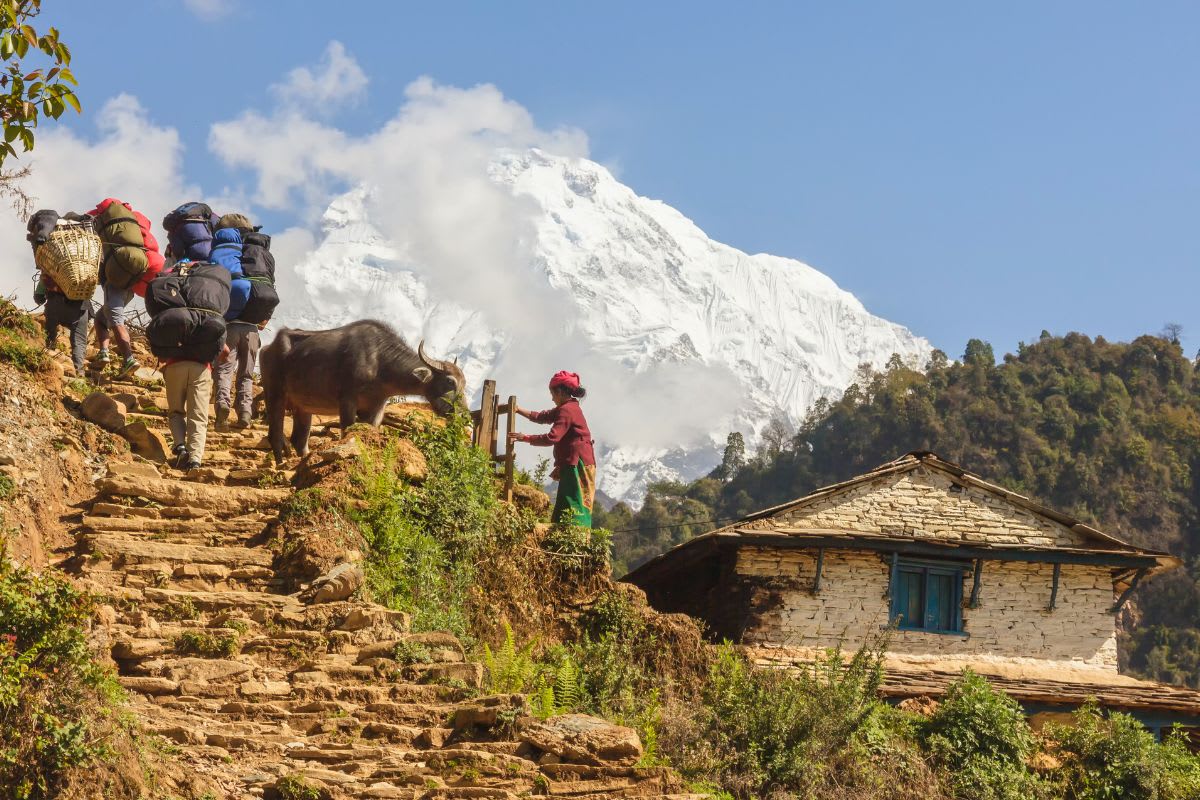
Responsible porter treatment means a load limit around 20 to 25 kg per porter, a fair daily wage, insurance coverage, and appropriate clothing and footwear for the altitude the porter is carrying to, standards set by organizations like the International Porter Protection Group. Overloading porters, common with budget operators competing purely on price, is the single most documented welfare failure in Himalayan trekking, since a porter carrying 40 or 50 kg at altitude faces real injury and cold-exposure risk that a client rarely sees firsthand.
The full detail on wage ranges, insurance requirements, and the questions to ask an operator sits in the porter wages and welfare guide. A trekker who asks their operator directly what a porter carries and earns, rather than assuming a low trip price includes fair treatment, is doing more for porter welfare than any pledge on a website.
How should waste be managed on the trail?
Non-biodegradable waste, plastic wrappers, bottles, batteries, should be carried out of the Khumbu rather than left at a village or burned locally, since Sagarmatha National Park's high-altitude villages have no municipal waste system capable of processing it. The Sagarmatha Pollution Control Committee, based in Namche Bazaar, has run cleanup and waste-management programs in the region since 1991 and now requires trekkers and expeditions to carry out non-biodegradable rubbish generated on the trail.
Our guides carry a rubbish bag for the group's plastic waste on every departure and confirm it leaves the valley with the trekking party rather than getting left at a lodge, a small habit that matters more than it sounds given how many trekkers pass through Namche in a single autumn season. Reusable water bottles paired with purification tablets, covered in the food and water guide, cut plastic bottle waste at the source, which several Khumbu municipalities now restrict selling specifically for this reason.
What cultural customs should trekkers actually follow?
Walk clockwise around mani walls, chortens, and stupas, keeping the structure on your right side, a Buddhist custom observed throughout the Khumbu and one local communities notice visitors ignoring more than almost any other etiquette point. Remove hats and speak quietly inside monasteries, ask before photographing monks or ceremonies in progress, and avoid touching prayer wheels or religious objects beyond spinning a prayer wheel clockwise if invited to.
These aren't arbitrary tourist rules; they reflect how Sherpa Buddhist communities actually practice their faith day to day, and following them costs a visitor nothing while genuinely mattering to the people whose home the trekking route passes through. A guide from the region, which is why Everest-region departures on this site are led by guides with direct Khumbu roots, can flag the specific etiquette that applies at each monastery or village rather than a generic list applied uniformly.
Does choosing a licensed local operator actually matter for responsible trekking?
Yes, concretely: a licensed Nepali operator employing local guides and porters keeps trekking income inside the communities the route passes through, rather than routing the bulk of a trip's cost to a foreign-based booking agency that subcontracts locally at a markup. Guide and porter wages, lodge bookings, and permit fees paid directly support Khumbu households when the operator itself is Nepal-based and Khumbu-connected.
This is a verifiable claim, not a marketing one: a trekker can ask any operator where guides and porters are from, whether wages are paid directly or through a subcontractor, and whether the company is TAAN-registered and NMA-affiliated, the same credentials covered in the Nepal trekking permits guide. An operator unwilling to answer these questions specifically is a signal worth taking seriously.
What questions should I ask an operator to check their responsible-trekking claims?
Ask an operator directly what a porter on your trek will carry in kilograms, what daily wage they're paid, whether porter insurance is included, and what the operator does with non-biodegradable waste generated on the trek. A specific, immediate answer with real numbers, rather than a vague reassurance, is the marker of an operator whose responsible-trekking practice is real rather than aspirational.
Our own porters carry a maximum of 25 kg per person, hold accident insurance for the duration of the trek, and are paid a daily wage set above the regional minimum recommended by porter-welfare groups, figures Ramesh Rai, our Permits and Logistics Manager, confirms on every departure roster before a group leaves Kathmandu. A trekker asking the same specific question of any operator, us included, should expect an equally specific answer.
What is fair tipping practice at the end of a trek?
Tipping is customary, not included in the trek price, and it's the part of responsible trekking most first-time trekkers get wrong by either under-tipping out of uncertainty or over-tipping in a way that distorts local wage expectations. A commonly used guideline on Everest region treks is 10 to 15% of the total trip cost split among the crew, with guides receiving a larger individual share than porters given the difference in responsibility, typically pooled and divided by the team rather than handed out unevenly by individual trekkers guessing at fair amounts.
Group departures usually pool tips into a single envelope presented to the guide on the last day in Lukla or Kathmandu, which the guide then splits among the crew according to role, a system that avoids the awkwardness of individual trekkers tipping individual staff members inconsistently. Trekkers uncertain what's appropriate should ask their guide directly partway through the trek rather than guessing at the end, since the honest answer varies by group size and trip length in a way no fixed number captures perfectly.
How does firewood and lodge fuel use factor into responsible trekking?
Above Namche, most teahouses have shifted from firewood to kerosene or gas for cooking and dining-room heating specifically because Sagarmatha National Park restricts and monitors firewood collection to protect the region's already-sparse high-altitude forest. Trekkers can support this shift directly by choosing lodges that use kerosene or gas over ones still burning wood, and by keeping dining-room stove use efficient, closing doors promptly, not requesting extra heating beyond what the group needs, since fuel above Namche is carried in at real cost and environmental impact.
This is a smaller lever than porter treatment or waste, but it compounds over thousands of trekkers a season, and it is exactly the kind of practical, checkable choice that separates responsible trekking from a general good intention.
FAQ
Common questions
How much weight should a porter carry on an Everest Base Camp trek?+
Porter-welfare organizations like the International Porter Protection Group recommend a load limit around 20 to 25 kg per porter. Overloading, common with budget operators, is the most documented welfare failure in Himalayan trekking, so asking an operator directly what a porter carries is a fair and useful question before booking.
What should I do with plastic waste on the trail?+
Carry non-biodegradable waste, plastic wrappers, bottles, batteries, out of the Khumbu rather than leaving it at a village or lodge, since Sagarmatha National Park's villages have no municipal system to process it. The Sagarmatha Pollution Control Committee in Namche Bazaar requires this, and most operators carry a group rubbish bag for exactly this purpose.
How should I behave at a monastery or mani wall?+
Walk clockwise around mani walls, chortens, and stupas, remove hats and speak quietly inside monasteries, and ask before photographing monks or ceremonies. These reflect how Sherpa Buddhist communities practice their faith daily, and following them costs nothing while genuinely mattering to local residents.
Does it matter if I book through a Nepal-based operator versus a foreign agency?+
Yes. A licensed Nepal-based operator employing local guides and porters keeps trekking income inside the communities the route passes through, rather than routing most of a trip's cost through a foreign booking agency that subcontracts locally at a markup. Asking where guides and porters are from and how they're paid is a fair way to check this.