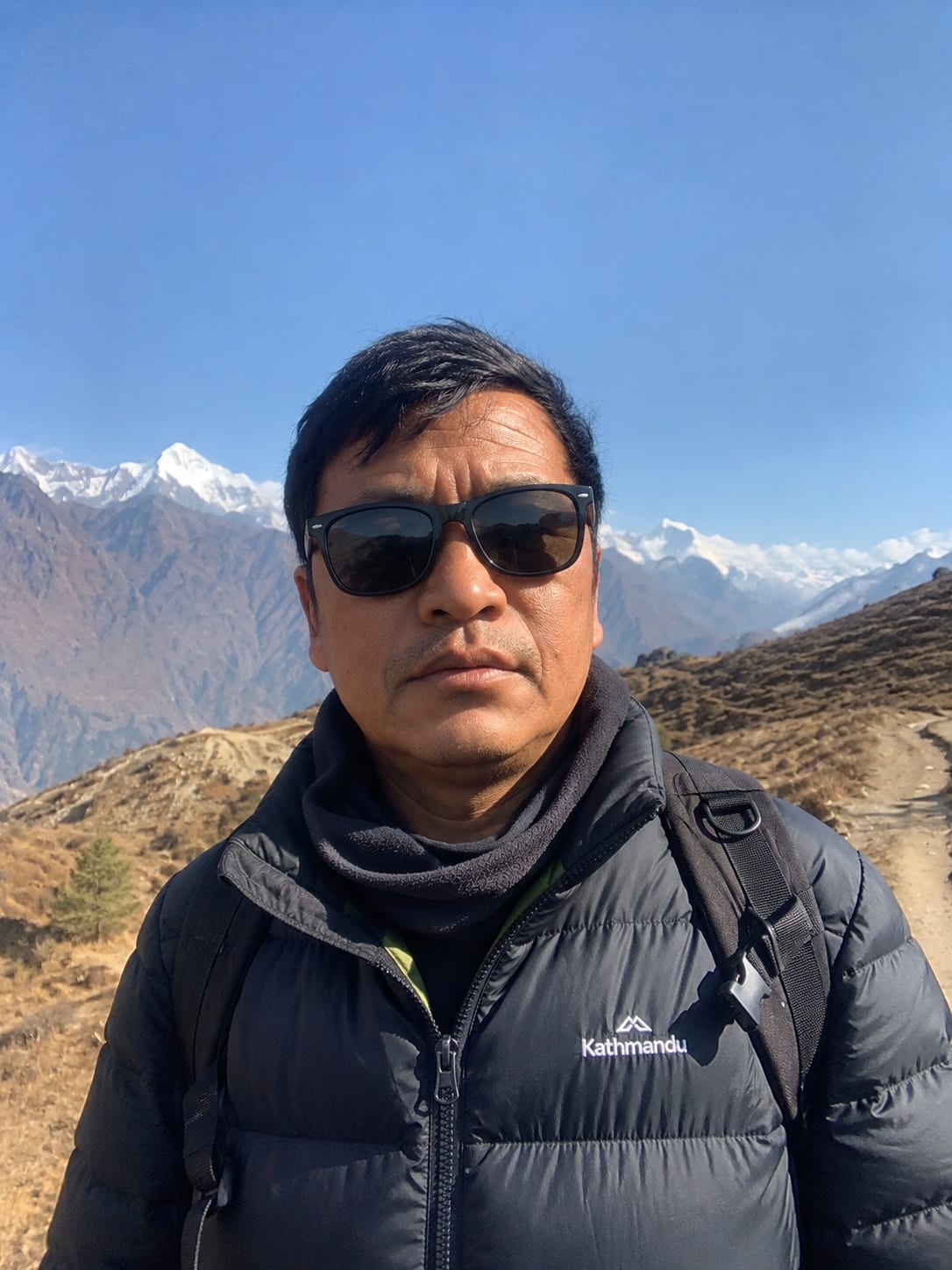
 Written & led by Mingma Sherpa
 Estimated per-person rate for this size — your guide confirms the exact quote.
The Upper Dolpo Circuit is an 18-day camping trek in Nepal's far-western rain shadow that runs from the Juphal airstrip through Shey Phoksundo National Park to Shey Gompa and crosses the Numa La (5,190 m) and Baga La (5,070 m) before looping back through Saldang and Dho Tarap. A 2026 group departure costs USD 2,900 to 3,600 per person, covering the Department of Immigration restricted-area permit (USD 500 for the first 10 days plus USD 50 per additional day), the Shey Phoksundo National Park entry (NPR 3,000), the full camping crew a lodge-free route requires, and the Kathmandu-Nepalgunj-Juphal flights at both ends. Mingma Tendi Sherpa, our Senior Guide and Safety Lead, plans the itinerary and crew for this route — it's the first bookable Dolpo trip on our route network, built directly from the permit, season, and logistics work our team has already done on the ground in the region.
Highlights
What our guides know that others don't.
Camping crew ratio
6-8 support staff per 8-trekker group beyond Ringmo, close to 1:1
Communication past Ringmo
Satellite phone standard safety kit; mobile coverage patchy to absent
What permits does the Upper Dolpo Circuit need?
Two permits cover this circuit: the Department of Immigration restricted-area permit at USD 500 for the first 10 days plus USD 50 for each additional day, and the Shey Phoksundo National Park entry at NPR 3,000. Since a full circuit runs 18 days with 8 to 12 of those days inside the restricted zone north of Ringmo, most groups pay the USD 500 base fee plus roughly USD 400 to 600 in extension days, totalling USD 900 to 1,100 in permit costs once the park fee is added. Both permits require a licensed Nepali guide and a registered-agency filing, with no liaison officer required and no second-trekker requirement since a March 2026 rule change, covered in full in the Dolpo restricted-area permit guide.
A registered agency files the restricted-area application directly with the Department of Immigration, the same one-working-day process used for Manaslu and Upper Mustang, so plan at least one working day in Kathmandu before flying to Nepalgunj and on to Juphal. The permit is priced and issued in fixed date blocks with no refund for early return, which is why our itineraries build one or two spare days into the paid window rather than filing for the exact planned length.
How much does the Upper Dolpo Circuit cost in 2026?
TAAN-registered operators quote USD 2,900 to 3,600 for a group Upper Dolpo departure in 2026, priced above every teahouse-based restricted route in Nepal, including Manaslu and Upper Mustang, because roughly half this circuit runs as a full camping trek. The table above breaks out where that cost goes: permits at USD 900 to 1,100, the four-sector Kathmandu-Nepalgunj-Juphal flight sequence at USD 400 to 550, and the camping crew and supply lines that a teahouse trek simply doesn't carry.
A quote noticeably below this band on Dolpo usually means the camping crew has been trimmed below the 6 to 8 support staff an 8-person group needs beyond Ringmo, which shows up on the trail as short food supplies or an undersized tent count at Shey Gompa and the high camps. The permit and flight costs are fixed regardless of operator, so the crew and equipment lines are where a cut-rate quote actually cuts.
Private departures cost more per person than the group rate, roughly USD 3,500 to 4,300, for the same reason group size matters on any camping trek: a small private party still needs close to the full six-to-eight-person support crew, so that fixed cost spreads across fewer trekkers. Comparing a Dolpo quote to the Manaslu Circuit's USD 1,500 to 2,100 group range in the Nepal trek costs guide is useful context, but the two routes aren't priced on the same basis: Manaslu's teahouse infrastructure absorbs a cost that Dolpo's camping crew has to carry directly.
| Upper Dolpo restricted-area permit + park entryUSD 500 base (10 days) + USD 50/day extension + NPR 3,000 park fee | $900–1100 |
| Kathmandu-Nepalgunj-Juphal flights, both waysFour short domestic sectors total | $400–550 |
| Licensed guide (mandatory, 18 days)USD 35-40/day | $630–780 |
| Camping crew: cook, kitchen assistants, porters/mules6-8 support staff for an 8-person group beyond Ringmo | $550–750 |
| Camping equipment, tents, and food supply12+ days without lodge resupply | $300–450 |
| Teahouse rooms and food, Juphal to Ringmo5-6 nights before the camping section begins | $80–140 |
| Company margin, satellite phone, logistics | $200–350 |
How difficult is the Upper Dolpo Circuit?
Strenuous is our grading: 215 km, roughly 8,500 m of cumulative ascent, walking days of 6 to 8 hours, and two pass crossings, the Numa La at 5,190 m and the Baga La at 5,070 m, on consecutive days with no lodge or resupply point between Shey Gompa and Saldang. Neither pass is technical, but both sit above 5,000 m on loose, exposed terrain, and the itinerary holds two dedicated acclimatization days, one at Ringmo (3,600 m) before the camping section begins and one at Shey Gompa, ahead of the double pass crossing.
Altitude management follows the same 500-m-per-day sleeping-altitude guideline used on every high route we operate, covered in the altitude sickness prevention guide, and our guides carry a pulse oximeter for twice-daily checks once the group passes Ringmo. A fitness benchmark worth taking seriously before booking: back-to-back 6 to 8 hour trekking days at altitude, on rough, ungraded trail, for close to three weeks, since there is no jeep or lodge shortcut once the circuit leaves Ringmo behind.
Insurance matters more here than on a teahouse trek, since helicopter evacuation from the terrain between Shey Gompa and Saldang, well beyond the nearest road or airstrip, is a genuinely more complex rescue than a pickup from a lodge-served route. We check every client's policy against the coverage criteria in helicopter evacuation insurance coverage before filing permits, and a policy covering evacuation to at least 5,500 m is mandatory on this departure, not a suggestion.
When is the best season for the Upper Dolpo Circuit?
May through October is Dolpo's trekking season, wider than the standard Nepal calendar, because the region sits in the Dhaulagiri rain shadow and stays largely dry through the June-to-September monsoon that washes out routes further south. The Numa La and Baga La hold their most reliable snow-free window from July through mid-October, and early-season attempts in May or June can still find winter snowpack lingering on the northern approach, detail covered fully in best season to trek Dolpo.
Winter, November through March, closes both passes under deep, unstable snow, and we run no full-circuit departures in that window. A July or August departure gives the widest safety margin on both crossings and, unusually for Nepal, is a genuine high season here rather than a compromise, since it's the low season on every route that isn't rain-shadow protected.
What crew does the Upper Dolpo Circuit need, and how does communication work on the trail?
An 8-person group travels with 6 to 8 support staff once the itinerary passes Ringmo: a cook, one or two kitchen assistants, and porters or pack animals sized to the group, a crew ratio close to one support member per trekker. This is the detail that separates a Dolpo circuit from a teahouse trek like Everest Base Camp or the Annapurna Circuit, where support staff needs are far lower, and it's the single biggest reason this route costs more per day than a lodge-based trek of similar length. Mules and yaks, hired locally in Dunai or Ringmo rather than brought from Juphal, carry the bulk food and tent loads for the camping section, the same local-hire pattern detailed on the sustainability page.
Mobile coverage is patchy at best from Ringmo onward and absent for long stretches near the passes, so every group carries a satellite phone as standard safety equipment once the camping section begins, the same practice used on Kanchenjunga and Nepal's other lodge-free restricted routes. This isn't an optional upgrade on our departures; it's how an emergency reaches Kathmandu without depending on village-to-village radio relay in terrain where the nearest teahouse may be a full trekking day away.
Does group size change the price of the Upper Dolpo Circuit?
Group size affects the per-person cost more sharply here than on a teahouse trek, because the fixed camping crew, cook, kitchen staff, and pack animals, gets shared across however many trekkers join a departure. A party of eight splits that fixed cost far more efficiently than a party of two, which is one reason our Dolpo departures target a group size well above the Department of Immigration's own two-trekker floor rather than running at the legal minimum.
This is a genuine structural difference from Everest Base Camp or the Annapurna Circuit, where a solo or two-person private departure adds a moderate premium over the group rate. On a camping route like this one, the same private-departure math applies to a fixed crew of six to eight people rather than to a single guide, so a small private group absorbs a proportionally larger share of costs that a full group departure spreads thin. Trekkers weighing a private Upper Dolpo departure against joining a scheduled group date should expect the price gap to be wider here than on any teahouse-based restricted route we run.
What wildlife might you see on the Upper Dolpo Circuit?
Shey Phoksundo National Park, which the entire route runs through, protects one of Nepal's most important snow leopard habitats, and Upper Dolpo's high, sparsely populated terrain around Shey Gompa and Crystal Mountain has hosted long-running snow leopard research and camera-trap studies precisely because sightings, while rare, are more plausible here than almost anywhere else in the country. Most trekkers won't see one directly; the animal is famously elusive even where its population density is highest, but guides on this route watch for and point out fresh tracks and scat in the snow near the high passes.
Blue sheep, known locally as bharal, are the more commonly sighted animal, grazing in herds on the slopes above Ringmo and along the approach to Shey Gompa, and they're also the snow leopard's primary prey species, so a bharal herd on a hillside is sometimes the first sign a guide reads before spotting other cat activity nearby. Himalayan tahr and, at lower elevations near Dunai and Ankhe, occasional Himalayan black bear sign round out the wildlife most groups encounter, alongside a range of high-altitude birdlife including the Himalayan griffon vulture, often visible circling the ridgelines above the Numa La and Baga La.
What should you pack for the Upper Dolpo Circuit?
Dolpo's packing list starts from the same four-season sleeping bag and layered clothing base covered in the Nepal trekking packing list, rated to at least -15 C comfort since teahouse rooms to Ringmo and tents beyond it are both unheated. Add a wider temperature margin than a standard teahouse trek: nights at the high camps near Numa La and Baga La run colder than a lodge room at equivalent altitude, since a tent offers less insulation than a stone-and-timber teahouse.
Camping-specific additions matter here beyond the standard list: a closed-cell foam sleeping pad as backup to an inflatable mat (punctures have no easy fix mid-circuit), a headlamp with spare batteries for the pre-dawn pass-crossing starts, and sun protection for the high-altitude, low-humidity stretch between Shey Gompa and Saldang, where UV exposure runs higher than the forested lower valleys.
Waypoints mark named stops on the route; the line between them is a straight-line approximation, not a surveyed trail. Map data © OpenStreetMap contributors.
Day by Day
18-day itinerary, every detail planned.
A 55-minute flight reaches Nepalgunj, a lowland city near the Indian border, where the group overnights ahead of the Juphal sector. This first leg runs on the main domestic network, so delays here are rare compared with the mountain sectors ahead.
What's Included
Transparent, all-in pricing.
Included in your price
Not included
Why Nepal Travel Packages
Built on published proof, not adjectives.
A named, licensed guide before you book
Full name, photo, NMA or TAAN license number, and a direct WhatsApp line. The guide on the page is the guide on the trail.
Itemized pricing, not a lump sum
Permits, guide, porter, lodging, and food broken out on every trip page. You see exactly where the price comes from.
Trail conditions updated monthly
Dated field reports from the guides running the route this season, not boilerplate written once and left to go stale.
Permits handled, not hidden
Every permit fee, checkpoint, and paperwork rule is filed for you and published in the guides — no surprise admin at Lukla.
Keep exploring
Related packages
Planning
Related guides
FAQ
Common questions
Can I trek the Upper Dolpo Circuit solo?+
No. The Department of Immigration issues the Upper Dolpo restricted-area permit only to groups of two or more trekkers with a licensed guide, the same floor as Manaslu and Upper Mustang. Solo travelers join one of our scheduled group departures, covered in the Dolpo restricted-area permit guide.
Does the Upper Dolpo Circuit use teahouses or camping?+
Both, in sequence. Juphal to Ringmo runs on teahouses and homestays, roughly 5-6 nights, but the route beyond Ringmo toward Shey Gompa and over the Numa La and Baga La has no lodge infrastructure, so the remaining 12 or more nights run as a full camping trek with a dedicated cook and kitchen crew.
How high does the Upper Dolpo Circuit go?+
The high point is the Numa La at 5,190 m, crossed the day after the Baga La at 5,070 m, Dolpo's two main passes. Both sit above 5,100 m combined difficulty terrain-wise, and the itinerary holds two acclimatization days, at Ringmo and Shey Gompa, before either crossing.
When is the best time to trek Upper Dolpo?+
May through October, with the passes most reliably snow-free from July through mid-October. Dolpo sits in the Dhaulagiri rain shadow, so it trades the standard Everest and Annapurna season for a window that includes the monsoon months, detailed in best season to trek Dolpo.
How does the Upper Dolpo Circuit compare to Manaslu or Upper Mustang?+
Dolpo costs more per day than either because roughly half the route runs as a camping trek rather than teahouse-to-teahouse, and its Numa La and Baga La sit higher than Upper Mustang's passes. It shares the two-trekker, licensed-guide requirement with both regions but needs a larger support crew once the trail leaves Ringmo, covered fully in Dolpo trek logistics.
Is there phone signal on the Upper Dolpo Circuit?+
Coverage is patchy at best from Ringmo onward and absent for long stretches near the passes. Every group carries a satellite phone as standard safety equipment for the camping section, so an emergency can reach Kathmandu without relying on village-to-village radio relay.
What does the Upper Dolpo Circuit cost beyond the permit fees?+
Permits run USD 900 to 1,100, but flights, the camping crew, and equipment add the rest of the USD 2,900 to 3,600 group price: roughly USD 400 to 550 for the four-sector Kathmandu-Nepalgunj-Juphal flights, USD 550 to 750 for the cook and porter crew, and USD 300 to 450 for camping equipment and food supply carried past Ringmo. The full line-item breakdown sits in the cost table above.
How does the Upper Dolpo Circuit compare to a Kanchenjunga trek?+
Both run largely as camping treks with a similar crew-to-trekker ratio and a comparably long, remote approach, though Kanchenjunga's Bhadrapur-Taplejung access differs from Dolpo's Nepalgunj-Juphal flight route. Dolpo's restricted-area permit is priced by the day (USD 500 base plus USD 50 per extra day) rather than Kanchenjunga's flat USD 20 per week, so the two regions' permit costs don't compare on a like-for-like basis without factoring in each circuit's actual length.
Will I see a snow leopard on the Upper Dolpo Circuit?+
Unlikely but genuinely possible. Shey Phoksundo National Park is one of Nepal's most important snow leopard habitats and has hosted long-running research in the area around Shey Gompa and Crystal Mountain, though the animal is elusive even where its population density is highest. Blue sheep, the snow leopard's main prey, are far more commonly sighted, grazing on the slopes above Ringmo and toward Shey Gompa.