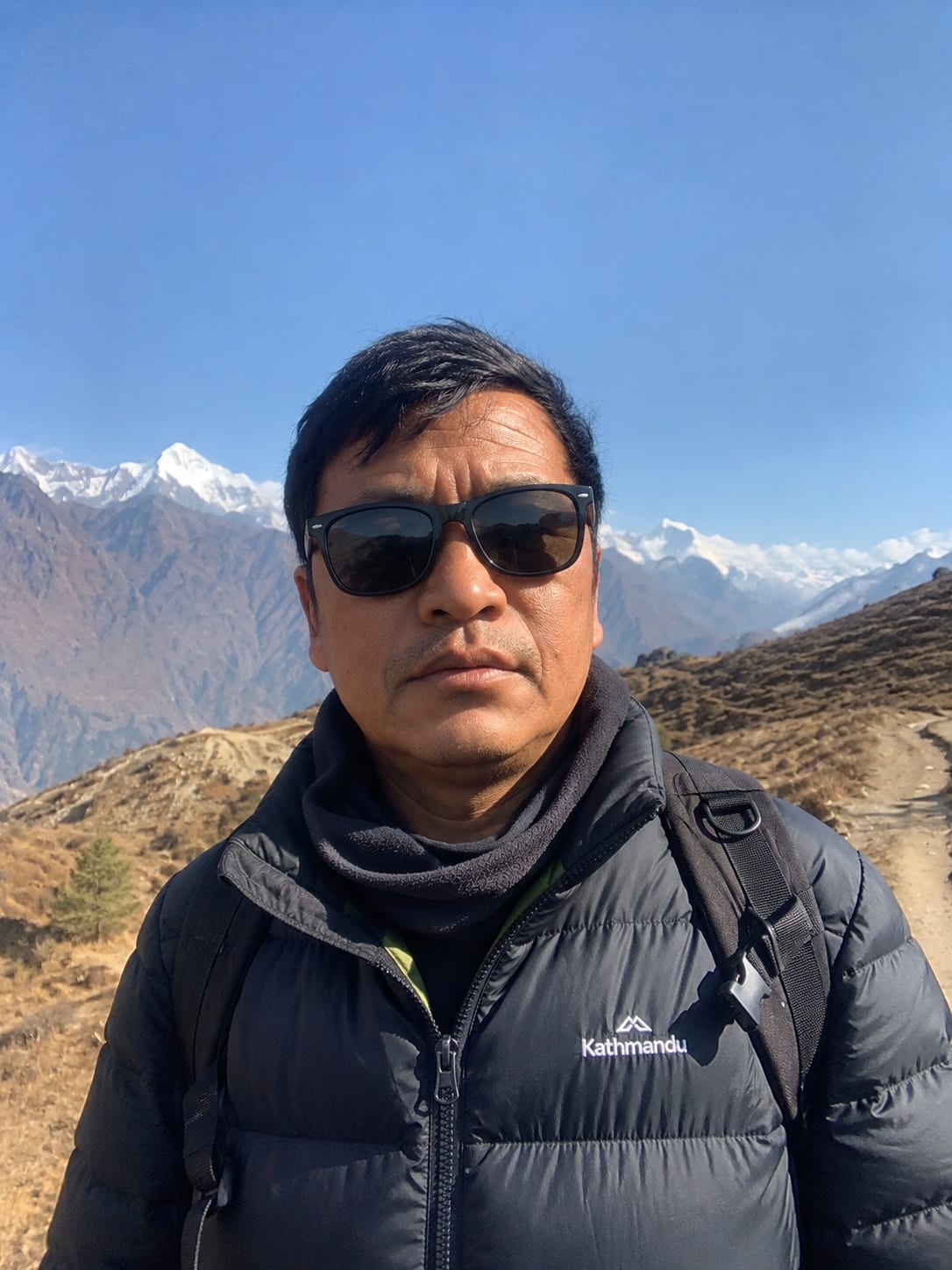
 Written & led by Mingma Sherpa
 Estimated per-person rate for this size — your guide confirms the exact quote.
The Lower Dolpo Phoksundo Lake Trek is a 10-day teahouse trek from the Juphal airstrip to Shey Phoksundo Lake, Nepal's deepest lake, that needs only standard national park entry rather than the restricted-area permit and full camping crew the Upper Dolpo Circuit requires. A 2026 group departure costs USD 1,400 to 1,900 per person, covering the Shey Phoksundo National Park entry (NPR 3,000), a licensed guide, teahouse and homestay accommodation for every night on the trail, and the Kathmandu-Nepalgunj-Juphal flights at both ends. Mingma Tendi Sherpa, our Senior Guide and Safety Lead, plans this route alongside the full Upper Dolpo Circuit as our Dolpo departures come online.
This is the second bookable Dolpo trip on our route network, built as the accessible counterpart to the Upper Dolpo Circuit — same rain-shadow season, same Juphal approach, without the restricted-area permit or camping crew the longer route requires.
Highlights
What our guides know that others don't.
Cost vs. Upper Dolpo Circuit
Roughly half the price of the full 18-day circuit, for the same flight sequence and the region's signature lake
Solo-friendly
No minimum group size, unlike every restricted-area route in Dolpo, Kanchenjunga, or Upper Mustang
Why does this route need no restricted-area permit?
A restricted-area permit only applies once a Dolpo itinerary crosses north of Ringmo toward Shey Gompa, Saldang, and the high passes covered in the Upper Dolpo Circuit. This trek turns back at Ringmo and Phoksundo Lake, so it only needs the Shey Phoksundo National Park entry at NPR 3,000, the same park fee that applies to both routes, with no Department of Immigration paperwork, no minimum group size, and no liaison-officer requirement on top. The Dolpo restricted-area permit guide covers the full two-tier system this route sits on the simpler side of.
This distinction matters for planning because it changes who can book: a solo traveler can join this trek without waiting to be paired into a two-person minimum group, unlike the Upper Dolpo Circuit or any restricted-area route in Kanchenjunga or Upper Mustang. The park entry permit is arranged either in advance through the agency or in person at the Dunai park office on day 2 or 3 of the trek, and unlike a restricted-area filing it needs no advance passport lodging with the Department of Immigration in Kathmandu, so a booking decided closer to departure is genuinely workable here in a way it isn't on the full circuit.
How much does the Lower Dolpo Phoksundo Lake Trek cost in 2026?
TAAN-registered operators quote USD 1,400 to 1,900 for a group departure in 2026, roughly half the USD 2,900 to 3,600 the full Upper Dolpo Circuit costs, for the same flight sequence and the region's best-known landmark. The cost table above breaks out where that goes: the four-sector Kathmandu-Nepalgunj-Juphal flights at USD 400 to 550 (identical to the Upper Dolpo Circuit, since both routes start and end at Juphal), a licensed guide, and teahouse accommodation and meals for every night on the trail.
The flight sequence is the single biggest fixed cost on this shorter trek, proportionally larger than on the 18-22-day circuit because there are fewer trekking days to spread it across. A trekker comparing this route's per-day cost to a teahouse trek with road access, like Langtang Valley at USD 650 to 950, should factor in that Dolpo's remote small-aircraft flights cost meaningfully more than road transport, even though both routes share the same teahouse-based accommodation model. Private departures run USD 1,700 to 2,300, a smaller premium over the group rate than on the Upper Dolpo Circuit, since a teahouse trek's fixed costs (permit, guide) don't scale with camping-crew size the way the full circuit's do.
| Trek | Days | Access | Group price (2026) |
|---|---|---|---|
| Langtang Valley | 7-10 | Road, no flight | USD 650-950 |
| Lower Dolpo Phoksundo Lake | 8-12 | Two-flight Juphal sequence | USD 1,400-1,900 |
| Upper Dolpo Circuit | 18-22 | Same flights, plus camping crew | USD 2,900-3,600 |
Reading this trek against that range, the flight sequence alone accounts for most of the gap against a road-accessible route of similar length, and it's the reason a short Dolpo trip never prices down to Langtang levels even though both are teahouse-based.
| Shey Phoksundo National Park entryNPR 3,000 at 2026 rates, no second permit required | $23 |
| Kathmandu-Nepalgunj-Juphal flights, both waysFour short domestic sectors total, same route as the Upper Dolpo Circuit | $400–550 |
| Licensed guide (10 days)USD 35-40/day | $280–480 |
| Teahouse and homestay accommodation, full trekEvery night on lodge infrastructure, no camping crew needed | $150–260 |
| Meals, full boardDal bhat and teahouse menu pricing rises with remoteness past Dunai | $200–320 |
| Company margin and logistics | $150–250 |
What makes Shey Phoksundo Lake worth the flights?
Shey Phoksundo Lake is Nepal's deepest lake at 145 m, formed by a natural dam of glacial debris, and its turquoise color comes from suspended glacial minerals rather than algae or reflected sky, a genuine geological feature rather than a photography trick. The lake sits inside Shey Phoksundo National Park, established in 1984 specifically to protect this basin and the trans-Himalayan terrain around it, and Ringmo village on its southern shore carries a centuries-old Bon monastery alongside a Buddhist gompa, a rare pairing that reflects Dolpo's mixed religious history more directly than most single-tradition sites elsewhere in Nepal.
A seasonal waterfall drops from the ridge above the lake's outlet, among the taller falls in Nepal when spring meltwater is running, and the day-6 exploration built into this itinerary includes a walk to the viewpoint when trail conditions allow. Snow leopard and blue sheep both inhabit the surrounding high terrain, though sightings are rare and never promised as part of a scheduled itinerary; guides point out fresh tracks and signs when the group crosses them rather than building an expectation of a direct encounter.
This combination, deepest lake, working monastery on its shore, genuine trans-Himalayan wilderness, is what the flight sequence and the trek's cost premium over a road-accessible route like Langtang Valley actually buys. It is also most of what the full Upper Dolpo Circuit delivers in its first five days, before that route continues north into terrain this shorter trek deliberately doesn't attempt.
How difficult is the Lower Dolpo Phoksundo Lake Trek, and who is it suited for?
Moderate is our grading: 96 km, roughly 3,200 m of cumulative ascent, walking days of 5 to 7 hours, and a maximum altitude of 3,600 m at Ringmo, well below the passes and camping sections that make the Upper Dolpo Circuit strenuous. No technical terrain and no high-pass crossing are involved, and the route stays on established teahouse trail the entire way, mostly packed dirt and stone through pine forest along the Thuli Bheri river rather than the loose scree or glacial moraine a high-pass route crosses.
Altitude risk is genuinely lower here than on most of Nepal's trekking classics; 3,600 m sits below the altitude where AMS becomes a serious planning concern for most trekkers, covered in the altitude sickness prevention guide, though the same 500-m-per-day sleeping-altitude guideline still applies on the approach to Ringmo, and our itinerary holds that gain under 500 m on day 5. A reasonable fitness benchmark: consecutive days of 5 to 7 hours walking on ungraded mountain trail, comparable to a moderate teahouse trek like Gosaikunda or the Annapurna Base Camp route rather than to Everest Base Camp or the Annapurna Circuit's longer daily stages.
This trek suits a trekker who wants Dolpo's remoteness and Shey Phoksundo Lake specifically, without the altitude exposure, camping logistics, or three-week time commitment the full circuit demands. It's a genuine mismatch for someone chasing a high-pass mountaineering objective, who is better served by the Upper Dolpo Circuit or Kanchenjunga North Base Camp Trek, and it's a strong fit for a trekker whose available days or altitude tolerance rule those routes out but who still wants a genuinely remote destination rather than a busier standard trail.
When is the best season for the Lower Dolpo Phoksundo Lake Trek?
May through October is Dolpo's core trekking season, the same rain-shadow window that applies to the Upper Dolpo Circuit, since the region sits behind the Dhaulagiri massif and stays largely dry through the monsoon that closes routes further south, detail covered fully in best season to trek Dolpo. Because this route stays below 3,600 m and never approaches Dolpo's high passes, it also has a wider shoulder-season window than the full circuit: March-April and November are viable here even though they carry lingering snow risk on Numa La and Baga La further north.
Winter, December through February, is possible on this lower route in a way it isn't on the full circuit, though cold temperatures at Ringmo and reduced teahouse operating hours make it a less comfortable choice than the May-to-October window. Most of our departures still run in the core season for the most reliable Juphal flight conditions and the fullest teahouse service.
How does this route compare to the full Upper Dolpo Circuit?
Both routes share the same first five days, Juphal to Dunai to Ankhe to Sulighat to Ringmo, so the choice comes down to whether Phoksundo Lake itself is the goal or a waypoint on a longer restricted-area circuit. This trek turns back at Ringmo after a day or two exploring the lake; the Upper Dolpo Circuit continues north through Shey Gompa and over the Numa La and Baga La before looping back through Saldang, roughly doubling the trip length and adding the restricted permit, camping crew, and satellite-phone requirement that route needs.
For a trekker with limited time, a smaller budget, or no interest in a two-week camping section, this route delivers Dolpo's defining landscape, the lake, the Ringmo gompa, the Thuli Bheri valley, at roughly half the cost and half the commitment. For a trekker who wants Dolpo's full remote-region experience, including Shey Gompa near Crystal Mountain and the high passes, the full circuit is the route that earns that. Both share the same guide, Mingma Tendi Sherpa, and the same flight logistics, so switching between them mid-planning, before permits are filed, is a straightforward conversation rather than a full itinerary rebuild.
Communication is one more practical difference worth naming: mobile coverage on this route stays reasonably available through Dunai and improves again near Ringmo's village center, unlike the patchy-to-absent coverage the Upper Dolpo Circuit runs into once it pushes north past Ringmo into the restricted zone. A satellite phone, standard safety kit on the full circuit's camping section, isn't a requirement here, since this trek never leaves an area where a village or teahouse is within a day's walk.
What should you pack for the Lower Dolpo Phoksundo Lake Trek?
This route follows the same core packing list covered in the Nepal trekking packing list: a four-season sleeping bag rated to at least -15 C comfort, since teahouse rooms this remote have no heating, layered clothing, and broken-in waterproof boots. Because this trek never leaves teahouse infrastructure, the camping-specific additions the Upper Dolpo Circuit needs, a backup sleeping pad, an extended cold-weather margin for tent nights, aren't necessary here.
Sun protection matters on the open trail sections along the Thuli Bheri river and around the lake, where UV exposure runs higher than in forested lower valleys, and a headlamp is worth carrying for the pre-dawn Juphal flight departure on both ends of the trip.
Cash in Nepali rupees should cover the full trip, since no ATM serves Dunai or Ringmo, and teahouse charging runs on limited solar or generator power once past Dunai, so a spare power bank is worth the extra weight rather than counting on a wall outlet every night. A printed or offline map is a sensible backup too, given how thin mobile data coverage runs beyond Dunai even where voice signal holds.
Waypoints mark named stops on the route; the line between them is a straight-line approximation, not a surveyed trail. Map data © OpenStreetMap contributors.
Day by Day
10-day itinerary, every detail planned.
A 55-minute flight reaches Nepalgunj, a lowland city near the Indian border, where the group overnights ahead of the Juphal sector. Nepalgunj's flat, humid Terai climate is a deliberate contrast to the mountain terrain ahead, and the overnight here exists purely to catch an early-morning Juphal departure, since that sector flies only in the day's first clear window.
What's Included
Transparent, all-in pricing.
Included in your price
Not included
Why Nepal Travel Packages
Built on published proof, not adjectives.
A named, licensed guide before you book
Full name, photo, NMA or TAAN license number, and a direct WhatsApp line. The guide on the page is the guide on the trail.
Itemized pricing, not a lump sum
Permits, guide, porter, lodging, and food broken out on every trip page. You see exactly where the price comes from.
Trail conditions updated monthly
Dated field reports from the guides running the route this season, not boilerplate written once and left to go stale.
Permits handled, not hidden
Every permit fee, checkpoint, and paperwork rule is filed for you and published in the guides — no surprise admin at Lukla.
Keep exploring
Related packages
Planning
Related guides
FAQ
Common questions
Do I need a restricted-area permit for the Lower Dolpo Phoksundo Lake Trek?+
No. This route stays south of Ringmo, so it needs only the Shey Phoksundo National Park entry at NPR 3,000. The restricted-area permit applies only to itineraries continuing north toward Shey Gompa and the high passes, covered on the Upper Dolpo Circuit.
Can I trek to Phoksundo Lake solo?+
Yes. Unlike the Upper Dolpo Circuit, Manaslu, or Upper Mustang, this route carries no minimum group size, since it doesn't require a restricted-area permit. A licensed guide is still required for the trek.
Does this trek use teahouses or camping?+
Teahouses and homestays every night, with no camping required at any point. This is the key practical difference from the Upper Dolpo Circuit, which needs a full camping crew beyond Ringmo.
How does the cost compare to the full Upper Dolpo Circuit?+
Roughly half: USD 1,400 to 1,900 for this route against USD 2,900 to 3,600 for the full circuit. Both share the same flight sequence and the same first five trekking days; the price gap comes entirely from the restricted permit and camping crew the longer route needs beyond Ringmo.
How high does this trek go?+
The high point is Ringmo and Phoksundo Lake at 3,600 m, well below the Upper Dolpo Circuit's 5,190 m pass crossings and below the altitude where AMS becomes a major planning concern for most trekkers.
When is the best time for the Lower Dolpo Phoksundo Lake Trek?+
May through October, the same rain-shadow window that covers all of Dolpo. Because this route stays below 3,600 m, March-April and November are also viable here, a wider window than the full circuit's passes allow.
Can I combine this trek with the Upper Dolpo Circuit?+
Yes, since both routes share the same first five days, Juphal to Ringmo. A trekker can start on this itinerary and extend north into the restricted zone if a restricted-area permit is arranged in advance; message your guide before booking if you want this option kept open, since the permit paperwork needs to be filed before departure, not decided partway through the trail.
Is the Lower Dolpo Phoksundo Lake Trek suitable for a first-time trekker?+
Yes, with reasonable fitness for 5 to 7 hour walking days on ungraded mountain trail. The lack of technical terrain, high passes, or serious altitude exposure makes this a more approachable introduction to Nepal's remote regions than Kanchenjunga or the full Upper Dolpo Circuit, though it still requires two flight sectors each way, real physical effort, and comfort with basic, simple teahouse accommodation well off Nepal's standard trekking corridors.
What is Shey Phoksundo Lake known for?+
It's Nepal's deepest lake at 145 m, with a distinctive turquoise color from suspended glacial minerals rather than reflected sky. Ringmo village on its shore holds a centuries-old Bon monastery alongside a Buddhist gompa, and a seasonal waterfall near the outlet is among the taller falls in Nepal during spring meltwater, best seen when spring snowmelt is feeding it directly.
Do I need travel insurance for this trek?+
Yes. Even though this route carries lower altitude risk than the Upper Dolpo Circuit, its remoteness from any road or hospital means a policy covering emergency evacuation is still essential, not optional, the same standard this site applies to every Nepal departure regardless of altitude ceiling.
Is there phone signal on the Lower Dolpo Phoksundo Lake Trek?+
Reasonably, through Dunai and again near Ringmo village center, unlike the patchy-to-absent coverage the Upper Dolpo Circuit runs into once it pushes north of Ringmo. A satellite phone isn't standard kit on this route, since a village or teahouse is always within a day's walk.
What wildlife might I see on this trek?+
Blue sheep and, rarely, snow leopard inhabit the high terrain around Shey Phoksundo National Park, though sightings are never guaranteed. Guides point out tracks and signs when the group crosses them along the trail, but no specific encounter is promised as part of the itinerary or built into the daily schedule.