
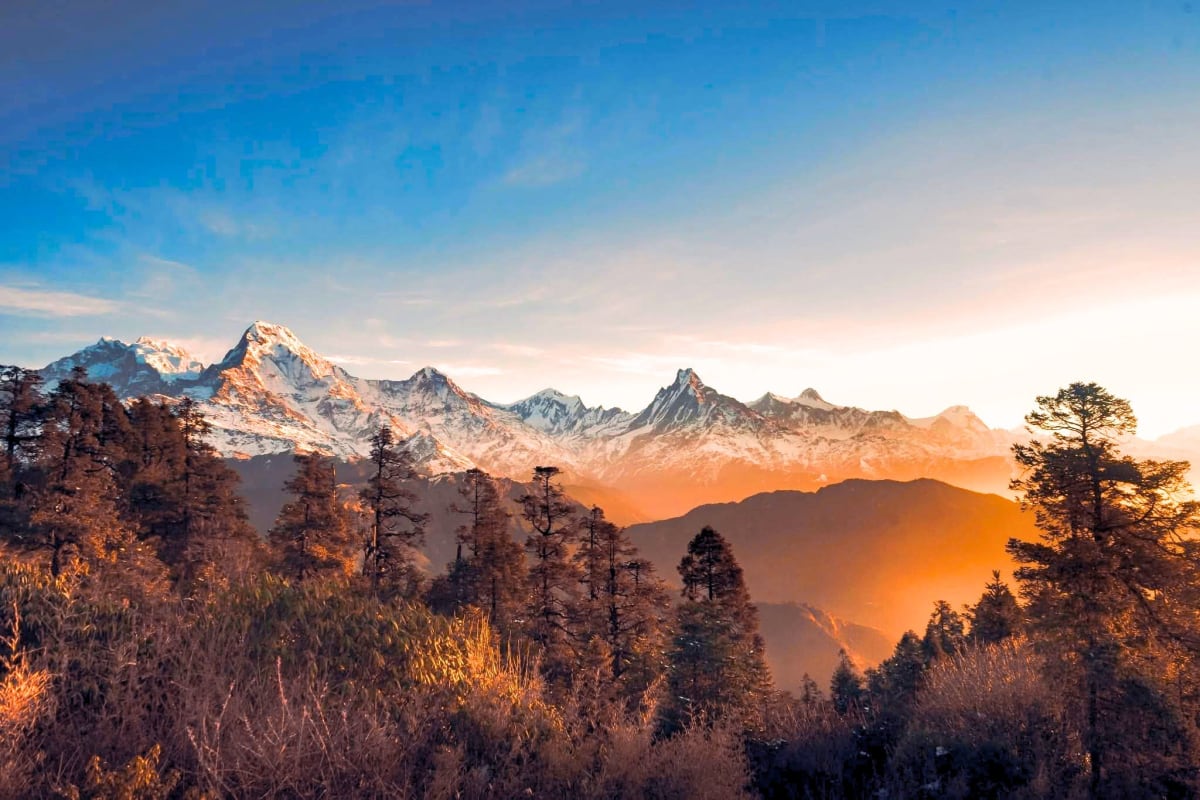
Rara Lake's best trekking season runs April through June and September through November, a partial rain-shadow window created by the Api-Saipal range to the west, wider than a standard central-Nepal trek but narrower than the near-monsoon-proof calendar Dolpo and Upper Mustang get from a fuller rain shadow. Daytime temperatures at Rara Lake (2,990 m) run 15 to 20 C from April to June, and the lake itself, Nepal's largest, sits low enough that snow rarely closes access outside the deepest winter months. Passang Dawa Sherpa, who has guided departures across every Nepal season, wrote this guide as the Far West's route options expand.
The sections below cover the partial rain-shadow effect specifically, the strongest months for Rara and Khaptad, what monsoon does to the region, and how winter differs from the high passes further east.
In this guide 4
Does Far West Nepal have a rain-shadow trekking season?
Far West Nepal gets a partial rain-shadow effect from the Api-Saipal range along its western edge, though not the full protection that the Dhaulagiri and Annapurna massifs give Dolpo and Upper Mustang further east. This means the June-to-September monsoon still reaches Rara Lake and Khaptad with real rainfall, unlike Dolpo's largely dry summer, but the effect is enough to make the shoulder months, April to June and September into early November, noticeably more reliable here than at similar elevations in central Nepal.
The practical result is a wider window than Everest or Annapurna, but not the same monsoon-defying calendar Dolpo advertises. Far West Nepal's real seasonal advantage is the shoulder months on either side of monsoon extending slightly further than usual, not a genuine ability to trek through July and August, a distinction worth holding onto when comparing rain-shadow claims across Nepal's different remote regions.
When is the best time to trek Rara Lake?
April through June is Rara Lake's strongest window, when the surrounding forests are green, the lake itself is at its clearest, and access via the Talcha airstrip runs with the fewest weather delays of the year. September through November is the second strong window, cooler and drier as the monsoon clears, similar in character to the standard Nepal autumn season but arriving slightly later in the Far West than it does in the Everest or Annapurna regions. May specifically stands out as the single most reliable month for both clear lake views and steady flight operations into Talcha.
| Season | Rara Lake conditions | Khaptad conditions |
|---|---|---|
| March-June | Strongest window, green and clear | Grasslands greening, good access |
| July-August | Reduced rainfall vs. central Nepal, still wet | Wet, muddy plateau trails |
| September-November | Second strong window, cool and dry | Good, clearest late-autumn views |
| December-February | Cold, Talcha flights weather-dependent | Cold, limited access |
Khaptad National Park, sitting on a high plateau rather than around a lake, follows a similar pattern with its own character: the grasslands green up through spring and hold their best color into early summer, while autumn brings the clearest long-range views across the plateau. Photographers and birdwatchers, two groups Khaptad draws specifically, tend to favor the early autumn weeks when the plateau grasses turn gold and visibility across the park is at its best.
Limi Valley, deeper into Humla and further from the Api-Saipal rain shadow's effect than Rara or Khaptad, follows a season closer to Kanchenjunga's than to Rara's: spring and autumn are the reliable windows, and the restricted zone's higher terrain near the Tibet border means winter closes it more firmly than it closes Rara Lake's gentler elevation profile.
What does monsoon do to Far West Nepal?
June through August brings real rainfall to Rara and Khaptad, muddying trails and adding cloud cover that reduces the lake and plateau views that are much of the draw, though the rainfall intensity runs somewhat lighter than the monsoon hits central and eastern Nepal, per the partial rain-shadow effect from the Api-Saipal range. This is a meaningfully different picture from Dolpo, where the same months are the region's strongest, and worth stating honestly rather than overselling the Far West's rain-shadow benefit to match Dolpo's.
Flights to the Talcha airstrip near Rara Lake become less reliable during the heaviest monsoon weeks, since cloud buildup over the surrounding hills affects the small aircraft that serve the route, adding a practical access reason to avoid a July or August departure alongside the trail-condition reasons.
Trekkers set on a mid-summer Far West departure, drawn by the lower rates and empty trails that any monsoon-month trip offers, get a better result at Rara than at Khaptad, since Rara's lakeside forest holds up better under rain than Khaptad's open plateau grassland, which turns to soft, difficult mud once the summer rains set in. Neither destination matches Dolpo's dry-season monsoon performance, so a July or August booking here should be a deliberate trade for lower cost and solitude, not an expectation of the same clear conditions the shoulder months deliver.
Can you trek Rara Lake in winter?
Winter, December through February, brings real cold to Rara Lake, and the Talcha airstrip's flight schedule becomes more weather-dependent as winter storms move through, though the lake itself sits low enough at 2,990 m that deep snow rarely closes ground access the way it closes the high passes on Dolpo or Kanchenjunga circuits. A short, well-timed winter visit to Rara is more realistic than a winter Dolpo or Kanchenjunga trek, covered in trekking Nepal in winter, simply because Rara's elevation profile is gentler.
Khaptad's high plateau gets colder and windier than Rara in winter, and its more limited winter infrastructure makes a December-to-February visit a harder sell than Rara Lake over the same months. April to June and September to November remain the two windows we recommend for both destinations. Trekkers set on a winter Far West trip should default to Rara over Khaptad for exactly this reason, the same elevation-and-infrastructure logic that makes Poon Hill a stronger winter choice than a Manaslu circuit crossing the Larkya La.
FAQ
Common questions
What's the best month to visit Rara Lake?+
April through June is the strongest window, with the clearest lake views and the most reliable flights to the Talcha airstrip. September through November is the second-best window as the monsoon clears.
Is Far West Nepal trekkable during monsoon?+
Not ideally. The Api-Saipal range gives a partial rain-shadow effect, lighter rainfall than central Nepal sees, but June through August still brings real rain, muddy trails, and less reliable flights to Rara Lake's Talcha airstrip.
Is Rara Lake trekkable in winter?+
More realistic than Dolpo or Kanchenjunga in winter, since Rara sits at only 2,990 m and doesn't rely on a high pass crossing. Cold and weather-dependent flights are still real factors, so April-June or September-November remain the recommended windows.