
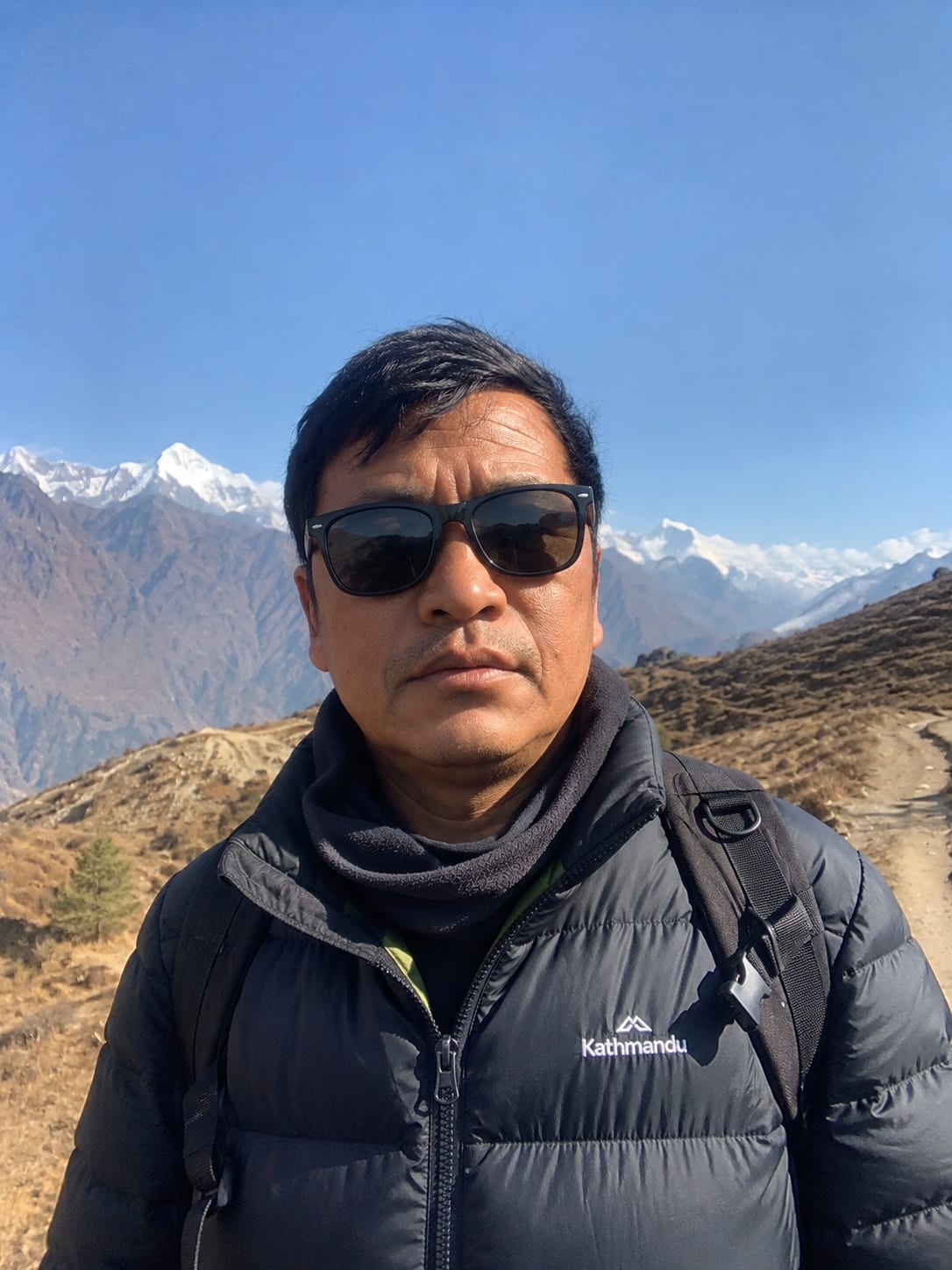
 Written & led by Mingma Sherpa
 Estimated per-person rate for this size — your guide confirms the exact quote.
The Limi Valley Trek is a 18-day camping trek in Humla district, Nepal's remotest corner against the Tibet border, that flies into Simikot and follows the Karnali and Humla river valleys over the Nara La (approximately 4,560 m) into three Tibetan Buddhist villages, Til, Halji, and Jang, that see fewer foreign trekkers in a year than Everest Base Camp sees in a single peak-season week. A 2026 group departure costs USD 2,600 to 3,400 per person, covering the Department of Immigration restricted-area permit (USD 50 per person per week, roughly USD 100 total for this itinerary's 8 to 12 days inside the restricted zone), a licensed guide, a full camping crew for the majority of the route, and the Kathmandu-Nepalgunj-Simikot flights. Mingma Tendi Sherpa, our Senior Guide and Safety Lead, plans the crew and flight logistics for every remote-region departure we run and put this itinerary together as our Far West route network expands beyond the Rara Lake Trek.
This is the third bookable Far West trip on our route network and the region's most demanding — strenuous rather than moderate, with a camping crew and flight-seat scarcity that shape every Limi departure.
Highlights
What our guides know that others don't.
Flight-seat scarcity
Simikot flights run smaller aircraft on lower-frequency schedules than Kathmandu-Pokhara; book several weeks ahead
Border-village culture
Til, Halji, and Jang are Tibetan Buddhist villages with centuries-old trade and monastic ties across the Tibet border, among the least-visited inhabited villages in Nepal
What permits does the Limi Valley Trek need?
Two layers of paperwork cover this trek: the Department of Immigration restricted-area permit at USD 50 per person per week, and a variable Humla district local fee confirmed at the time of booking rather than fixed in advance. Since this itinerary spends 8 to 12 days inside the restricted zone, most trekkers pay for two weekly periods, roughly USD 100 in national restricted-area fees, on top of whatever the district-level levy runs that season. Full detail on how this compares to the region's other permit systems sits in the Far West Nepal permits guide.
Humla's local fee is the one line item on this trek genuinely liable to shift year to year, since district-level tourism levies in this part of Nepal change more often than the national Department of Immigration schedule does; we confirm the current figure at booking rather than quoting a number here that could go stale. Both the restricted-area permit and the local fee require a licensed guide, with no second trekker needed since a March 2026 rule change that dropped the group-size floor every restricted area in Nepal used to enforce. A registered agency files the restricted-area application directly with the Department of Immigration, and the trekker's original passport needs to be available in Kathmandu before the Simikot flight, so plan at least one working day in the capital before departure.
How much does the Limi Valley Trek cost in 2026?
TAAN-registered operators quote USD 2,600 to 3,400 for a group Limi Valley departure in 2026, priced close to the Upper Dolpo Circuit's USD 2,900 to 3,600 range for similar reasons: both routes spend most of their length as a full camping trek with a restricted-area permit layered on top. The table above breaks the total down: permits and local fees at USD 100 to 180, the Kathmandu-Nepalgunj-Simikot flight sequence at USD 500 to 680, meaningfully above Dolpo's Juphal fares given Simikot's lighter flight competition, and the camping crew and equipment lines that make up the largest single share of the cost.
A quote noticeably below this band on Limi Valley usually means the camping crew has been trimmed below what the route beyond Yari genuinely needs, since every meal from that point on has to be carried in rather than bought at a lodge. Private departures run USD 3,100 to 3,900, a smaller premium over the group rate than the raw difference suggests once the fixed camping-crew cost is accounted for, the same structural pattern that applies to every camping-based restricted route this site runs. Comparing a Limi Valley quote against the Nepal trek costs guide's teahouse-route price bands is not a like-for-like comparison; this trek's cost structure sits closer to Dolpo's or a full Kanchenjunga circuit's than to any teahouse-supported route in that table.
| Humla restricted-area permit + local feeUSD 50/week for roughly 2 weeks inside the zone; local fee confirmed at booking | $100–180 |
| Kathmandu-Nepalgunj-Simikot flights, both waysLimited-seat sectors; fares run above Juphal or Talcha given lighter competition | $500–680 |
| Licensed guide (18 days)USD 35-40/day | $560–800 |
| Camping crew: cook, kitchen assistants, portersHired locally in Simikot; full crew from beyond Yari | $620–880 |
| Camping equipment and food supply10+ days without lodge resupply beyond Yari | $350–520 |
| Teahouse rooms and food, Simikot to Yari3-4 nights before the camping section begins | $90–160 |
| Company margin, satellite phone, logistics | $200–350 |
How difficult is the Limi Valley Trek?
Strenuous is our grading: roughly 155 km, close to 4,800 m of cumulative ascent, walking days of 6 to 7 hours on rough, ungraded river-valley and pass terrain, and a high point at the Nara La of approximately 4,560 m. Neither the Nara La nor any other section of this route is technical, but the sustained daily walking over close to three weeks, combined with genuinely thin logistics support once the trail leaves Simikot's immediate surroundings, puts this trek's overall demand above a standard teahouse route like Everest Base Camp or the Annapurna Circuit.
The itinerary holds a dedicated acclimatization day inside the Limi Valley itself, once the group has crossed the Nara La and reached Til, following the same 500-m-per-day sleeping-altitude guideline used on every high route we operate and covered in full in the altitude sickness prevention guide. A fitness benchmark worth taking seriously before booking: consecutive 6 to 7 hour trekking days on remote river-valley trail for the better part of three weeks, with no jeep or lodge shortcut anywhere along the route once past the first villages out of Simikot.
Insurance requirements here match Dolpo and Kanchenjunga, not a standard teahouse trek: helicopter evacuation from deep inside Humla, well beyond any road or major airstrip, is a genuinely complex rescue, and we check every client's policy against the coverage tiers in helicopter evacuation insurance coverage before filing permits. A policy covering evacuation from remote, camping-based terrain is mandatory on this departure.
When is the best season for the Limi Valley Trek?
Spring, March through May, and autumn, September through November, are the two reliable windows for Limi Valley, closer in character to Kanchenjunga's season than to Rara Lake's partial rain-shadow calendar, since Humla sits far enough from the Api-Saipal range that Rara's shoulder-season advantage doesn't extend this deep into the district. Full seasonal detail for the whole Far West region, including how Limi's calendar differs from Rara's and Khaptad's, sits in the Rara Lake trekking season guide.
Winter closes the Limi Valley more firmly than it closes Rara Lake's gentler elevation profile, since the restricted zone's higher terrain near the Tibet border holds snow longer and the Nara La becomes a genuinely harder crossing under winter conditions. We run no Limi Valley departures between December and February for this reason. Monsoon, June through August, is avoidable here for the same access-and-trail-condition logic that applies across the rest of the Far West: real rainfall, higher flight-delay risk into Simikot, and river crossings that run higher and less predictable than in the shoulder months.
What crew does the Limi Valley Trek need, and why are flights harder to book?
A full Limi Valley departure needs a licensed guide, a cook, kitchen assistants, and porters hired locally in Simikot rather than brought from Kathmandu, the same local-hire pattern used on the Dolpo trek logistics and Kanchenjunga trek logistics guides. Teahouses and homestays cover the first 3 to 4 nights out of Simikot, but the crew shifts to full camping once the trail passes Yari and heads toward the restricted zone, since lodge infrastructure genuinely runs out from that point.
Flight seats to Simikot are limited, smaller aircraft on a lower-frequency schedule than the main Kathmandu-Pokhara domestic network, so booking this sector several weeks ahead matters more here than on almost any other route this site operates, including Dolpo's Juphal sector and Kanchenjunga's Bhadrapur flights. Weather delays run higher during the shoulder months either side of monsoon, which is another reason we build a spare day into the flight schedule at both ends of every Limi Valley departure, rather than only at Simikot.
Mobile coverage is absent for long stretches beyond Yari, so every group carries a satellite phone as standard safety equipment once the camping section begins, matching the practice on Dolpo and Kanchenjunga. This isn't an optional add-on; it's the only reliable way an emergency reaches Kathmandu from terrain this far from a road or major airstrip.
What makes the Limi Valley villages culturally distinctive?
Til, Halji, and Jang, the three villages this itinerary visits inside the Limi Valley proper, are Tibetan Buddhist communities with centuries-old trade and monastic ties across the nearby Tibet border, historically more connected to Tibetan plateau culture than to central Nepal given how remote this corner of Humla sits from Kathmandu. Halji is home to Rinchenling Gompa, a monastery with a documented history stretching back roughly a thousand years, one of the oldest continuously used religious sites in this part of the Himalaya, and the village's daily rhythm still centers on the monastery in a way that's increasingly rare even in other high-Himalayan Buddhist communities.
These villages see genuinely few foreign visitors in a given year, a direct function of the restricted-area status, the flight-seat scarcity into Simikot, and the multi-day approach before the valley itself even begins, rather than any deliberate limit on visitor numbers. Trekkers drawn to Limi Valley specifically for this cultural depth should expect a slower, more observational pace through the valley's three villages rather than the packed sightseeing schedule of a Kathmandu Valley tour, and our guides brief every group on respectful visiting practice around the monasteries before arrival.
Jang, the northernmost and most remote of the three villages, sits close enough to the Tibet border that its trading and family ties across the frontier have historically mattered more to daily life there than any connection to Kathmandu, a pattern common across Nepal's high-Himalayan border districts but rarely visible to trekkers on the country's more established routes. Local livelihoods in all three villages still center on a mix of subsistence farming at this altitude, herding, and small-scale trade, a way of life our guides describe honestly to visitors rather than romanticizing it as untouched or unchanged.
How does the Limi Valley Trek compare to Rara Lake and Khaptad?
Within the Far West region, Limi Valley is the genuinely remote, camping-based expedition next to Rara Lake's accessible teahouse trek and Khaptad's middle-ground plateau walk, covered together in the Far West Nepal trek logistics guide. A trekker choosing between Rara Lake's 6 days and this trek's 16 to 20 should weigh a week of gentle lakeshore walking against a three-week restricted-zone expedition; they serve genuinely different appetites rather than sitting on the same spectrum at different lengths.
Against Nepal's other restricted regions, Limi Valley's USD 50 per week permit sits between Kanchenjunga's USD 20 per week and Upper Dolpo's USD 500-plus-daily-extension structure, covered in the Far West Nepal permits guide, though the real cost driver across all three is the camping crew and flight logistics, not the permit fee itself. Trekkers who have already completed Upper Dolpo or a Kanchenjunga circuit and want a comparably remote next objective, rather than a repeat of a route they've already done, are a genuine fit for Limi Valley specifically because it shares that camping-based, restricted-border profile without duplicating either route's terrain or villages.
What should you pack for the Limi Valley Trek?
Limi Valley's packing list starts from the same four-season sleeping bag and layered clothing base covered in the Nepal trekking packing list, rated to at least -15 C comfort given the tent nights beyond Yari. Add the same camping-specific items the Upper Dolpo Circuit needs: a closed-cell foam sleeping pad as backup to an inflatable mat, since punctures have no easy fix mid-trek, and a headlamp with spare batteries for early starts on the Nara La crossing.
Cash in Nepali rupees should cover the full trip, since no ATM serves this route past Kathmandu or Nepalgunj, and a modest gift of tea or basic supplies is a genuinely appreciated gesture when visiting the Limi villages, worth discussing with your guide before arrival rather than deciding on the trail. Sun protection matters more here than the itinerary's cool temperatures might suggest, since the high, dry Humla terrain carries strong UV exposure with little tree cover once past the first days out of Simikot, and a buff or scarf against dust on the drier valley sections is worth the small extra weight.
Waypoints mark named stops on the route; the line between them is a straight-line approximation, not a surveyed trail. Map data © OpenStreetMap contributors.
Day by Day
18-day itinerary, every detail planned.
A short domestic flight reaches Nepalgunj, a lowland city near the Indian border, where the group overnights ahead of the Simikot sector.
What's Included
Transparent, all-in pricing.
Included in your price
Not included
Why Nepal Travel Packages
Built on published proof, not adjectives.
A named, licensed guide before you book
Full name, photo, NMA or TAAN license number, and a direct WhatsApp line. The guide on the page is the guide on the trail.
Itemized pricing, not a lump sum
Permits, guide, porter, lodging, and food broken out on every trip page. You see exactly where the price comes from.
Trail conditions updated monthly
Dated field reports from the guides running the route this season, not boilerplate written once and left to go stale.
Permits handled, not hidden
Every permit fee, checkpoint, and paperwork rule is filed for you and published in the guides — no surprise admin at Lukla.
Keep exploring
Related packages

Planning
Related guides
FAQ
Common questions
Can I trek the Limi Valley solo?+
No. The Department of Immigration issues the Humla restricted-area permit only to groups of two or more trekkers with a licensed guide, the same floor as Dolpo, Kanchenjunga, and Upper Mustang. Solo travelers join one of our scheduled group departures, covered in the Far West Nepal permits guide.
Does the Limi Valley Trek use teahouses or camping?+
Both, in sequence. Simikot to Yari runs on teahouses and homestays, roughly 3-4 nights, but the route beyond Yari toward Hilsa, the Nara La, and the three Limi villages has no lodge infrastructure, so the remaining nights run as a full camping trek with a dedicated cook and kitchen crew.
How high does the Limi Valley Trek go?+
The high point is the Nara La at approximately 4,560 m, crossed twice, once on the way in and once on the return. The itinerary holds a dedicated acclimatization day at Halji inside the valley itself before the return crossing.
Why is Limi Valley more expensive than Rara Lake?+
Length and logistics, not distance from Kathmandu. Limi Valley runs 18 days against Rara Lake's 6, needs a restricted-area permit and full camping crew that Rara's simple park-entry system doesn't require, and its Simikot flights cost more given more limited seat availability. Both are covered together in the Far West Nepal permits guide.
When is the best time to trek Limi Valley?+
Spring (March-May) and autumn (September-November). Winter closes the Nara La under snow, and monsoon brings higher flight-delay risk into Simikot and less predictable river crossings, detailed in the Rara Lake trekking season guide.
Is there phone signal on the Limi Valley Trek?+
No, not for long stretches beyond Yari. Every group carries a satellite phone as standard safety equipment once the camping section begins, matching the practice on Dolpo and Kanchenjunga, so an emergency can reach Kathmandu without relying on village-to-village relay.
How does Limi Valley compare to Upper Dolpo or Kanchenjunga?+
Similar in structure: all three are restricted-area, camping-based expeditions with comparable crew ratios and satellite-communication requirements. Limi Valley's USD 50/week permit sits between Kanchenjunga's USD 20/week and Dolpo's higher, day-priced restricted fee, though the real cost driver across all three is the camping crew and flight logistics rather than the permit itself.
Can I visit the Limi Valley monasteries?+
Yes, with respectful visiting practice guides brief every group on before arrival. Halji's Rinchenling Gompa, with a documented history stretching back roughly a thousand years, is the itinerary's primary monastery visit, and a rest day is built in specifically to allow unhurried time there.
Is the Limi Valley Trek suitable for a first Nepal trek?+
No. This is one of the site's most demanding itineraries, comparable to the Upper Dolpo Circuit or a full Kanchenjunga circuit in duration, camping requirements, and remoteness. Trekkers with at least one prior high-altitude or restricted-area trek behind them are the better fit, and first-time Nepal trekkers are better served by a teahouse route like Everest Base Camp or the Annapurna Circuit.
How much cash should I carry for the Limi Valley Trek?+
Enough Nepali rupees to cover the full trip, since no ATM serves this route past Kathmandu or Nepalgunj, and even Simikot has limited banking infrastructure. A modest gift of tea or basic supplies is also genuinely appreciated when visiting the Limi villages, worth arranging with your guide before arrival.