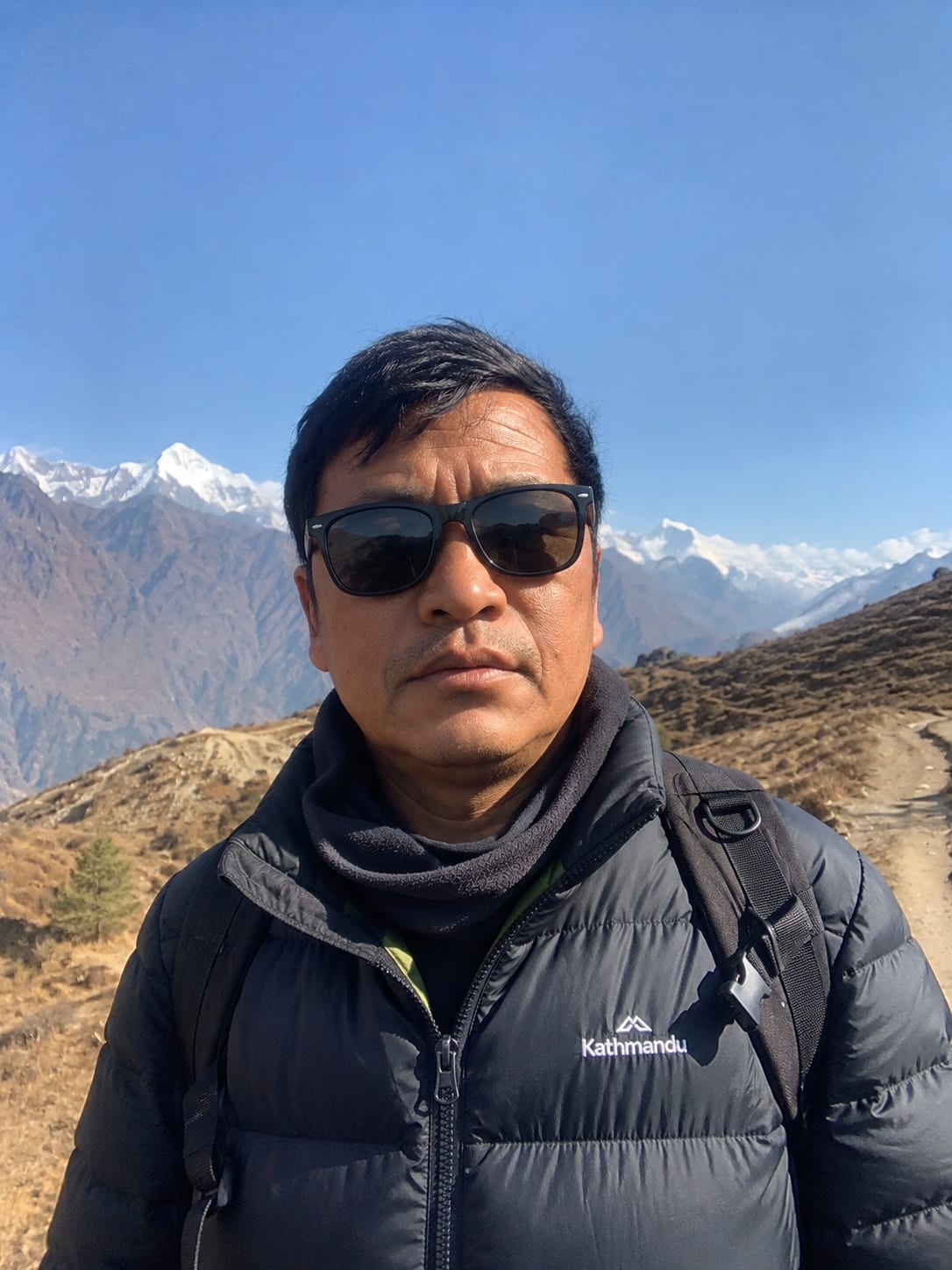
 Written & led by Mingma Sherpa
 Estimated per-person rate for this size — your guide confirms the exact quote.
The Kanchenjunga North Base Camp Trek is a 17-day restricted-area trek in Nepal's far east that follows the Tamor and Ghunsa valleys to Pangpema (5,140 m), the closest viewpoint of Kanchenjunga's (8,586 m) sheer north face, without the second pass crossing the full circuit adds. A 2026 group departure costs USD 2,300 to 2,900 per person, driven mostly by the two-flight-and-jeep approach through Bhadrapur and Taplejung and the camping crew the route needs beyond Ghunsa, not by the permit itself: the restricted-area fee runs just USD 20 per person per week, the lightest in Nepal, with no separate conservation charge. Because the trek turns back at Pangpema instead of crossing Lapsang La (5,160 m) and Sinion La (4,660 m) to reach South Base Camp, it trims four to six days off the full circuit while keeping the single most-photographed view on the route: Kanchenjunga's north face rising directly above the Kangchenjunga Glacier.
Mingma Tendi Sherpa, our Senior Guide and Safety Lead, plans crew and route logistics for this and every other remote-region departure we run — the same restricted-permit paperwork, checkpoint sequence from Taplejung to Ghunsa, and camping-crew ratio he sets before every approach to Pangpema.
Highlights
What our guides know that others don't.
Crew ratio beyond Ghunsa
6-8 support staff per 8-person group: guide, cook, kitchen assistants, porters
Bhadrapur flight reliability
Several daily flights, rarely sold out, the least delay-prone sector of any Nepal remote-region approach
How does the Kanchenjunga restricted-area permit work for this route?
A single restricted-area permit at USD 20 per person per week covers the North Base Camp trek, issued by the Department of Immigration in Kathmandu through a registered agency, with no separate conservation-area fee layered on top. This route spends roughly two weekly periods inside the restricted zone, entered above Sekathum, so the permit line totals about USD 40 per person, a fraction of what Manaslu or Upper Mustang charge for a similar-length trek. The same permit that covers North Base Camp also covers the South Base Camp side at Oktang, so extending this itinerary into the full circuit later needs no second application, only an amended group filing.
Immigration requires a licensed guide and a registered-agency booking, the same rule applied across every restricted region in Nepal; since 22 March 2026 a solo trekker can hold the permit alone, with no second-trekker requirement. Processing takes one working day once passport scans, visa pages, photographs, and the guide's license reach our office, though the multi-day journey to the actual trailhead means the permit itself is rarely what determines a departure date. The full fee structure, checkpoint sequence, and application process sit in the Kanchenjunga permit and restricted-area guide, which Ramesh Rai updates whenever the Department of Immigration confirms a change.
How much does the Kanchenjunga North Base Camp Trek cost in 2026?
A 2026 group departure runs USD 2,300 to 2,900 per person, with private departures at USD 2,700 to 3,400. Unlike Manaslu or Upper Mustang, where the restricted permit itself is the dominant cost line, this route's price comes mostly from the Bhadrapur-Taplejung approach and the camping crew needed beyond Ghunsa: permits add only about USD 40, while flights, the jeep transfer, and the six to eight support staff a camping section requires account for most of the difference against a standard teahouse trek of similar length.
A quote well under USD 2,000 for this route usually means an undersized camping crew or a compressed itinerary that skips one of the two acclimatization days built into ours. Because Ghunsa is the last point with lodge-cooked food, every meal from there to Pangpema and back has to be carried in, and cutting kitchen staff to save money directly increases the risk of running short on food if weather holds a group at Lhonak an extra day.
| Kanchenjunga Restricted Area Permit, 2 weeksUSD 20/week; no separate conservation fee on this route | $40 |
| Kathmandu-Bhadrapur flights, both waysDomestic short-hop, frequent daily departures | $300–400 |
| Bhadrapur-Taplejung jeep, both ways6-8 hours each way; monsoon-season road damage can add hours | $120–200 |
| Licensed guide (mandatory, shared in group)USD 35-40/day over 17 days including guide's food, lodging, insurance | $595–680 |
| Camping crew: cook, kitchen assistants, porters beyond Ghunsa6-8 support staff per 8-person group, hired locally in Taplejung and Ghunsa | $700–900 |
| Teahouse rooms, Sekathum to Ghunsa (4 nights)NPR 500-1,200/night, basic lodges | $40–80 |
| Camping food and fuel, Ghunsa to Pangpema and returnCarried in; no resupply past Ghunsa | $260–340 |
| Company margin, permit filing, staff equipment | $245–260 |
Why is Kanchenjunga's permit so much cheaper than Manaslu or Dolpo's?
Kanchenjunga's USD 20-per-week restricted-area fee is roughly a fifth of Manaslu's low-season rate and a fraction of Upper Dolpo's USD 500 first-week charge, and the gap comes down to conservation-area administration, not a lesser mountain or an easier route. The Kanchenjunga Conservation Area operates under a community-based management model rather than the National Trust for Nature Conservation structure that runs ACAP in the Annapurna region, and community-managed areas in this part of Nepal have historically charged no separate visitor entry fee on top of the national restricted-area permit.
| Region | Weekly restricted fee | Extra conservation layer |
|---|---|---|
| Kanchenjunga | USD 20 | None |
| Manaslu (Sept-Nov) | USD 100 first week | MCAP + ACAP, NPR 3,000 each |
| Upper Dolpo | USD 500 first 10 days | Park entry, NPR 3,000 |
This single-fee structure is worth confirming against current Department of Immigration notices before departure, since community-conservation-area policy occasionally shifts; our permits team checks the fee schedule before every filing and updates the Kanchenjunga permit guide whenever a change is confirmed. The fee difference has no bearing on the trekking experience itself: Kanchenjunga's low permit cost reflects administrative history, not a shorter, easier, or less remote route than Manaslu or Dolpo.
What checkpoints and approach does the route follow?
The approach runs Kathmandu to Bhadrapur by air, then six to eight hours by jeep to Taplejung, the district headquarters where the restricted-area permit gets its first check. From Taplejung the trail follows the Tamor river through Mitlung and Chirwa before turning north at Sekathum into the Ghunsa valley, where a second permit check runs alongside the shift from teahouse to increasingly basic lodge coverage. Ghunsa (3,595 m) is the last village with reliable teahouse infrastructure and the point where our camping crew, cooks and kitchen assistants hired locally, takes over full catering for the remainder of the trek.
Beyond Ghunsa the trail climbs through Kambachen and Lhonak toward Pangpema, with no permanent settlement and no resupply point past Ghunsa, which is why the camping crew and the food they carry are sized for the full round trip rather than replenished en route. Domestic flights to Bhadrapur run several times daily and rarely sell out, the most reliable sector of any remote-region approach we operate, though the jeep transfer to Taplejung is the more weather-exposed leg: monsoon-season road damage can add hours to the normal six-to-eight-hour drive, one more reason this trek runs in the spring and autumn windows rather than through the wet season.
How difficult is the Kanchenjunga North Base Camp Trek, and how does acclimatization work?
Strenuous is our grading: 145 km, roughly 7,800 m of cumulative ascent, walking days of five to seven hours, and two nights above 4,500 m on the approach to Pangpema. No section is technical, but the trail's remoteness, its distance from any road or airstrip once past Ghunsa, means a health problem takes longer to resolve here than on a teahouse route like Everest Base Camp or the Annapurna Circuit. A fitness benchmark: back-to-back six-hour hill days with a loaded daypack, comfortably, before you book.
Altitude management follows the Himalayan Rescue Association's guideline of gaining no more than 500 m of sleeping altitude per day above 3,000 m, which is why our itinerary holds acclimatization days at Ghunsa (3,595 m) and Kambachen (4,050 m) before the push to Lhonak (4,780 m) and the round trip to Pangpema (5,140 m). Acute mountain sickness symptoms and our descent protocols are covered in the altitude sickness prevention guide, and our guide carries a pulse oximeter with twice-daily checks from Kambachen onward. Helicopter evacuation from the Pangpema area takes longer to mobilize than from the Everest or Annapurna corridors given the flight distance from Kathmandu, which is why a policy covering evacuation to 5,500 m, detailed in the helicopter evacuation insurance coverage guide, is mandatory on every departure.
This trek suits a trekker with prior high-altitude experience and genuine comfort with 5 to 7 hour walking days on remote, occasionally exposed terrain, and it's a real mismatch for a first-time high-altitude trekker who hasn't tested their acclimatization response on a shorter route first. Trekkers who've completed Everest Base Camp or the Annapurna Circuit and want a quieter, more demanding follow-up are the most common fit for this itinerary.
Why does this trek need a full camping crew, and how is it staffed?
Ghunsa is the last village with lodge-cooked meals on this route, so everything past it, tents, kitchen equipment, and food for the group and crew alike, has to be carried in rather than bought along the way. An eight-person group runs with six to eight support staff once the trail leaves Ghunsa: a licensed guide, a cook, one or two kitchen assistants, and porters sized to the load, close to a one-to-one support ratio and far higher than the near-zero staffing a teahouse trek like Poon Hill needs.
Local porters are hired in Taplejung or Ghunsa rather than brought the whole way from Kathmandu, the same porter-welfare model detailed on the sustainability page, which also keeps costs from escalating on the approach. Trekkers weighing this route against a shorter, cheaper camping-free option should read it against the Kanchenjunga vs Everest region trekking comparison, which sets out exactly where the extra cost goes and what a group gets for it: a base-camp view that even a shoulder-season Everest departure's traffic can't match.
Why does Kanchenjunga carry a different reputation than Everest or Annapurna?
Kanchenjunga is the world's third-highest peak at 8,586 m, straddling the Nepal-Sikkim border, and it carries a distinct cultural weight in the region: the name itself translates roughly to "Five Treasures of the Snow," referring to five summits believed in local Limbu and Sikkimese tradition to hold gold, silver, gems, grain, and holy scripture. Many historical mountaineering expeditions, including the first successful 1955 British ascent, have stopped a symbolic distance short of the true summit out of respect for these beliefs, a detail that sets Kanchenjunga apart from Everest's more commercialized summit culture even at the trekking level, well below any technical climbing terrain.
That cultural weight, combined with the region's genuine remoteness, is a large part of why a Kanchenjunga trek reads differently on the trail than an Everest or Annapurna departure: fewer trekkers, a longer approach, and a mountain regarded locally as sacred rather than primarily as a climbing objective. Pangpema itself sits close enough to the north face that this context is hard to miss, standing directly beneath a peak most visitors never get this close to.
Waypoints mark named stops on the route; the line between them is a straight-line approximation, not a surveyed trail. Map data © OpenStreetMap contributors.
Day by Day
17-day itinerary, every detail planned.
A short domestic flight covers the distance a road journey would take two days to close. Bhadrapur sits in Nepal's lowland Terai near the Indian border, a different climate entirely from the mountains ahead, and flights on this sector run several times daily with a low delay rate compared with the mountain airstrips used later on other whale-region routes.
What's Included
Transparent, all-in pricing.
Included in your price
Not included
Why Nepal Travel Packages
Built on published proof, not adjectives.
A named, licensed guide before you book
Full name, photo, NMA or TAAN license number, and a direct WhatsApp line. The guide on the page is the guide on the trail.
Itemized pricing, not a lump sum
Permits, guide, porter, lodging, and food broken out on every trip page. You see exactly where the price comes from.
Trail conditions updated monthly
Dated field reports from the guides running the route this season, not boilerplate written once and left to go stale.
Permits handled, not hidden
Every permit fee, checkpoint, and paperwork rule is filed for you and published in the guides — no surprise admin at Lukla.
Keep exploring
Related packages
Planning
Related guides
FAQ
Common questions
Can I trek Kanchenjunga North Base Camp solo?+
No. The Department of Immigration issues Kanchenjunga restricted-area permits only to groups of two or more trekkers with a licensed guide, applied for through a registered operator. Solo travelers join one of our scheduled group departures, the same workaround used on Manaslu and Upper Mustang.
How is this different from the full Kanchenjunga circuit?+
The North Base Camp trek turns back at Pangpema instead of crossing Lapsang La (5,160 m) and Sinion La (4,660 m) to reach South Base Camp at Oktang, trimming the itinerary from 22 days down to 17. It uses the same permit, the same approach through Bhadrapur and Taplejung, and reaches the same first close view of Kanchenjunga's north face.
Do I need camping experience for this trek?+
No prior camping experience is required. Our crew, cook, kitchen assistants, and porters, handles all camp setup, cooking, and logistics from Ghunsa onward; trekkers walk and sleep in provided tents without needing to manage any of the camping infrastructure themselves.
How much does the Kanchenjunga permit cost for this route?+
About USD 40 per person, calculated at USD 20 per week for the roughly two weeks this itinerary spends inside the restricted zone. Full fee mechanics and the application process are in the Kanchenjunga permit and restricted-area guide.
What is the best season for Kanchenjunga North Base Camp?+
Late September through November is the strongest window, with October the clearest month, followed by March to May as a second option. Kanchenjunga sits in Nepal's far east with no rain-shadow protection, so monsoon months (June to September) and winter (December to February) are not recommended.
Is Kanchenjunga North Base Camp less crowded than Everest Base Camp?+
Yes, substantially. Kanchenjunga's longer approach and restricted-area status keep visitor numbers a fraction of even a shoulder-season Everest departure, which is the main trade-off against this route's higher day rate and longer travel time from Kathmandu.
Why is the Kanchenjunga permit so much cheaper than Manaslu's?+
The Kanchenjunga Conservation Area is community-managed and charges no separate conservation fee, unlike ACAP or MCAP, which stack a second fee on top of the restricted-area permit for Annapurna and Manaslu. Kanchenjunga's USD 20/week rate reflects that administrative structure, not a shorter or easier route.
Can I trek to both Kanchenjunga base camps in one trip?+
The single restricted-area permit covers both North Base Camp at Pangpema and South Base Camp at Oktang, but this itinerary is the North-only version. Extending to the full circuit adds a crossing of Lapsang La (5,160 m) and Sinion La (4,660 m) and roughly four to six more days; ask your guide about the full-circuit option if both sides interest you.
Is there phone signal on this trek?+
Coverage runs from Taplejung through Chirwa, then drops once the trail enters the restricted zone at Sekathum and stays largely absent until the return leg reaches Chirwa again. This is a genuinely disconnected stretch, similar to the Upper Dolpo Circuit's camping section.
Why do some Kanchenjunga expeditions stop short of the true summit?+
Kanchenjunga holds sacred status in local Limbu and Sikkimese tradition, and many historical expeditions, including the first successful 1955 ascent, stopped a symbolic distance short of the true summit out of respect for that belief. This trek only reaches base camp at Pangpema, well below any summit terrain, but the cultural context shapes how the region is regarded locally.