
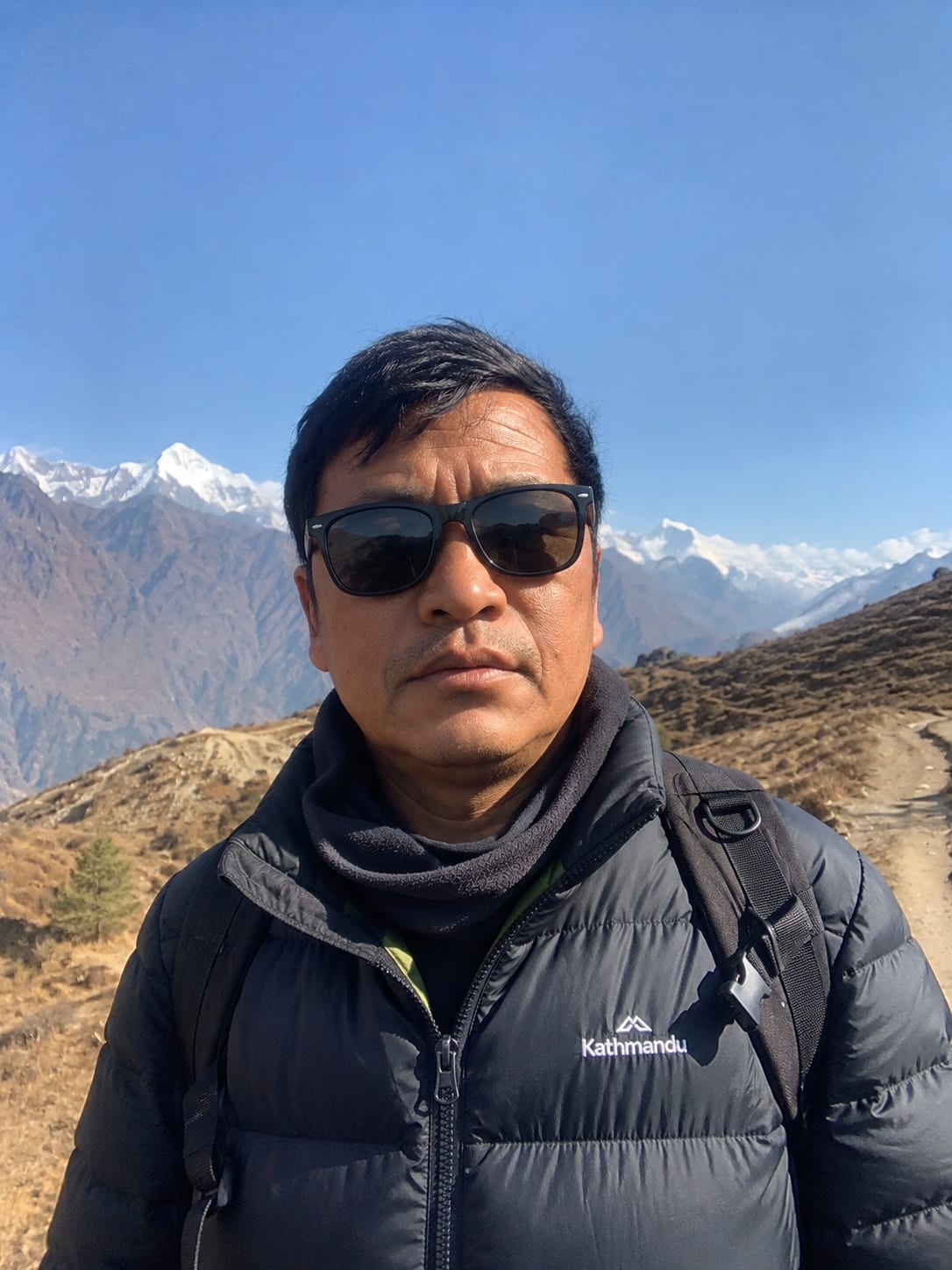
 Written & led by Mingma Sherpa
 Estimated per-person rate for this size — your guide confirms the exact quote.
The Kanchenjunga Circuit Trek is a 22-day restricted-area trek in Nepal's far east that reaches both Pangpema (5,140 m), North Base Camp, and Oktang, South Base Camp (approximately 4,730 m), crossing the Lapsang La (5,160 m) and Sinion La (4,660 m) on a no-resupply section between the two sides of the world's third-highest mountain. A 2026 group departure costs USD 2,800 to 3,500 per person, covering the same USD 20-per-week restricted-area permit as our North Base Camp Trek, an extra one to two weeks of camping crew and carried food for the connecting passes, and the same Bhadrapur-Taplejung approach. This circuit adds four to six days to the North-only itinerary in exchange for the south side's view of Kanchenjunga's Yalung face and Jannu, a mountain most Everest or Annapurna trekkers never see from any angle. Group departures run twice a year, once in the autumn window and once in spring, since the crew and permit coordination this longer itinerary needs works better on a fixed schedule than an on-demand booking.
Mingma Tendi Sherpa, our Senior Guide and Safety Lead, plans crew and route logistics for this and every other remote-region departure we run, including the carried-food math for the no-resupply stretch between the two base camps.
Highlights
What our guides know that others don't.
Crew for the connecting section
Full camping crew carries 4-5 days of food across the no-resupply Lapsang La-Sinion La stretch, the longest such carry of any route we operate
South-side views
Kanchenjunga's Yalung face and Jannu (7,710 m), visible from the south side and from almost nowhere on the North Base Camp-only itinerary
Does the Kanchenjunga Circuit need a different permit than the North Base Camp Trek?
No. The same USD 20-per-week restricted-area permit that covers the North Base Camp Trek also covers the full circuit to Oktang, South Base Camp, with no second application required, per the Kanchenjunga permit and restricted-area guide. Because this itinerary spends roughly three weekly periods inside the restricted zone rather than two, the permit line totals about USD 60 per person instead of USD 40, still the lightest restricted-area cost of any Nepal region by a wide margin.
The same two-trekker, licensed-guide minimum applies, filed once with a registered agency through the Department of Immigration in Kathmandu. Trekkers who book the North-only trip and later decide to add the south side need only an amended group filing, not a fresh application, since Immigration checks the group roster rather than a specific base camp destination.
How much does the Kanchenjunga Circuit Trek cost in 2026?
A 2026 group departure runs USD 2,800 to 3,500 per person, roughly USD 500 to 600 above the North Base Camp Trek's USD 2,300 to 2,900 range for the same trip's core, plus four to six extra days of camping crew, food, and permit weeks. The connecting section between Lapsang La and Sinion La carries no lodge or resupply point, so the extra cost concentrates in that stretch: more food carried per trekker, and a slightly larger crew than the North-only trip needs to manage two base camps instead of one.
Compared with Manaslu Circuit's USD 1,500 to 2,100 group rate in the Nepal trek costs guide, the Kanchenjunga Circuit costs more for a genuinely different reason: Manaslu's price reflects its restricted permit and conservation fees on a teahouse-supported route, while Kanchenjunga's price reflects a much longer camping section with almost no lodge infrastructure at all past Ghunsa. A quote noticeably under USD 2,500 for this circuit is worth questioning closely, since the crew and food carried across the connecting passes are the one part of this itinerary with no shortcut.
| Kanchenjunga Restricted Area Permit, 3 weeksUSD 20/week; single permit covers both base camps | $60 |
| Kathmandu-Bhadrapur flights, both waysDomestic short-hop, frequent daily departures | $300–400 |
| Bhadrapur-Taplejung jeep, both ways6-8 hours each way; monsoon-season road damage can add hours | $120–200 |
| Licensed guide (mandatory, shared in group)USD 35-40/day over 22 days including guide's food, lodging, insurance | $770–880 |
| Camping crew: cook, kitchen assistants, porters beyond Ghunsa and over the connecting passes6-9 support staff per 8-person group; extra days for the no-resupply pass section | $950–1200 |
| Teahouse rooms, Sekathum to Ghunsa (4 nights)NPR 500-1,200/night, basic lodges | $40–80 |
| Camping food and fuel, Ghunsa to Pangpema, over the passes, to Oktang, and out via YamphudinCarried in for both base camps and the connecting section; no resupply between Ghunsa and Tseram | $400–500 |
| Company margin, permit filing, staff equipment | $160–180 |
What is the connecting section between the two base camps actually like?
From Ghunsa, the circuit climbs back past Kambachen toward a high camp below the Lapsang La (5,160 m), the trek's highest point, crossed on firm morning snow before the pass typically clouds over by mid-morning. The descent from Lapsang La leads to a second climb over the Sinion La (4,660 m) within the same push or the following day depending on group pace and weather, and this stretch, roughly four to five days from Ghunsa to the south-side village of Tseram, has no lodge, teahouse, or resupply point anywhere along it.
Every meal across this section is carried in by the camping crew from the moment the group leaves Ghunsa, the same no-resupply discipline used on the Upper Dolpo Circuit's Numa La-Baga La stretch, though Kanchenjunga's connecting section runs longer. Weather holds are the main planning risk here: a storm at either pass can add a full day to the crossing, which is why our itineraries build one spare day into this section rather than the tighter margin a shorter trek allows.
What does the South Base Camp side add that the North side doesn't?
Oktang, South Base Camp, sits at approximately 4,730 m and looks directly onto Kanchenjunga's Yalung face, a completely different aspect of the mountain from Pangpema's view of the north wall, plus a clear line to Jannu (7,710 m), a peak barely visible from anywhere on the North-only itinerary. Reaching Oktang from Tseram is a shorter, gentler push than the approach to Pangpema, since the south side's base camp trail climbs less steeply over its final stretch.
The exit from the south side runs through Tortong and down to Yamphudin, a lower-altitude Limbu village that the North-only itinerary never passes through, before rejoining a jeep-accessible road back toward Taplejung. This means a circuit trekker sees meaningfully more of the region's cultural and geographic range, both faces of the mountain, two distinct approach valleys, and villages on both the Tamor and the southern watershed, than the North Base Camp Trek alone covers.
How difficult is the Kanchenjunga Circuit, and how does acclimatization work across two base camps?
Strenuous is our grading, a step above the North Base Camp Trek alone: 195 km, roughly 9,600 m of cumulative ascent, and multiple nights above 4,500 m spread across both the Pangpema approach and the Lapsang La-Sinion La crossing. No single section is technical, but the extended high-altitude exposure, several days in a row above 4,000 m with two separate passes above 4,600 m, asks more of a trekker's acclimatization than either base camp alone.
Our itinerary holds acclimatization days at Ghunsa (3,595 m) and Kambachen (4,050 m) before the push to Pangpema, the same schedule as the North-only trip, and adds a rest day at Tseram (3,870 m) on the south side before the group descends toward Yamphudin, giving the body a lower-altitude buffer after the connecting-pass crossing rather than pushing straight down to the road. The Himalayan Rescue Association's 500-m-per-day sleeping-altitude guideline, covered in the altitude sickness prevention guide, governs every stage of this itinerary, and our guide runs twice-daily pulse-oximeter checks from Kambachen through the Tseram rest day. Because this circuit spends more consecutive days above 4,000 m than almost any other route we operate, a policy covering helicopter evacuation to at least 5,500 m, detailed in helicopter evacuation insurance coverage, is mandatory, not optional.
When is the best season for the Kanchenjunga Circuit?
Late September through November gives the surest crossing conditions on both the Lapsang La and Sinion La, per the best season to trek Kanchenjunga guide, since Kanchenjunga carries no rain-shadow protection and both passes need firm, settled snow rather than the fresh, unstable cover an early-season or storm-affected window can leave. Late April into May is the second window, once lingering winter snow has had time to clear from both crossings; an earlier spring departure risks a pass closure that a North-only itinerary, with its single approach and no connecting crossing, doesn't carry.
We do not run this circuit during the June-to-September monsoon or the December-to-February winter closure, the same restrictions that apply to the North Base Camp Trek, but the stakes are higher on the full circuit specifically because a weather delay at either pass has no lower-altitude bailout route the way a single-approach trek does.
Booking timing matters more here than on the North-only trip: a spring departure needs confirmation by February to secure the crew and permit slots this longer itinerary requires, since the camping crew for the connecting-pass section is larger and harder to assemble on short notice than the North Base Camp Trek's staffing. Autumn departures should be confirmed by July for the same reason, ahead of the October-November peak window most groups target for the surest crossing conditions.
What should you pack for the Kanchenjunga Circuit?
Start from the Nepal trekking packing list's four-season sleeping bag, rated to at least -15 C comfort, and the same layered clothing base every high route on this site requires. The connecting-pass section between Lapsang La and Sinion La runs colder and more exposed than either base camp approach alone, so pack an extra insulating layer and windproof shell beyond what the North Base Camp Trek alone needs, plus trekking poles for the longer sustained descents on both the north and south sides.
Because this circuit carries more consecutive high-altitude camping nights than most routes we operate, a closed-cell foam sleeping pad as backup to an inflatable mat is worth the extra weight; a punctured mat has no easy fix on the multi-day stretch between Ghunsa and Tseram.
What crew does the Kanchenjunga Circuit need beyond what the North Base Camp Trek requires?
An eight-person circuit group runs with seven to nine support staff across the full itinerary, one or two more than the North Base Camp Trek's six to eight, since the connecting-pass section needs enough hands to move camp faster than a single-approach trek requires. The extra crew member typically covers additional food-carrying capacity for the Lapsang La-Sinion La stretch rather than a specialist role, since no technical climbing skills apply anywhere on this route.
Local porters are hired in Taplejung and Ghunsa for the north-side approach and, where the itinerary allows, supplemented near Yamphudin for the return leg, the same local-hire pattern detailed on the sustainability page. This split hiring keeps costs from concentrating in one village's labor market and follows the porter-welfare approach we apply on every remote-region departure, camping-based or not.
Who should book the full circuit instead of the North Base Camp Trek alone?
Trekkers who've already completed a shorter restricted-area route, or who specifically want both faces of Kanchenjunga rather than a single approach, are the clearest fit for the full circuit. The extra four to six days and roughly USD 500 to 600 buy a genuinely different second half of the trip, not a repeat of the first: a different valley, a different village culture on the exit through Yamphudin, and a mountain aspect, the Yalung face, that the North-only itinerary never reveals.
Trekkers with a tighter schedule, a first restricted-area trek under their belt, or less certainty about multi-day high-altitude camping should start with the North Base Camp Trek instead; it reaches the same first close view of Kanchenjunga in six fewer days and without the connecting-pass section's no-resupply demands. Both itineraries run on the same permit and the same guide, so upgrading from one to the other on a future trip needs no new paperwork beyond an amended booking.
Waypoints mark named stops on the route; the line between them is a straight-line approximation, not a surveyed trail. Map data © OpenStreetMap contributors.
Day by Day
22-day itinerary, every detail planned.
A short domestic flight covers the distance a road journey would take two days to close. Bhadrapur sits in Nepal's lowland Terai near the Indian border, and flights on this sector run several times daily with a low delay rate compared with the mountain airstrips used later on other whale-region routes.
What's Included
Transparent, all-in pricing.
Included in your price
Not included
Why Nepal Travel Packages
Built on published proof, not adjectives.
A named, licensed guide before you book
Full name, photo, NMA or TAAN license number, and a direct WhatsApp line. The guide on the page is the guide on the trail.
Itemized pricing, not a lump sum
Permits, guide, porter, lodging, and food broken out on every trip page. You see exactly where the price comes from.
Trail conditions updated monthly
Dated field reports from the guides running the route this season, not boilerplate written once and left to go stale.
Permits handled, not hidden
Every permit fee, checkpoint, and paperwork rule is filed for you and published in the guides — no surprise admin at Lukla.
Keep exploring
Related packages
Planning
Related guides
FAQ
Common questions
Is the Kanchenjunga Circuit harder than the North Base Camp Trek alone?+
Yes. The circuit adds a second high pass (Sinion La, 4,660 m) beyond the Lapsang La crossing, several more nights above 4,000 m, and a longer no-resupply camping section, on top of everything the North Base Camp Trek already covers. Both share the same permit and approach, but the circuit is a genuine step up in altitude exposure and camping demand.
Do I need a different permit for the South Base Camp side?+
No. The same USD 20-per-week restricted-area permit covers both Pangpema (North) and Oktang (South) Base Camp on a single filing, so the circuit costs slightly more in permit fees only because it spends more weeks inside the restricted zone, not because of a second application.
How much food does the crew carry across the connecting passes?+
Four to five days' worth for the full group and crew, since the stretch from Ghunsa to Tseram, over both Lapsang La and Sinion La, has no lodge, teahouse, or village resupply point anywhere along it. This is the longest continuous carried-food section of any route we operate, longer than the equivalent stretch on the Upper Dolpo Circuit.
What does the South Base Camp side look like compared to the North side?+
Oktang faces Kanchenjunga's Yalung face directly, a different aspect from Pangpema's view of the north wall, and adds a clear line to Jannu (7,710 m). The approach to Oktang from Tseram is also shorter and less steep than the climb to Pangpema.
Can I book just the North Base Camp side and add the circuit later?+
Yes. The North Base Camp Trek and the full circuit use the same permit and guide, so a trekker who starts with the shorter itinerary can extend to the full circuit on a future booking without new paperwork beyond an amended group filing.
What's the best season for the full Kanchenjunga Circuit?+
Late September through November, the same window that gives the surest conditions on the North Base Camp Trek, is even more important here since the circuit crosses two high passes with no lower-altitude bailout route. Late April into May is the second option, once winter snow has cleared both crossings.
How does the Kanchenjunga Circuit compare in cost to the Upper Dolpo Circuit?+
Both run USD 2,800 and up for a similarly long, camping-heavy restricted-area trek, though Kanchenjunga's permit is far cheaper (USD 20/week against Dolpo's USD 500 first-week charge) while its longer no-resupply pass section and Bhadrapur-Taplejung approach keep the overall price in a comparable range. Read Dolpo vs Upper Mustang for the closest existing comparison on this site's other camping-heavy restricted circuit.
How far in advance should I book the Kanchenjunga Circuit?+
Confirm a spring departure by February and an autumn departure by July. The connecting-pass section needs a larger camping crew than the North Base Camp Trek alone, and assembling that crew on short notice is harder for a 22-day itinerary than for a shorter, single-approach trek.
Is prior trekking experience required for the Kanchenjunga Circuit?+
Yes, in practice. We recommend at least one prior high-altitude trek, ideally a restricted-area route like Manaslu or Upper Mustang, before booking this circuit, since the extended no-resupply camping section and back-to-back nights above 4,500 m ask more of a trekker's acclimatization response than a first Himalayan trek should.