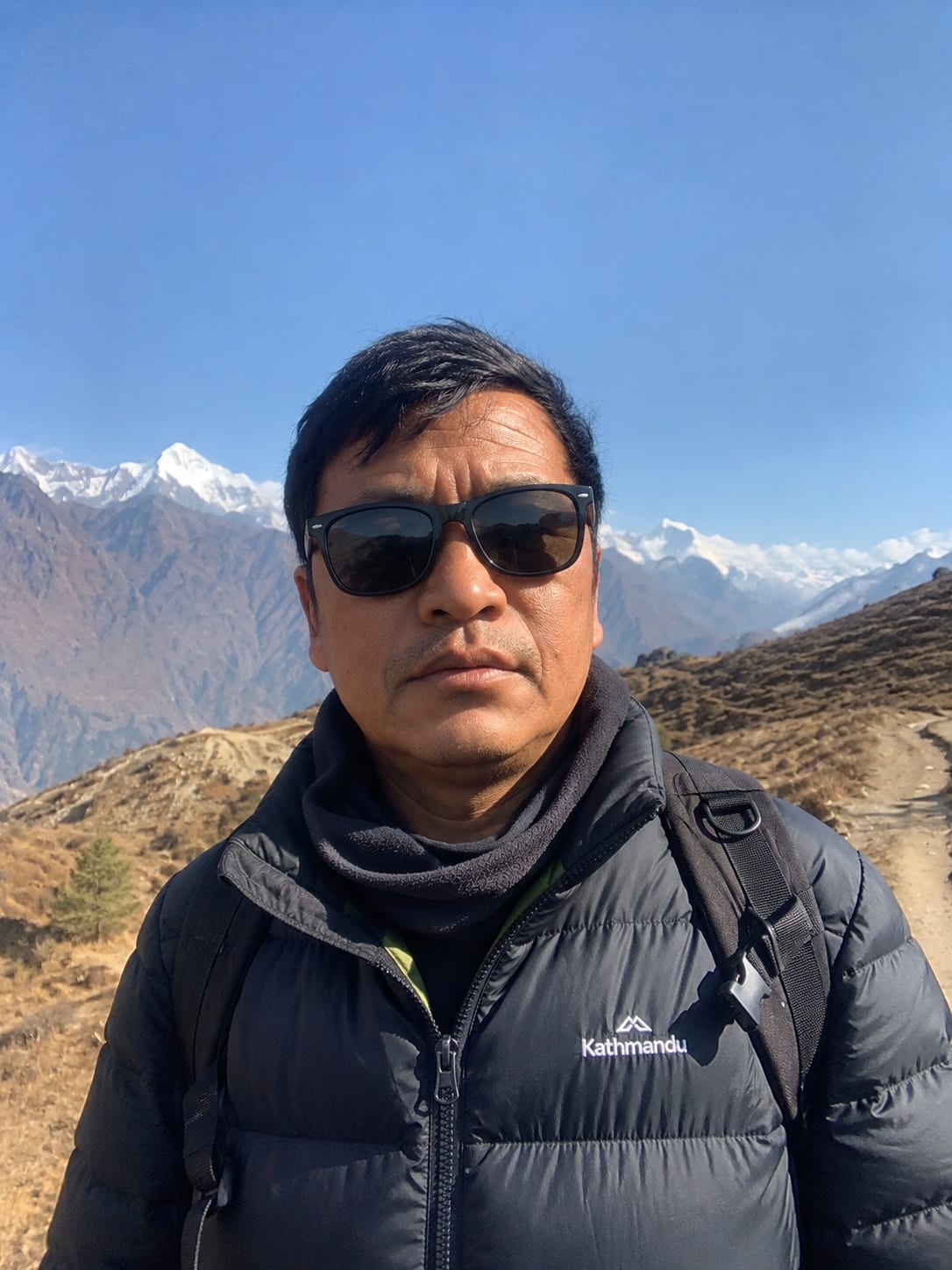
Trekkers turn back before Everest Base Camp mainly for four reasons: altitude sickness from ascending faster than the body adapts, a Lukla flight closure that eats the itinerary's buffer days, underestimated fitness demands on consecutive long walking days, and gastrointestinal illness from food or water. Nearly all four are preventable with a properly paced schedule rather than bad luck alone. Mingma Tendi Sherpa, our Senior Guide and Safety Lead, has managed turnback decisions across departures in the Himalaya and wrote this guide from that record.
The sections below cover each cause in turn, what our own departures do differently to reduce each risk, and how a trekker evaluating an operator can tell whether a schedule is actually built to prevent turnbacks or just priced to look competitive.
In this guide 7
- 01 What's the single biggest cause of an EBC turnback?
- 02 Can a Lukla flight cancellation force a turnback?
- 03 Do people underestimate the physical demands of the trek?
- 04 How much does illness from food or water contribute to turnbacks?
- 05 What do our own departures do differently to reduce turnback risk?
- 06 Does group pressure cause trekkers to push past their limits?
- 07 Is a turnback actually a failure?
What's the single biggest cause of an EBC turnback?
Altitude sickness from ascending too fast is the leading cause of turnbacks on Everest Base Camp treks, because the trail's altitude gain outpaces what the body can safely adapt to on a compressed schedule. Above 3,000 m, sleeping altitude should rise no more than 500 m a day with a rest day for every 1,000 m gained, a rule the acclimatization schedules guide covers in full. Itineraries shorter than 12 days on the classic route compress this margin and raise turnback risk measurably.
Symptoms rarely appear suddenly without warning signs: a headache that doesn't clear with rest, nausea, or disrupted sleep at a new altitude are the early markers our guides watch for, detailed further in the altitude sickness prevention guide. A guide who ignores these signs to keep a group "on schedule" is the actual failure point, not the altitude itself.
Can a Lukla flight cancellation force a turnback?
Yes, a multi-day Lukla flight closure can force a turnback even when a trekker's body is handling altitude fine, because it eats the schedule buffer that acclimatization itself depends on. The Lukla flight guide tracks on-time departure rates as low as 61% in May, and when three or four consecutive mornings close without a clear weather window, a trekker with a fixed return flight can lose the days needed to reach base camp and get back safely.
This is why every departure we sell for Everest Base Camp carries two unscheduled Kathmandu days at the end specifically to absorb a Lukla closure. A trekker who books a trip with no such buffer, or who books international flights with less than two spare days after the trek ends, is choosing a schedule where a single bad-weather week can end the trip early regardless of fitness or acclimatization.
Do people underestimate the physical demands of the trek?
Yes, and it's a common, avoidable cause: the classic Everest Base Camp route covers roughly 130 km with 6,015 m of cumulative ascent over 12 days, a workload that surprises trekkers who assume "trekking" means an easy walk rather than 5 to 7 hours a day on uneven terrain at altitude. Cardiovascular fitness matters more than technical hiking skill, since the route itself needs no climbing gear or rope work, just sustained daily output at elevations where oxygen availability drops.
A trekker who arrives without having trained, expecting the trek itself to be the fitness-building event, often finds the accumulated fatigue by day eight or nine, around Dingboche or Lobuche, becomes the actual limiting factor rather than any single hard day. Building a training base of multi-day hiking and cardio in the months before departure is the single most controllable variable in this list.
How much does illness from food or water contribute to turnbacks?
Gastrointestinal illness from contaminated food or water causes a smaller but real share of turnbacks, since dehydration and nutrient loss compound altitude symptoms rather than existing as a separate risk. Untreated water is unsafe at every altitude on the route because livestock graze upstream of nearly every village, a risk the food and water guide covers with the specific purification steps our departures follow.
A trekker who skips water purification to save time, or who eats an under-cooked dish at a lower-altitude lodge, risks a stomach illness that on its own rarely forces a turnback but that compounds badly with the fatigue and appetite loss already common above 4,000 m. Our guides carry purification supplies and flag any lodge with a recent illness report among past clients.
What do our own departures do differently to reduce turnback risk?
Our standard Everest Base Camp itinerary runs 12 days specifically to build in the Namche and Dingboche acclimatization days the 500 m rule calls for, rather than compressing the schedule to a shorter, cheaper-looking trip. On our last three Everest Base Camp departures, two groups reached base camp on the original schedule and the third added a single extra acclimatization day at Dingboche after a client's oxygen saturation reading came in low, a decision that added one day and avoided a turnback entirely.
Choosing an operator by comparing itinerary length rather than price alone is the practical takeaway here: a 9-day EBC itinerary and a 14-day one cover the same distance and altitude gain, and the difference in days is almost entirely acclimatization margin, the exact variable that determines whether a trekker reaches base camp or turns back partway.
Does group pressure cause trekkers to push past their limits?
Yes, and it's an underreported factor next to the four physical causes above. A trekker developing early symptoms in a group setting sometimes minimizes or hides them rather than reporting them honestly, worried about slowing the group down or standing out as the weak link, and that reluctance is exactly what turns a manageable early symptom into a forced late-stage descent. Our guides are trained to ask direct, specific questions, "rate your headache one to ten," "did you sleep at all last night," rather than the open "how are you feeling," which trekkers under this social pressure answer with a reflexive "fine" regardless of the truth.
Private and small-group departures reduce this pressure somewhat, since there's less of an audience to perform fitness in front of, but the dynamic exists even in a group of two: a trekker doesn't want to be the reason their trekking partner misses base camp either. Naming this pressure directly to a group on day one, and stating plainly that reporting symptoms early is what keeps everyone moving rather than what stops the trek, measurably changes how honestly clients report symptoms on the days that matter most.
Is a turnback actually a failure?
No, and treating it that way is itself part of the problem. A guide who holds a group at Dingboche for an extra acclimatization day, or who sends one trekker down while the rest continue, isn't failing to deliver the trek; that decision is the trek working as designed. The genuinely bad outcome isn't reaching Pheriche instead of base camp, it's a guide who pushes a symptomatic client higher because the itinerary said so, which is the actual mechanism behind Everest region rescue statistics far more often than any single unavoidable factor.
FAQ
Common questions
What percentage of Everest Base Camp trekkers turn back?+
There's no single reliable industry-wide figure, since operators track this differently or not at all, but altitude sickness from too-fast ascent is consistently cited as the leading cause across guiding organizations. A properly paced 12-day itinerary with built-in rest days at Namche and Dingboche reduces this risk substantially compared to a compressed schedule.
Can a fit, experienced hiker still get altitude sickness on EBC?+
Yes. Altitude sickness risk depends on ascent rate and individual physiology, not general fitness or hiking experience, so a strong hiker who ascends too fast faces the same risk as a less fit trekker on the same rushed schedule. This is why the 500 m sleeping-altitude rule applies to every trekker regardless of fitness level.
What happens if I need to turn back partway through the trek?+
Our guides descend with an affected trekker to a safe sleeping altitude immediately rather than waiting for a scheduled rest day, and the rest of the group either waits or continues under a second guide on departures with more than a handful of trekkers. A helicopter evacuation is arranged for anyone showing serious symptoms that don't improve with descent.
Does travel insurance cover a turnback due to altitude sickness?+
Most trekking-specific travel insurance policies cover medical evacuation and trip curtailment for altitude sickness, but coverage details vary by provider, so checking the policy's altitude and evacuation clauses before departure matters. The insurance guide covers what to look for in a policy.