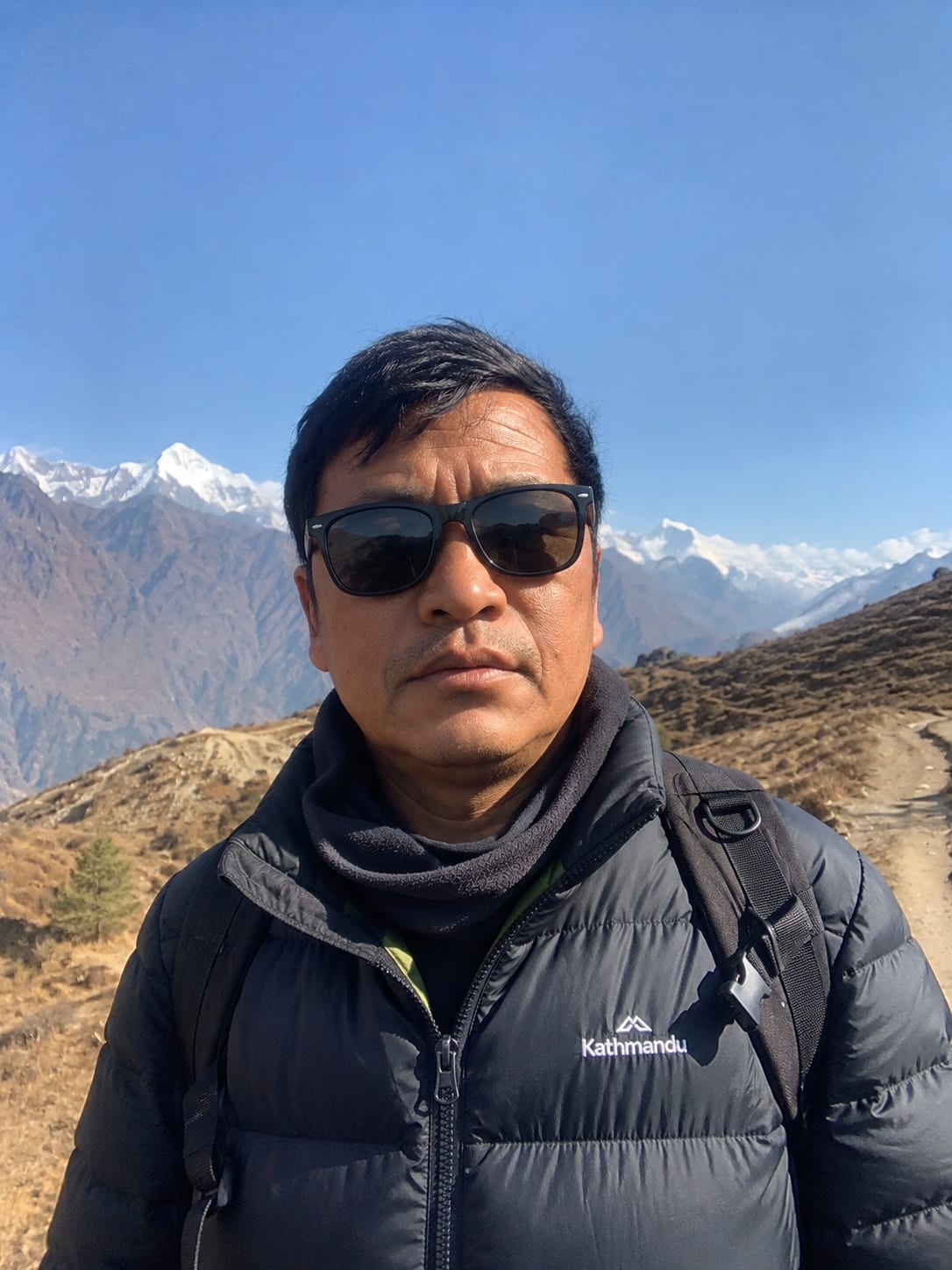
An acclimatization schedule is a planned ascent profile that keeps sleeping-altitude gains under 500 m per day above 3,000 m with rest days built in, and each Nepal trekking route has its own schedule tuned to its altitude curve. The Himalayan Rescue Association's Pheriche clinic sets the 500 m rule, and a rest day every 1,000 m of gain, as the standard our itineraries follow. Mingma Tendi Sherpa, our safety lead, wrote this guide, reviewed by lead guide Passang Dawa Sherpa.
The sections below explain the sleeping-altitude rule, the acclimatization days on the main routes, the climb-high-sleep-low principle, and how schedules differ between trekking and climbing peaks. This supports but does not replace your guide's on-trail judgment.
In this guide 6
What is the sleeping-altitude rule?
The sleeping-altitude rule is the core of every acclimatization schedule: above 3,000 m, the altitude at which you sleep should rise by no more than 500 m per day, with a rest day for every 1,000 m of net gain. The Himalayan Rescue Association's Pheriche clinic sets this guideline, and it works because the body adapts to altitude during sleep, so the sleeping height matters more than the daytime high point. A trekker can walk to 5,000 m during the day and sleep at 4,400 m safely, but sleeping 800 m higher than the night before invites acute mountain sickness. This rule is conservative by design: some individually fit trekkers could safely gain more than 500 m a day, but building a schedule around the rule rather than around individual variation is what keeps a group of eight, with different fitness levels, moving together safely.
This is why itineraries are measured by where you sleep, not where you walk. The symptoms that a broken schedule produces, and the descent that treats them, are covered in the altitude sickness prevention guide.
What are the acclimatization days on the main routes?
Each classic route builds in specific rest days at the points where the altitude curve steepens. The Everest Base Camp trek fixes rest days at Namche Bazaar (3,440 m) and Dingboche (4,410 m), the two thresholds where the trail crosses into thinner air. The Annapurna Circuit fixes two nights at Manang (3,540 m) before the Thorong La. The Langtang Valley trek uses a day at Kyanjin Gompa (3,870 m) for the Tserko Ri climb.
These days are not padding; they are the acclimatization the high sections depend on, and skipping them is the most common reason trekkers turn back short of their goal. On our departures the rest days are non-negotiable regardless of how strong the group feels.
How does climb-high-sleep-low work?
Climb-high-sleep-low is the technique that makes a rest day active rather than idle: on an acclimatization day, the group hikes several hundred metres above the sleeping altitude and then returns to sleep low. The Namche rest day climbs to the Everest View Hotel at 3,880 m and sleeps back at 3,440 m; the Dingboche day climbs Nangkartshang at 5,083 m and sleeps at 4,410 m. The high excursion stimulates the body's adaptation while the lower sleeping height keeps the night safe.
This principle is why a rest day is not a day off but a training day for the lungs and blood. Our guides log oxygen saturation on these days to confirm the adaptation is working before the group climbs higher.
Pulse oximeter readings anchor this monitoring in numbers rather than guesswork: a healthy reading at 4,000 m typically sits at 80% or above, and our guides flag anything below 75% that doesn't recover after rest as grounds to hold a group at its current altitude rather than continue the day's planned ascent. This threshold isn't a hard medical rule so much as an operational trigger, one that has prevented several summit-day and pass-crossing pushes from continuing on our departures when a client's numbers didn't support it.
How do climbing-peak schedules differ?
Climbing-peak schedules are longer and more conservative than trekking schedules, because the summit heights are higher and the summit day is a single hard push. An Island Peak climb uses the full Everest Base Camp acclimatization approach, often including base camp and Kala Patthar, before the group even reaches the peak's base camp. This extra adaptation is what lets a fit trekker with no climbing background summit a 6,189 m peak safely.
The higher the peak, the more acclimatization it needs even when it is technically easier, which is why Mera Peak at 6,476 m demands a longer schedule than the more technical Island Peak. The fitness that pairs with these schedules is in the climbing fitness preparation guide.
What are the warning signs a schedule needs to slow down?
A working acclimatization schedule still produces mild symptoms; the question is which ones mean stop and which mean push on carefully. A dull headache, mild nausea, or disrupted sleep on the first night at a new altitude are common and usually resolve within a day without descending, provided they don't worsen. A headache that doesn't respond to rest and water, vomiting, ataxia (a stumbling, drunken gait that our guides test for by having a trekker walk heel-to-toe), or confusion are the signs that end a day's ascent regardless of the planned itinerary.
Our guides carry a pulse oximeter on every departure above 4,000 m and check oxygen saturation twice daily rather than relying on symptom reports alone, because saturation numbers catch a problem before a trekker feels it. A reading that drops sharply between two checks, even if still inside a normal range, is treated as seriously as a reading that's low outright, since the trend matters more than the single number.
Does age or fitness change the schedule?
Neither age nor fitness reliably predicts who acclimatizes well, which is the single most counterintuitive fact in altitude medicine and the reason schedules are built around the route, not the individual. A very fit 25-year-old and an unfit 55-year-old face statistically similar acute mountain sickness risk at the same altitude gain rate, because acclimatization is a physiological adaptation largely independent of cardiovascular fitness. Fitness still matters for the walking itself, covering distance and elevation gain without exhaustion, but it buys no immunity from the sleeping-altitude rule.
What does predict risk is prior altitude history and ascent rate: a trekker who has acclimatized well on a previous Himalayan trip has some evidence they'll do so again, and a schedule that respects the 500 m rule protects a first-timer and a veteran equally. This is why our guides apply the same schedule to every client on a departure rather than adjusting it by age, and why a strong hiker who wants to push ahead of the group is asked to hold to the sleeping-altitude pace regardless.
FAQ
Common questions
How many rest days do I need on a Nepal trek?+
Plan a rest day for every 1,000 m of net sleeping-altitude gain above 3,000 m, following the Himalayan Rescue Association guideline. The Everest Base Camp trek uses two, at Namche (3,440 m) and Dingboche (4,410 m); the Annapurna Circuit uses two nights at Manang. These days use climb-high-sleep-low hikes to build adaptation and are non-negotiable on safe itineraries.
What is climb-high-sleep-low?+
Climb-high-sleep-low means hiking several hundred metres above your sleeping altitude on a rest day, then returning to sleep lower. The Namche rest day climbs to 3,880 m and sleeps at 3,440 m. The high excursion stimulates the body's adaptation while the lower sleeping height keeps the night safe, which is why rest days are active rather than idle.
What if someone in the group isn't acclimatizing on schedule?+
The schedule holds for the group, but the response to a struggling individual is immediate: a guide descends with that person to a safe sleeping altitude rather than waiting for the next planned rest day, and the rest of the group either waits or continues under a second guide if the itinerary has one assigned. This is why every departure above 4,000 m on routes like the Everest Base Camp trek and Manaslu Circuit travels with more than one guide once the group exceeds a handful of trekkers. Splitting the group this way costs nothing extra and is standard practice, not an emergency measure, whenever the itinerary crosses 4,000 m with more than four or five clients.