Nepal Travel Packages
Everest Three Passes Trek

Everest Three Passes Trek

★★★★★ 4.9 (58 reviews)
Everest, Nepal 18-20 days Strenuous Max 5,545 m
Duration
18-20 days
Max altitude
5,545 m
Difficulty
Strenuous
Group size
Up to 10
Total distance
~166 km
Elevation gain
9,800 m
Best season
late March to May, October to November
Avg daily walk
6-8 hours
Starts in
Lukla (2,860 m)
Ends in
Lukla (2,860 m)
Accommodation
Teahouse lodges throughout
✓ TAAN & NMA licensed guides ✓ Permits included, no hidden fees ✓ Small group departures
Group departure · per person
USD2,300
Permits, guide, porter, lodging & food included
Departure date
Email Nepal
Permits and logistics fully arranged
Licensed guide included on every departure
Direct WhatsApp line to your guide

The Everest Three Passes Trek is an 18 to 20 day teahouse circuit in Nepal's Khumbu region that crosses the Kongma La (5,535 m), Cho La (5,420 m), and Renjo La (5,360 m) while taking in Everest Base Camp and the Gokyo Lakes. A 2026 group departure costs USD 1,900 to 2,600 per person including the Khumbu Pasang Lhamu Rural Municipality permit (NPR 2,000) and Sagarmatha National Park entry (NPR 3,000). It is the most demanding standard teahouse trek in the entire Khumbu region, and we run it only for trekkers with prior high-altitude experience above 4,500 m.

Passang Dawa Sherpa has led 11 full Three Passes crossings against 74 standard Everest Base Camp departures, and treats this as a genuinely different product from the base camp trek rather than a longer version of it: smaller groups, longer guide engagement, and a fitness and altitude-history screening at booking. The sections below cover the two permits, a cost breakdown against the USD 1,900 to 2,600 range, the prior-experience requirement, the pass-day start times and turnaround rules that keep the crossings safe, Lukla flight reliability, and what teahouses and packing look like across a circuit that spans three distinct sections of the Khumbu.
Highlights

What our guides know that others don't.

1

Pass-day start times

4-5 am starts; hard turnaround if not at the pass by set times

2

Cho La ice section

Short glacier crossing, microspikes carried Oct-May

Live from the trail

Updated 2 Jul 2026

Monsoon status: passes not advised, closed for the season

The high passes carry monsoon cloud and wet rock through the summer, and the Cho La glacier is unstable in the warm months. We do not run Three Passes departures in monsoon. The route reopens for scheduled crossings in early October after the first stable high-pressure spells.

What permits does the Everest Three Passes Trek require?

The same two permits cover the Three Passes as the standard Everest Base Camp route: the Khumbu Pasang Lhamu Rural Municipality permit at NPR 2,000 and the Sagarmatha National Park entry at NPR 3,000. Both are issued in Lukla or at Monjo, take Nepali rupees, and cover the entire circuit including the Gokyo side, because the whole route stays inside the national park. No extra permit applies for the passes themselves.

Because the circuit never exits the park, one park entry covers all three passes and both the EBC and Gokyo arms. The permit process, checkpoints, and payment detail sit in the Everest Base Camp permit costs guide. Both permits are checked at Monjo on the way in, the same hard checkpoint every Khumbu route passes through, and carrying them in a daypack rather than a porter's load matters just as much on an 18-day circuit as a 12-day trek, since a lost permit has no field replacement.

No TIMS card applies anywhere in the Khumbu, and no restricted-area permit or minimum group size governs this route, unlike Manaslu, Upper Mustang, or Dolpo. Solo trekkers remained legal in the Khumbu as of this page's most recent update, covered in our solo trekking guide requirement page, though the technical Cho La section and the circuit's remoteness make a licensed guide's judgment worth far more here than the permit rules require.

How much does the Everest Three Passes Trek cost in 2026?

TAAN-registered operators quoted USD 1,900 to 2,600 for a group Three Passes departure in 2026, well above standard EBC because the trek runs 18 to 20 days and needs extra staff and technical gear. The table shows the breakdown, and duration drives every wage and food line upward against a 14-day trek. We include group microspikes and a rope for the Cho La glacier in the logistics line.

The Lukla flight cost is identical to any Everest trek, but the guide and porter engagement is a third longer, and the food budget at sustained altitude runs high. This is not a route where a low quote makes sense; the technical passes demand experienced staff paid properly.

Compared to a standard Everest Base Camp departure at USD 1,200 to 1,800, the Three Passes runs roughly 50 to 60% higher for a route that's about 50% longer in days, which tracks closely with how guide and porter wages scale with duration on any Nepal trek. Private departures at USD 2,300 to 3,200 carry a smaller proportional premium over the group rate than on a shorter trek, since the fixed technical-gear costs, group microspikes, rope, don't change much whether the party is two trekkers or ten.

Where the price goes · per person
Permits (Khumbu municipality + Sagarmatha NP)NPR 5,000 total at 2026 rates$38
Kathmandu/Ramechhap-Lukla flights, round tripFixed USD fare band for foreign nationals$360–440
Licensed guide (shared in group)USD 35-40/day over 18-20 days$560–760
Porters, one per two trekkersUSD 25/day, longer engagement$400–540
Teahouse rooms, 17-19 nightsHigher at the high passes' base lodges$110–220
Food and drinking waterLong duration at altitude drives this up$420–620
Company margin, logistics, staff equipmentIncludes group microspikes and rope$200–380

Why does the Three Passes need prior experience?

The Three Passes crosses three cols above 5,300 m on consecutive walking days at altitude, which compounds fatigue and altitude stress in a way the single-destination EBC trek does not. We ask that trekkers have spent prior nights above 4,500 m, ideally on a Nepal or comparable high trek, so we know how their bodies handle sustained altitude before committing to the Kongma La. A first-timer's altitude response is unknown, and finding it out at 5,535 m on a glacier is the wrong place.

Fitness matters, but altitude history matters more, and our booking process asks about it directly. Trekkers without that background are better served by the standard Everest Base Camp trek first, then the Three Passes on a later trip.

Passang Dawa Sherpa, who has led 11 full Three Passes crossings against 74 standard Everest Base Camp departures, treats this route differently on the ground too: a smaller maximum group size (10 against 12 on the standard trek), a longer guide engagement per trekker, and a fitness and altitude-history conversation at booking that a standard EBC enquiry doesn't get. This is not a route we upsell to first-time high-altitude trekkers regardless of how fit they say they are, because the risk profile of three consecutive 5,300 m+ days genuinely differs from a single destination at similar peak altitude.

What are the pass-day start times and turnaround rules?

Each pass day starts at 4 to 5 am so the group crosses before the afternoon wind and cloud build, and each carries a hard turnaround time: if we are not at the col by the set hour, we descend and try again or reroute. On our last three Cho La crossings, one group turned back at the ice section in poor visibility and crossed cleanly the next morning, which is exactly how the rule is meant to work. The Cho La involves a short glacier section where we carry microspikes and a rope from October through May.

These rules are the difference between a managed high crossing and an exposed gamble, and Pemba enforces them regardless of how close the group feels. Altitude planning and the descent protocol behind them are in the altitude sickness prevention guide.

Our guides score symptoms twice daily above 4,000 m using the Lake Louise scale, rating headache, gastrointestinal upset, fatigue, and dizziness from 0 to 3 each; a score of 6 or higher means immediate descent on any of the three pass days, not just a discussion. HAPE (fluid in the lungs, breathlessness at rest, a wet cough) and HACE (fluid on the brain, confusion, a stumbling gait) are the two emergency forms we train for, and this route's back-to-back high passes are exactly the profile where compounding fatigue raises that risk over a standard single-destination trek. Both are treated identically: immediate descent, oxygen if available, evacuation, and a policy covering evacuation to at least 5,600 m is mandatory on every departure we run.

How reliable are Lukla flights for a Three Passes departure?

Our departure records from 2024 to 2026 show Lukla flights leaving on schedule 83% of the time in February, 76% in October, 68% in April, and 61% in May, single-operator figures from 41 flights that explain why we build spare days into every itinerary. On the Three Passes specifically, a delayed start matters more than on a standard trek, since the circuit's back-to-back high days leave little slack to compress once the group is moving, so we hold two buffer days at the end rather than one.

Ramechhap (Manthali), a 4 to 5 hour drive from Kathmandu, carries most high-season Lukla traffic, while winter departures generally fly from Kathmandu directly. A cancelled flight rolls passengers to the next morning's manifest in booking order, and a helicopter seat at USD 500 to 700 per person is the paid same-day alternative, covered in full in our Lukla flight guide.

What are teahouses like on the Three Passes, and what should you pack?

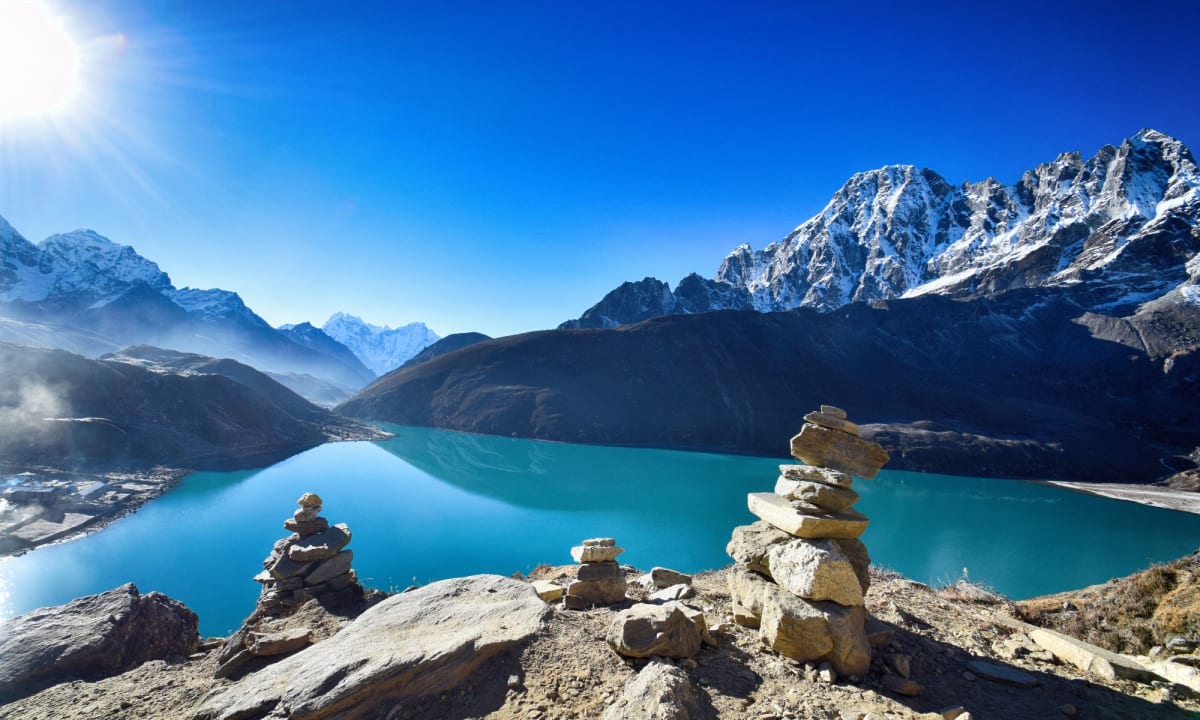
Teahouse infrastructure on this circuit matches whichever section you're on: base camp trail standard (NPR 300-1,500 a night, cheaper with meals included) through Lobuche and Gorak Shep, and Gokyo-valley pricing (NPR 800-1,200) through the lakes. The remote stretch between Dzongla, over the Cho La, and Thagnak has the thinnest lodge choice on the entire circuit, and our guides' standing relationships with specific lodge owners matter more here than on any single-destination Everest route, since a full teahouse at 4,700 m with no alternative down the trail is a genuinely different problem than one in Namche.

Packing follows the same core list as any high Khumbu route, a four-season sleeping bag rated to -15 C comfort, layered clothing, broken-in boots, detailed in the Nepal trekking packing list, with two additions specific to this circuit: microspikes and trekking poles for the Cho La's glacier section, and a wider cold-weather margin than a standard trek, since three consecutive nights near or above 4,700 m run colder than the equivalent altitude on a single-pass itinerary. WiFi and charging costs track the base camp and Gokyo guides exactly, NPR 600 for a 10 GB Everest Link card, NPR 300 to 500 per device charge above Dingboche, with no connectivity at all on the two most remote pass-crossing days.

Elevation profile High point 5,545 m
3,0003,5004,0004,5005,0002,610 m123456785,164 m9101112131415162,860 m17DAY
Acclimatization night High point

Day by Day

18-day itinerary, every detail planned.

Day1
Trip Day
Fly to Lukla (2,860 m), trek to Phakding (2,610 m)
~3h walking8 km
2,610m alt.

The 30-minute mountain flight and a gentle 250 m descent over 8 km to Phakding mirror the standard EBC start. The long circuit ahead makes an easy first day worthwhile, and guides use the walk to check pack weights and pace before the harder days begin.

2,610 m8 km~3h
Day2
Trip Day
Phakding to Namche Bazaar (3,440 m)
~6h walking11 km
3,440m alt.
Day3
Acclimatization
Acclimatization day in Namche
~4h walking
3,440m alt.
Day4
Trip Day
Namche to Tengboche (3,860 m)
~5h walking10 km
3,860m alt.
Day5
Trip Day
Tengboche to Dingboche (4,410 m)
~5h walking11 km
4,410m alt.
Day6
Acclimatization
Acclimatization day in Dingboche
~4h walking
4,410m alt.

What's Included

Transparent, all-in pricing.

Included in your price

Permits (Khumbu municipality + Sagarmatha NP)
Kathmandu/Ramechhap-Lukla flights, round trip
Licensed guide (shared in group)
Porters, one per two trekkers
Teahouse rooms, 17-19 nights
Food and drinking water
Company margin, logistics, staff equipment

Not included

Nepal entry visa fee (USD 30-125, paid on arrival)
Travel insurance with helicopter evacuation cover
Personal trekking gear and equipment
Tips for your guide and porter
Bottled drinks, wifi, and device charging at teahouses
Meals in Kathmandu outside the itinerary

Dates & prices

Upcoming departures.

Start dateEnd datePrice / personAvailability
1 Oct 202618 Oct 2026USD 2,300Guaranteed · 4 leftEnquire
20 Oct 20266 Nov 2026USD 2,300Open · 7 leftEnquire
5 Apr 202722 Apr 2027USD 2,250Open · 8 leftEnquire

Verified reviews

What travellers say.

4.9/5 from 58 reviews on TripAdvisor, checked July 2026

★★★★★

The hardest and best trek I have done. Pemba's pass-day discipline was total, 4 am starts and one turnaround on the Cho La that proved right the next morning. Having done EBC two years earlier made the altitude manageable.

AN
Andreas Nilsson · Sweden
12 May 2026
★★★★★

Three passes, EBC, and Gokyo in one loop is a serious undertaking and it delivered. The Renjo La view back over Gokyo to Everest was the highlight of nineteen days. Come fit and acclimatized.

RC
Rebecca Cho · United States
28 Apr 2026

Why Nepal Travel Packages

Built on published proof, not adjectives.

A named, licensed guide before you book

Full name, photo, NMA or TAAN license number, and a direct WhatsApp line. The guide on the page is the guide on the trail.

Itemized pricing, not a lump sum

Permits, guide, porter, lodging, and food broken out on every trip page. You see exactly where the price comes from.

Trail conditions updated monthly

Dated field reports from the guides running the route this season, not boilerplate written once and left to go stale.

Permits handled, not hidden

Every permit fee, checkpoint, and paperwork rule is filed for you and published in the guides — no surprise admin at Lukla.

FAQ

Common questions

How experienced do I need to be for the Three Passes?+

We ask for prior nights above 4,500 m, ideally on a Nepal or comparable high trek, so your altitude response is known before the Kongma La. The trek crosses three cols above 5,300 m on consecutive days, which compounds altitude stress. Strong first-time trekkers are better served by the standard Everest Base Camp trek first.

Do the passes require technical climbing skills?+

No roping-up or climbing skill is needed on the Kongma La or Renjo La, which are rocky walks. The Cho La has a short glacier section where we issue microspikes and use a rope for security from October through May. Our guides fix and manage that section, so no prior glacier experience is required, only sure footing and comfort walking on uneven, exposed terrain in cold conditions before sunrise.

Can the passes be closed?+

Yes, heavy snow can close any of the three passes for a day or two, and our itinerary carries contingency time for it. The Cho La is the most weather-sensitive because of its ice section. Guides make the crossing call each morning on the pass report, and reroute over the lower trails if a pass stays shut, which is why the itinerary's built-in buffer days matter as much for pass closures as for Lukla flight delays at either end.

What insurance do I need for the Three Passes?+

A policy covering trekking to 5,600 m with helicopter evacuation is essential on this route, given three high passes and remote terrain. Evacuation from the upper Khumbu can cost USD 3,000 to 6,000, and rescue from the remote Lungden-to-Thame stretch specifically takes longer to coordinate than from the busier base camp trail. Coverage tiers and what to check are in the helicopter evacuation insurance coverage guide.

How does the Three Passes compare to Everest Base Camp?+

The Three Passes is significantly longer (18-20 days against 12-16), reaches the same Kala Patthar high point (5,545 m) but adds three more passes above 5,300 m, and costs USD 1,900-2,600 against USD 1,200-1,800 in group rates. It shares the same permits and the same first six days out of Lukla. Trekkers without prior high-altitude experience are better served starting with the Everest Base Camp Trek and returning for the full circuit on a later trip.

Can I do just one or two passes instead of all three?+

Yes, informally. A trekker who wants Everest Base Camp and Gokyo without the Kongma La can follow the Gokyo Lakes Trek and add a Cho La crossing partway through, effectively doing two of the three passes on a shorter, less demanding schedule. We scope this as a custom itinerary rather than a fixed product, since the exact combination changes the days and cost meaningfully, and it's a conversation to have directly with your guide before booking rather than a published fixed-price option.

What is the coldest point on the Three Passes circuit?+

The three consecutive nights near or above 4,700 m, Dzongla, Thagnak, and the approach to Lungden, run colder than the equivalent altitude on a single-pass itinerary, since the body has less recovery time between high nights. Bedrooms are unheated at every altitude on this route, which is why our packing list specifies a four-season sleeping bag rated to -15 C comfort as the minimum, colder-rated for a winter departure.

What training should I do before the Three Passes?+

Build well beyond the standard EBC benchmark: aim for 20 km days with 900 m to 1,000 m of cumulative ascent on consecutive days, carrying a 6 to 8 kg daypack, in the three to four months before departure, since the circuit's back-to-back pass days compound fatigue in a way a single-destination trek doesn't. Prior nights above 4,500 m matter as much as raw fitness, which is why we ask about altitude history directly at booking rather than relying on a fitness questionnaire alone.

When is the best season for the Three Passes specifically?+

Late March to May and October to November are the two windows we run scheduled departures, narrower than the standard EBC season, since the Cho La's glacier section and the other two passes carry real snow risk outside those months. We do not run Three Passes departures in monsoon or the depth of winter, unlike the standard base camp trek, which we still operate through January and February for trekkers who accept the cold trade-off.