Nepal Travel Packages
Everest Foothills Yoga Trek

Everest Foothills Yoga Trek

★★★★★ 4.8 (21 reviews)
Yoga Treks, Nepal 8-9 days Moderate Max 3,860 m
Duration
8-9 days
Max altitude
3,860 m
Difficulty
Moderate
Group size
Up to 10
Total distance
~62 km
Elevation gain
2,100 m
Best season
March to May, late September to December
Avg daily walk
3-5 hours
Starts in
Lukla (2,860 m)
Ends in
Lukla (2,860 m)
Accommodation
Teahouse lodges with practice space
✓ TAAN & NMA licensed guides ✓ Permits included, no hidden fees ✓ Small group departures
Group departure · per person
USD1,550
Permits, guide, porter, lodging & food included
Departure date
Email Nepal
Permits and logistics fully arranged
Licensed guide included on every departure
Direct WhatsApp line to your guide

The Everest Foothills Yoga Trek is an 8 to 9 day teahouse trek in Nepal's Khumbu region that pairs twice-daily yoga practice with gentle trekking to Tengboche at 3,860 m, stopping well short of Everest Base Camp's 5,364 m and capping daily ascent at 500 to 600 m. A 2026 group departure costs USD 1,250 to 1,750 per person including the Khumbu Pasang Lhamu Rural Municipality permit (NPR 2,000), Sagarmatha National Park entry (NPR 3,000), and the Lukla flight. Two lodge nights at Namche Bazaar (3,440 m) plus a slower two-day approach from Phakding keep the ascent inside the daily cap, so the evening practice session is never sacrificed to a hard climbing day.

Ajay Shrestha, who holds a 500-hour Yoga Alliance certification earned in Rishikesh in 2019, designed this itinerary and pairs with Passang Dawa Sherpa, whose 18 years of guiding cover every teahouse lodge between Lukla and Tengboche, for the trekking logistics on each departure. The sections below cover the two permits shared with every Everest-region trek, a cost breakdown against the USD 1,250 to 1,750 range, the practice schedule's cold-morning adjustment above Namche, and why the route stops at Tengboche rather than continuing to base camp.

Highlights

What our guides know that others don't.

1

Cold-morning practice adjustment

Sunrise sessions shift to mid-morning above Namche (3,440 m) once temperatures allow

2

Route ceiling

Ends at Tengboche (3,860 m); itineraries are not extended to Everest Base Camp (5,364 m)

Live from the trail

Updated 2 Jul 2026

Monsoon status: Khumbu wet below Tengboche, practice moves indoors

Monsoon rain is falling daily below Tengboche and the trail between Phakding and Monjo is leech-active, the same conditions affecting the full Everest Base Camp Trek. Lodge terraces are often too wet for outdoor practice through the low season, so sessions move to dining halls. Lukla flights are running via Kathmandu rather than Ramechhap in the low season. Next scheduled departure: early October.

Who is the Everest Foothills Yoga Trek built for?

This trek suits travellers who want Khumbu scenery and daily yoga practice without the 12 to 16 day commitment or the 5,364 m altitude of the full Everest Base Camp Trek. Tengboche at 3,860 m is the trip's ceiling, low enough that acute mountain sickness risk stays minimal while Ama Dablam and Everest's summit pyramid are both visible from the monastery courtyard. Prior yoga experience is not required, and prior trekking experience is not required either given the moderate grading and the 500 to 600 m daily ascent cap.

The route borrows the same trail as the Everest Base Camp Trek through Namche Bazaar and Tengboche, so trekkers who later want to continue to base camp already know the first four days. Travellers who want the Annapurna region's gentler foothills instead should compare the yoga trek in the Annapurna foothills, and those planning a longer stay afterward can add the post-trek recovery guide once they are back in Kathmandu.

What does the Everest Foothills Yoga Trek cost in 2026?

A group departure runs USD 1,250 to 1,750 per person in 2026, above the Annapurna-region yoga treks because the Lukla flight alone costs USD 360 to 440 round trip and neither distance nor discount changes that fare. The table below shows the breakdown, and the yoga teacher and Khumbu guide line is the second-largest cost, since the trip carries both a certified teacher and a locally licensed trekking guide rather than one person doing both jobs. Permits add a fixed NPR 5,000 (about USD 38) at 2026 rates.

Nine days is shorter than the 12 to 16 day Everest Base Camp Trek, which keeps the porter and food lines smaller even though the flight cost is identical. A private departure for a couple sits at USD 1,600 to 2,100 because the teacher and guide costs spread across fewer people. Two spare Kathmandu days after the Lukla flight, the same buffer built into every Khumbu itinerary, are not included in the trek price.

Where the price goes · per person
Permits (Khumbu municipality + Sagarmatha NP)NPR 5,000 total at 2026 rates$38
Kathmandu/Ramechhap-Lukla flights, round tripFixed USD fare band for foreign nationals$360–440
Yoga teacher and Khumbu guide (shared)RYT 500 teacher plus a TAAN-registered local guide$320–460
Porter, one per two trekkersUSD 25/day, 20 kg shared load, 8-9 days$130–190
Teahouse rooms with practice space, 7-8 nightsLodges chosen for a room to practice in$70–140
Food and drinking waterDal bhat and lighter practice-day meals$210–320
Company margin, logistics, mats and props$110–190

How does the practice schedule handle Khumbu cold mornings?

Sunrise vinyasa at 2,610 m in Phakding stays on schedule, but above Namche Bazaar (3,440 m) morning temperatures commonly sit at -5 to 2 C before the sun clears the ridgeline, so the sunrise session there shifts to a mid-morning slot after breakfast. This cold-morning adjustment is the trek's defining rare attribute, since no other yoga trek on this site changes its practice timing for altitude-driven temperature. Evening sessions stay restorative rather than vigorous from Namche upward, closer to the yin style Ajay teaches on the Pokhara retreat.

Layered clothing matters more here than on the Annapurna yoga treks, since a thin practice layer that works at 1,940 m in Ghandruk is not enough at 3,860 m in Tengboche. Passang Dawa Sherpa checks morning temperatures at each lodge and confirms the session slot the night before, so the group is never caught practicing in a room too cold to hold a pose. Two practice sessions a day still happen every day of the trek, just timed to the mountain rather than the clock.

Why does this trek stop at Tengboche instead of continuing to Everest Base Camp?

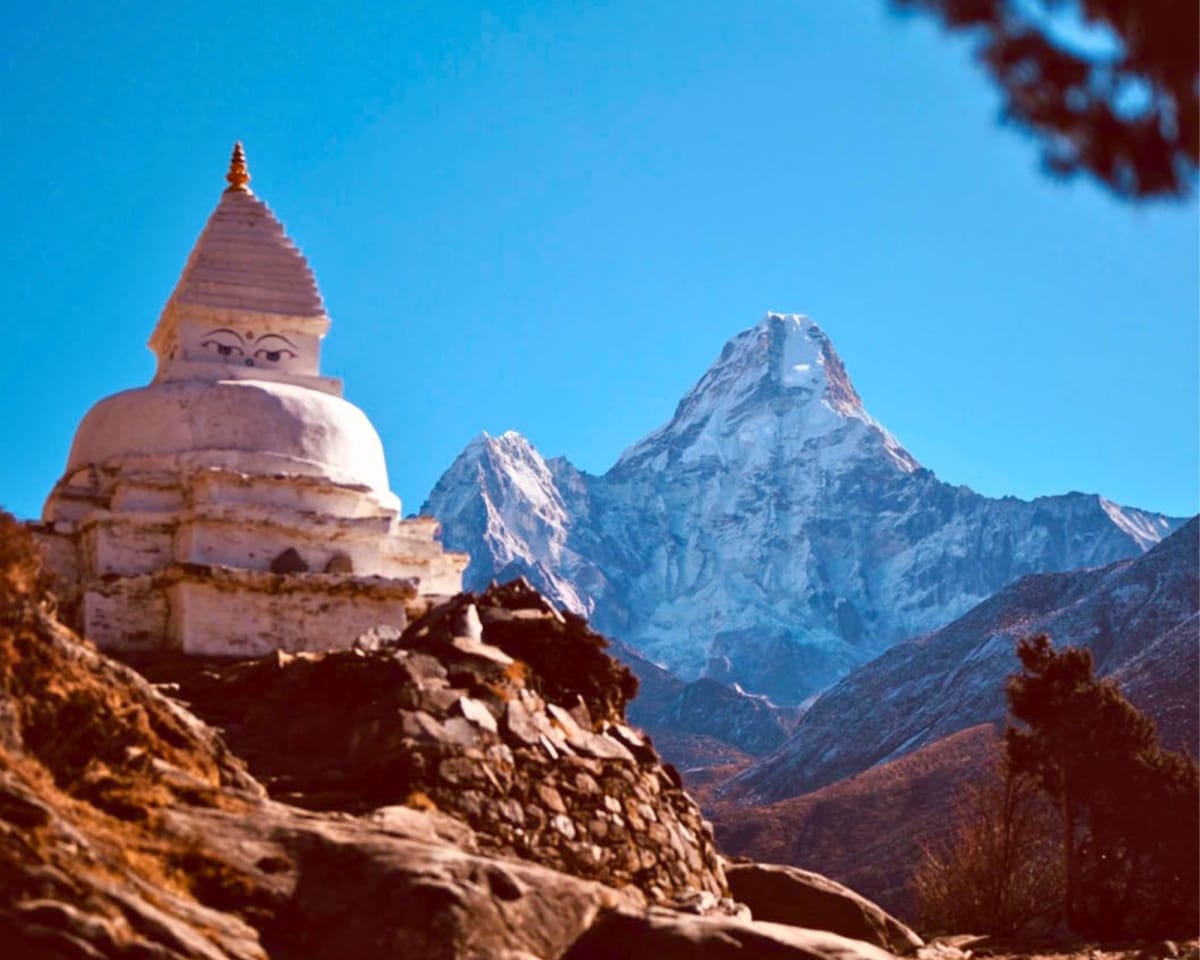
Tengboche's 3,860 m is a deliberate ceiling, roughly 1,500 m below Everest Base Camp's 5,364 m and well under the altitude where acute mountain sickness becomes a serious risk for most trekkers. The Everest Base Camp Trek needs 11 nights above 3,000 m and two dedicated acclimatization days to reach 5,364 m safely; this trek needs neither, which is what keeps it to 8 or 9 days instead of 12 to 16. Travellers who want the summit-pyramid views without that altitude commitment get them at Tengboche monastery, one of the route's best viewpoints of Everest, Nuptse, and Ama Dablam together.

This is not a shortened version of the Everest Base Camp Trek, and our itineraries do not extend it upward on request, because the daily ascent cap and practice schedule stop working above 4,000 m. Trekkers who complete this trip and want to continue toward base camp on a later visit already have Namche and Tengboche behind them. The two permits are identical either way, so nothing about the paperwork changes if a return trip goes further.

What permits does the Everest Foothills Yoga Trek require?

Two permits cover this route, the same pair required for the full Everest Base Camp Trek: the Khumbu Pasang Lhamu Rural Municipality permit at NPR 2,000 (about USD 15) and the Sagarmatha National Park entry at NPR 3,000 (about USD 23). Both are issued in Lukla or at the Monjo checkpoint, never in Kathmandu, and checked again at the Namche exit post. No restricted-area permit applies, and no separate yoga or wellness permit exists in Nepal.

Ramesh Rai's team processes these two permits for every Khumbu departure this company runs, regardless of how far up the valley the itinerary goes. Both permits are already included in the group and private prices above, so no separate paperwork errand falls on the trekker beyond carrying a passport photo for the counter in Lukla. The requirement has stayed unchanged since the rural municipality replaced TIMS in the Khumbu in 2018.

Who leads the Everest Foothills Yoga Trek?

Ajay Shrestha and Passang Dawa Sherpa co-lead every departure of this trek, and neither role is interchangeable with the other. Ajay holds a 500-hour Yoga Alliance certification earned in Rishikesh in 2019 and designed the practice sequence specifically for teahouse terraces and cold-altitude mornings, the same background he brings to the Annapurna Yoga Trek and the Poon Hill Yoga Trek. Passang Dawa Sherpa has led 74 Everest Base Camp departures since 2008, holds NMA Trekking Guide License 1123, and grew up in Phortse at 3,840 m, a village on this trek's approach; his 18 years in the Khumbu cover every teahouse route between Lukla and Tengboche, including the one this trip uses.

Splitting the two roles matters because a trekking guide without yoga training can get a group safely up the trail but can't sequence a practice session for cold, thin-air mornings, and a yoga teacher without Khumbu experience can't judge whether a lodge's terrace is safe to practice on in wind. Every departure carries both, not one person doing both jobs at a lower standard. Full certifications for both are on the team page.

How does the Everest Foothills Yoga Trek compare to the standard Everest Base Camp Trek?

Both trips start at the same Lukla airstrip and share the first four days of trail through Phakding, Monjo, and Namche Bazaar, so the real comparison is what happens after Namche. The standard Everest Base Camp Trek continues 6 to 8 more days past Tengboche to reach 5,364 m at base camp and 5,545 m at Kala Patthar, with two further acclimatization days and roughly 3,500 m of total ascent; this yoga trek turns back at Tengboche's 3,860 m after one practice-focused night there, for a total ascent of 2,100 m.

The price gap reflects that difference in scope less than it might seem: the standard trek runs USD 1,200-1,800 in a group against this trip's USD 1,250-1,750, nearly identical, because both carry the same fixed Lukla flight and permit costs even though this trip has fewer trekking days, offset by carrying a second, specialist instructor. Trekkers who complete this yoga trek and later want to continue to base camp keep the same permits and the same first four days of trail already familiar; nothing about this trip forecloses a future base camp attempt.

When is the best season for the Everest Foothills Yoga Trek?

March to May and late September to December are this trek's two reliable windows, the same seasonal pattern that governs every Khumbu route, since Lukla flights depend on the same clear-morning conditions regardless of what happens on the trail afterward. Spring brings rhododendron blooms below Namche and warming daytime temperatures, while autumn and early winter carry the clearest mountain visibility of the year, both good conditions for outdoor practice sessions on lodge terraces.

Winter, January through February, is not scheduled for this trek even though the Khumbu stays accessible, because overnight temperatures at Tengboche regularly drop well below what the cold-morning practice adjustment is designed to handle. Monsoon, June through early September, is avoided for a different reason: the practice sessions themselves stay viable, but daily rain and leech activity on the lower trail between Phakding and Monjo make the approach unpleasant enough that departures don't run in that window, covered in the same terms for the full Everest Base Camp Trek in the trekking Nepal in monsoon guide.

What altitude and acclimatization schedule does this trek follow?

Tengboche at 3,860 m is roughly 1,500 m below the altitude where acute mountain sickness becomes a serious risk for most trekkers, but the trip still follows the same 500 m sleeping-altitude guideline used on every high route this company runs, covered in the altitude sickness prevention guide. The itinerary's one acclimatization day sits at Namche Bazaar (3,440 m) on day 4, before the final push to Tengboche, with a day hike to the Everest View Hotel at 3,880 m that briefly touches higher ground than the trek's actual sleeping ceiling, the standard climb-high-sleep-low pattern.

Passang Dawa Sherpa carries a pulse oximeter and checks the group each morning from Namche onward, the same protocol used on the full Everest Base Camp Trek, even though this shorter trip's lower ceiling makes serious AMS unlikely. Anyone who has previously struggled with altitude below 4,000 m on another trip should mention it before booking, since the practice sessions' twice-daily pace gives more opportunity than a straight trekking itinerary to notice early symptoms and adjust.

What should you pack for the Everest Foothills Yoga Trek?

Packing follows the same core Khumbu list covered in the Nepal trekking packing list: a four-season sleeping bag rated to at least -15 C comfort, since teahouse rooms above Namche have no heating at any altitude on this route. A lightweight yoga mat is worth carrying rather than renting, since lodge floor texture varies from Phakding to Tengboche and a personal mat keeps the practice consistent; most trekkers pack a travel mat under 1 kg rather than a full-thickness studio mat.

Layered practice clothing matters more here than on the Annapurna yoga treks, covered in the practice-schedule section above: a thin layer that works at 2,610 m in Phakding is not enough for a mid-morning session at 3,860 m in Tengboche. A warm layer to put on immediately after practice, not just during it, prevents the post-session chill that catches first-time cold-weather practitioners off guard.

Elevation profile High point 3,860 m
3,0003,5002,610 m12343,860 m5672,860 m8DAY
Acclimatization night High point

Day by Day

9-day itinerary, every detail planned.

Day1
Trip Day
Fly Kathmandu/Ramechhap to Lukla (2,860 m), trek to Phakding (2,610 m)
~3h walking8 km
2,610m alt.

The 30-minute mountain flight lands at Tenzing-Hillary Airport by mid-morning in normal conditions, then an easy 3-hour riverside walk reaches Phakding. A gentle arrival practice session on the lodge terrace closes the first day.

2,610 m8 km~3h
Day2
Trip Day
Phakding to Monjo (2,835 m)
~3h walking7 km
2,835m alt.
Day3
Trip Day
Monjo to Namche Bazaar (3,440 m)
~4h walking5 km
3,440m alt.
Day4
Acclimatization
Acclimatization and practice day in Namche Bazaar
~4h walking
3,440m alt.
Day5
High Point
Namche to Tengboche (3,860 m)
~5h walking10 km
3,860m alt.
Day6
Acclimatization
Practice day at Tengboche, monastery ceremony
~1h walking
3,860m alt.

What's Included

Transparent, all-in pricing.

Included in your price

Permits (Khumbu municipality + Sagarmatha NP)
Kathmandu/Ramechhap-Lukla flights, round trip
Yoga teacher and Khumbu guide (shared)
Porter, one per two trekkers
Teahouse rooms with practice space, 7-8 nights
Food and drinking water
Company margin, logistics, mats and props

Not included

Nepal entry visa fee (USD 30-125, paid on arrival)
Travel insurance with helicopter evacuation cover
Personal trekking gear and equipment
Tips for your guide and porter
Bottled drinks, wifi, and device charging at teahouses
Meals in Kathmandu outside the itinerary

Dates & prices

Upcoming departures.

Start dateEnd datePrice / personAvailability
4 Oct 202612 Oct 2026USD 1,550Guaranteed · 4 leftEnquire
8 Nov 202616 Nov 2026USD 1,500Open · 7 leftEnquire
7 Mar 202715 Mar 2027USD 1,500Open · 8 leftEnquire
11 Apr 202719 Apr 2027USD 1,600Open · 8 leftEnquire

Verified reviews

What travellers say.

4.8/5 from 21 reviews on TripAdvisor, checked July 2026

★★★★★

Tengboche monastery at dusk was worth the whole trip on its own, and the practice sessions shifting to mid-morning above Namche made total sense once we felt how cold it was at dawn. Passang Dawa Sherpa, Ajay's co-guide for this route, had rooms waiting at every lodge from Phakding to Tengboche. We got Everest's summit-pyramid views without the two-week commitment the full base camp trek needs.

KF
Karen Fitzgerald · Ireland
2 May 2026
★★★★★

My knees were grateful for the 500 to 600 m ascent cap after doing the full Everest Base Camp Trek with a different operator two years ago. The yoga sessions at Tengboche, with Ama Dablam framed in the monastery courtyard, are a memory I still return to. Nine days was exactly enough without pushing past 4,000 m.

TB
Thomas Berg · Germany
28 Mar 2026

Why Nepal Travel Packages

Built on published proof, not adjectives.

A named, licensed guide before you book

Full name, photo, NMA or TAAN license number, and a direct WhatsApp line. The guide on the page is the guide on the trail.

Itemized pricing, not a lump sum

Permits, guide, porter, lodging, and food broken out on every trip page. You see exactly where the price comes from.

Trail conditions updated monthly

Dated field reports from the guides running the route this season, not boilerplate written once and left to go stale.

Permits handled, not hidden

Every permit fee, checkpoint, and paperwork rule is filed for you and published in the guides — no surprise admin at Lukla.

FAQ

Common questions

Does this trek go to Everest Base Camp?+

No, the Everest Foothills Yoga Trek stops at Tengboche (3,860 m), about 1,500 m below Everest Base Camp's 5,364 m, and our itineraries do not extend it upward on request. Trekkers wanting the full base camp route should book the standard 12 to 16 day Everest Base Camp Trek instead, which carries two dedicated acclimatization days above 4,000 m that this shorter trip does not need.

Do I need yoga experience for this trek?+

No, the practice scales to all levels and Ajay's Khumbu-trained co-guide adjusts the walking pace to match. Complete beginners and experienced practitioners both fit on the same departure. Prior high-altitude trekking experience is not needed either, since the route stays below Tengboche's 3,860 m with a 500 to 600 m daily ascent cap.

Are the mornings really cold enough to change the schedule?+

Yes, mornings above Namche Bazaar (3,440 m) commonly sit at -5 to 2 C before the sun clears the ridgeline, cold enough that a sunrise practice session there would fight the temperature rather than work with it. The schedule shifts to a mid-morning slot from Namche upward, the trek's cold-morning adjustment. Below Namche, sunrise sessions run on the standard schedule.

How is this different from the Annapurna Yoga Trek?+

The Annapurna Yoga Trek runs 8 to 10 days in the Annapurna foothills, tops out at 3,210 m, and is led personally by Ajay Shrestha throughout. This Everest-region trek runs 8 to 9 days, reaches 3,860 m at Tengboche, and pairs Ajay's practice design with Passang Dawa Sherpa, the company's Khumbu-based lead guide, for the trekking logistics. Compare the two directly on the yoga trek in the Annapurna foothills page.

Is the Lukla flight reliable for a yoga trek group?+

Our EBC departure records from 2024 to 2026 show Lukla flights leaving on schedule 83% of the time in February and 68% in April, the same fleet and route this trek uses. Every itinerary sold, including this one, holds two spare Kathmandu days after the return flight for exactly this reason. A weather delay changes the return date, not the trek itself.

Can beginners to trekking join the Everest Foothills Yoga Trek?+

Yes. The 500 to 600 m daily ascent cap and moderate grading make this accessible to first-time trekkers with reasonable fitness, and no prior high-altitude experience is required since the trip stops well short of Everest Base Camp's altitude. Anyone with a diagnosed cardiac or respiratory condition should consult a doctor before booking any trek above 3,000 m, the same standard advice that applies to every Khumbu route on this site.

Who leads this trek?+

Ajay Shrestha, an RYT 500 certified teacher, designs and co-leads every departure alongside Passang Dawa Sherpa, an NMA-licensed guide with 74 Everest Base Camp departures since 2008. Both are named, credentialed staff, not subcontracted freelancers, and their full certifications are on the team page.

What should I pack that's specific to this trek?+

Beyond the standard Nepal trekking packing list, a lightweight personal yoga mat under 1 kg and an extra warm layer for immediately after practice sessions are worth carrying. Lodge floor texture varies enough on this route that most trekkers prefer their own mat to a rented one.

Can I extend this trek toward Everest Base Camp instead of turning back at Tengboche?+

Not on the same booking; this itinerary's practice schedule, permits, and daily ascent cap are built specifically around the Tengboche turnaround, and extending it upward would break the acclimatization pacing the trip relies on. Trekkers wanting both experiences should book this trek once and the full Everest Base Camp Trek on a separate visit, since both share the same permits and the same first four days of trail.

How does group size affect this trek?+

Groups run up to 10 people, with the practice sessions and teahouse room availability both factored into that cap; a larger group risks crowding a lodge's available practice space, especially at higher villages like Tengboche where room is limited. Private departures for a smaller party or a solo traveler are available at the private rate shown above.

How does this trek's cost compare to the Poon Hill Yoga Trek?+

This trek costs more, USD 1,250-1,750 against Poon Hill's USD 650-950, mainly because of the fixed Lukla flight cost and the second specialist guide this route carries alongside Ajay Shrestha. Poon Hill stays below 3,210 m and is led by Ajay alone; this trek reaches 3,860 m at Tengboche and needs Passang Dawa Sherpa's Khumbu-specific trekking expertise on top of the yoga instruction.