Nepal Travel Packages
Poon Hill Yoga Trek

Poon Hill Yoga Trek

★★★★★ 4.8 (18 reviews)
Yoga Treks, Nepal 6-7 days Easy Max 3,210 m
Duration
6-7 days
Max altitude
3,210 m
Difficulty
Easy
Group size
Up to 12
Total distance
~44 km
Elevation gain
2,700 m
Best season
October to December, March to May
Avg daily walk
3-5 hours
Starts in
Nayapul (1,070 m)
Ends in
Pokhara
Accommodation
Teahouse lodges with practice space
✓ TAAN & NMA licensed guides ✓ Permits included, no hidden fees ✓ Small group departures
Group departure · per person
USD780
Permits, guide, porter, lodging & food included
Departure date
Email Nepal
Permits and logistics fully arranged
Licensed guide included on every departure
Direct WhatsApp line to your guide

The Poon Hill Yoga Trek is a 6 to 7 day teahouse trek in the Annapurna foothills that pairs twice-daily yoga practice with the classic 3,210 m Poon Hill sunrise viewpoint, the gentlest yoga trek this company runs. A 2026 group departure costs USD 650 to 950 per person including the Annapurna Conservation Area Permit (NPR 3,000), a TIMS card (NPR 2,000), and a certified yoga teacher. Walking days run 3 to 5 hours on the same trail as the standard Poon Hill Trek, just paced two to three days slower so morning and evening practice never gets crowded out by the schedule.

Ajay Shrestha, who has led 21 departures of this route since it launched and holds a 500-hour Yoga Alliance certification earned in Rishikesh in 2019, designed and guides this trek himself. The sections below cover a cost breakdown against the USD 650 to 950 range, the same-day sunrise-to-practice flow that makes this the shortest yoga trek on the site, and how the Ulleri staircase fits into a slower pace.

Highlights

What our guides know that others don't.

1

Sunrise-to-practice flow

Poon Hill's dawn climb and the morning yoga session happen the same day, back at the lodge within the hour

2

Ulleri pacing

The roughly 3,200-step, 500 m Ulleri staircase is split earlier and followed by an evening restorative session

Live from the trail

Updated 2 Jul 2026

Monsoon status: green foothills, sunrise views unreliable

Monsoon rain is falling on the Annapurna foothills and Poon Hill's dawn panorama is unreliable through the low season, though the trail itself stays walkable. We schedule this trek for the drier autumn and spring windows rather than running it through monsoon. Next scheduled departure: mid-October.

Who is the Poon Hill Yoga Trek built for?

This trek suits travellers who want the shortest possible introduction to yoga trekking, without the 8 to 10 day commitment of the Annapurna Yoga Trek or any altitude above 3,210 m. Poon Hill's sunrise viewpoint is the trip's single fixed highlight, reached on day 4 and paired with the morning practice session on the same day, the sunrise-to-practice flow that makes this the shortest yoga trek this company runs. Prior yoga experience is not required, and the walking is graded easy throughout.

Travellers who might find the yoga trek in the Annapurna foothills too long can complete this shorter version in 6 to 7 days instead. Those wanting the sunrise walk without any yoga at all should book the standard Poon Hill Trek, which covers the same route in 4 to 5 days at a faster pace.

What does the Poon Hill Yoga Trek cost in 2026?

A group departure runs USD 650 to 950 per person in 2026, below the Annapurna Yoga Trek's USD 900 to 1,350 because the trip runs two to three fewer days on a shorter version of the same trail network. The table below shows the breakdown, and the teacher-guide line is the main premium over the standard Poon Hill Trek's USD 350 to 600 group price, since a certified teacher costs more than a trekking guide alone. Permits add a fixed NPR 5,000 (about USD 38) either way.

Six days is the practical minimum for this trek, covering the drive in, the Ulleri climb, the sunrise, and a slower descent than the standard route allows. A private departure for a couple or a solo traveller sits at USD 850 to 1,200 because the teacher's cost spreads across fewer people. This is the lowest-cost way to add structured yoga practice to an Annapurna foothill trek.

Where the price goes · per person
Permits (ACAP + TIMS)NPR 5,000 total at 2026 rates$38
Pokhara-Nayapul/Pokhara transfersPrivate or shared jeep, both ends$30–70
Certified yoga teacher and guide (shared)Teacher-guide premium over a standard Poon Hill guide$210–320
Porter, one per two trekkersUSD 25/day, 6-7 days$90–150
Teahouse rooms with practice space, 5-6 nightsLodges chosen for a room to practice in$40–90
Food and drinking waterDal bhat NPR 450-800$110–190
Company margin, logistics, mats and props$80–140

How does the same-day sunrise-to-practice flow work?

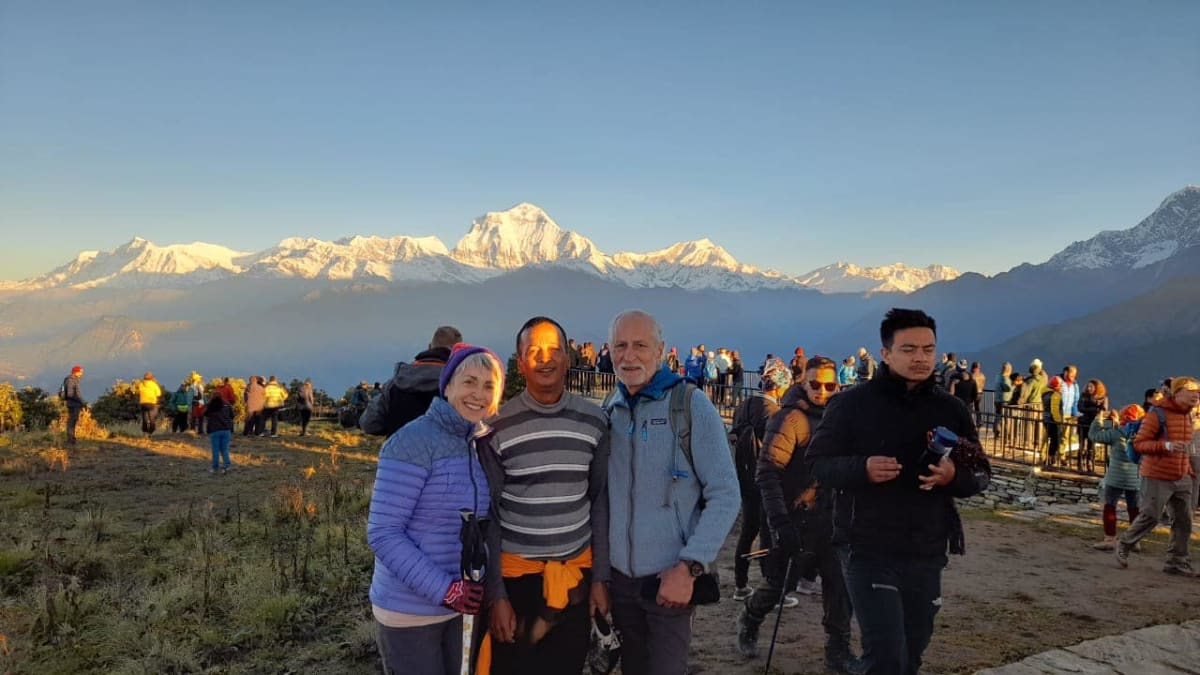
Day 4 opens with a 5 am climb to the 3,210 m Poon Hill viewpoint for the Dhaulagiri and Annapurna sunrise, then the group returns to the Ghorepani lodge by around 7:30 am for a full morning practice session while the legs are already warm from the climb. This same-day pairing is the trek's defining rare attribute, since the Annapurna Yoga Trek and the standard Poon Hill Trek both treat the sunrise and any practice as separate events on separate days. Breakfast follows the practice session rather than preceding the climb, which keeps the pre-dawn walk light.

An afternoon rest and a shorter pranayama session round out day 4 at Ghorepani, the trek's only true rest day. The compressed timing works because Ghorepani sits at 2,860 m, close enough to Poon Hill's 3,210 m summit that the round trip takes under two hours including the group's slower pace.

How does the Ulleri staircase fit into a yoga trek pace?

The Ulleri staircase, roughly 3,200 stone steps climbing 500 m from Tikhedhunga to Ulleri, is the trek's one demanding section and this itinerary splits it into a shorter climbing day followed by a gentler continuation to Ghorepani, rather than the single long push the standard Poon Hill Trek uses. Most groups take two to three hours over the steps with rests, and an evening restorative session at Ulleri eases tired legs before the second half of the climb the next morning. Trekking poles help the knees on the way down later in the trek.

Beyond Ulleri the trail eases into rolling village walking through Gurung and Magar settlements, which is why the trek stays graded easy overall despite the staircase. Splitting the climb across two shorter days, instead of the standard trek's combined Ulleri-to-Ghorepani push, is what protects the evening practice session from arriving on exhausted legs.

What is the Poon Hill sunrise like on a yoga trek pace?

Poon Hill at 3,210 m gives a 360-degree dawn panorama over Dhaulagiri (8,167 m), Annapurna I (8,091 m), and the fishtail summit of Machhapuchhre, reached by a 5 am climb from Ghorepani that this itinerary times to leave extra room for the practice session afterward. The viewpoint fills with trekkers in October, so an early start still matters even at a slower overall pace. On a cloudy morning the light show can still be worth the climb, and the group's flexible day-4 schedule allows a short rest before deciding on a second attempt.

Ghandruk, Ajay's home village, is the trek's quieter reward later in the route, and the slower six-to-seven-day pace gives it more time than the standard trek's single overnight allows. The yoga trek in the Annapurna foothills shares this village but reaches it from the opposite direction over a longer itinerary.

Who leads the Poon Hill Yoga Trek?

Ajay Shrestha leads every departure of this trek personally, the only yoga trek on this site with a single instructor covering both the practice and the trekking role rather than a paired specialist team. That's possible here specifically because the route stays easy-graded and never leaves teahouse infrastructure; the Everest Foothills Yoga Trek pairs him with a Khumbu-based guide precisely because that route's altitude and remoteness need a second specialist. Ajay holds a 500-hour Yoga Alliance certification earned in Rishikesh in 2019 and TAAN guide registration G-1098, and has led 21 departures of this specific route.

He grew up in Ghandruk at 1,940 m, a village this itinerary passes through on day 6, and his family still runs a lodge on the route. That local grounding is why the itinerary can slow down at Ghandruk rather than treating it as a pass-through stop; full certifications are on the team page.

What should you pack for the Poon Hill Yoga Trek?

Packing follows the standard Nepal trekking packing list, scaled down for this trek's easy grading and 3,210 m ceiling: a three-season sleeping bag is usually enough rather than the -15 C four-season bag needed on the Everest or Annapurna yoga treks, though a colder bag adds safety margin for a December departure. A lightweight personal yoga mat under 1 kg is worth carrying, since teahouse floor space varies from lodge to lodge along this route.

Warm layers still matter for the 5 am Poon Hill climb, even though daytime temperatures on this route rarely feel severe; pre-dawn temperatures at 3,210 m regularly sit near freezing even in the warmer shoulder months. A headlamp is essential for the sunrise departure from Ghorepani, and trekking poles help protect the knees on the descent from Ulleri later in the trip.

How does the Poon Hill Yoga Trek compare to the other two yoga treks on this site?

Three yoga treks run on this site, and Poon Hill is the shortest and gentlest of the three: 6 to 7 days against the Annapurna Yoga Trek's 8 to 10 and the Everest Foothills Yoga Trek's 8 to 9, and a 3,210 m ceiling against 3,860 m for Everest. Poon Hill is also the only one led solely by Ajay rather than a paired guide team, and the only one priced under USD 1,000 in a group.

Poon Hill Yoga Trek Annapurna Yoga Trek Everest Foothills Yoga Trek
Duration 6-7 days 8-10 days 8-9 days
Max altitude 3,210 m 3,210 m 3,860 m
Group cost (2026) USD 650-950 USD 900-1,350 USD 1,250-1,750
Leadership Ajay Shrestha solo Ajay Shrestha solo Ajay Shrestha + Passang Dawa Sherpa

Choosing between the Annapurna and Poon Hill versions comes down to time and depth rather than difficulty, since both share the same altitude ceiling and instructor; the yoga trek in the Annapurna foothills simply covers more of the same region over a longer, less rushed itinerary.

What group sizes and departure dates does the Poon Hill Yoga Trek run?

Groups run up to 12 guests, larger than the Everest Foothills Yoga Trek's cap of 10, since teahouse room and practice-space availability is less constrained on this lower, more established trail. Fixed group departures run through the October-to-December and March-to-May windows, roughly monthly in peak season and less frequently in the shoulder months either side, with exact dates confirmed on the trip's booking calendar rather than a fixed year-round schedule.

Private departures are available on request outside the standard calendar for travelers whose dates don't line up with a scheduled group, priced at the private rate shown above. Ajay personally leads every departure regardless of group size, so booking a private date doesn't mean a different or less experienced instructor, only a different price structure reflecting that his time isn't split across other paying travelers that week.

Does the Poon Hill Yoga Trek carry any altitude risk?

3,210 m at the Poon Hill viewpoint sits below the altitude range where acute mountain sickness becomes a meaningful planning concern for most trekkers, and the itinerary's slow six-to-seven-day pace over a route the standard trek covers in four to five days adds further margin. Even so, the same 500 m sleeping-altitude guideline used across every trek this company runs, covered in the altitude sickness prevention guide, shapes the schedule: the ascent from Tikhedhunga to Ghorepani is split across two days specifically so no single night's altitude gain exceeds that threshold.

Ajay Shrestha is not a medically certified guide, and while his Wilderness First Aid certification covers routine trail incidents, anyone with a pre-existing cardiac or respiratory condition should consult a doctor before any trek above 3,000 m regardless of how gentle the itinerary reads on paper. In practice, symptomatic altitude illness on this specific route is rare given how low its ceiling sits relative to Nepal's higher classic treks.

When is the best season for the Poon Hill Yoga Trek?

October to December and March to May are this trek's two reliable windows, matching the standard Poon Hill Trek's own season data, since both routes depend on the same clear-sky conditions for the sunrise viewpoint to be worth the 5 am climb. Autumn gives the most consistent mountain visibility of the year, while spring adds rhododendron blooms through the forest sections between Ulleri and Ghorepani.

Monsoon, June through September, is avoided entirely rather than run at reduced capacity, since Poon Hill's dawn panorama is the trek's central reward and cloud cover through the wet season makes that view unreliable most mornings; the trail itself stays walkable, but the itinerary's structure depends on a sunrise that's actually visible. Winter, December through February, is workable at this altitude and colder mornings often bring the clearest air of the year, covered in more depth in the trekking Nepal in winter guide.

Elevation profile High point 3,210 m
1,0001,5002,0002,5001,540 m122,860 m3456822 m7DAY
Acclimatization night High point

Day by Day

7-day itinerary, every detail planned.

Day1
Trip Day
Drive Pokhara to Nayapul, trek to Tikhedhunga (1,540 m)
~3h walking9 km
1,540m alt.

A 1.5-hour jeep reaches Nayapul, then a gentle riverside walk climbs to Tikhedhunga below the Ulleri staircase. The trail follows the Modi Khola through terraced farmland and small Gurung settlements, an easy introduction to the walking pace the rest of the trip holds. An arrival practice session on the lodge terrace opens the trek.

1,540 m9 km~3h
Day2
Trip Day
Tikhedhunga to Ulleri (2,070 m) via the staircase
~3h walking3 km
2,070m alt.
Day3
High Point
Ulleri to Ghorepani (2,860 m)
~3h walking9 km
2,860m alt.
Day4
Acclimatization
Poon Hill sunrise (3,210 m), same-day morning practice, rest at Ghorepani
~3h walking3 km
2,860m alt.
Day5
Trip Day
Ghorepani to Tadapani (2,630 m)
~5h walking10 km
2,630m alt.
Day6
Trip Day
Tadapani to Ghandruk (1,940 m)
~4h walking9 km
1,940m alt.

What's Included

Transparent, all-in pricing.

Included in your price

Permits (ACAP + TIMS)
Pokhara-Nayapul/Pokhara transfers
Certified yoga teacher and guide (shared)
Porter, one per two trekkers
Teahouse rooms with practice space, 5-6 nights
Food and drinking water
Company margin, logistics, mats and props

Not included

Nepal entry visa fee (USD 30-125, paid on arrival)
Travel insurance with helicopter evacuation cover
Personal trekking gear and equipment
Tips for your guide and porter
Bottled drinks, wifi, and device charging at teahouses
Meals in Kathmandu outside the itinerary

Dates & prices

Upcoming departures.

Start dateEnd datePrice / personAvailability
19 Oct 202625 Oct 2026USD 780Guaranteed · 5 leftEnquire
16 Nov 202622 Nov 2026USD 750Open · 8 leftEnquire
22 Mar 202728 Mar 2027USD 750Open · 9 leftEnquire
19 Apr 202725 Apr 2027USD 800Open · 10 leftEnquire

Verified reviews

What travellers say.

4.8/5 from 18 reviews on TripAdvisor, checked July 2026

★★★★★

Six days was the perfect length for my first trek, and reaching the sunrise and doing morning practice the same day at Ghorepani felt like a genuinely different trip from the standard Poon Hill route my friends did. The Ulleri staircase was still tough but the evening restorative session afterward made a real difference. Ajay led every session himself.

PN
Priya Nair · India
11 Apr 2026
★★★★

Good introduction to both yoga and trekking in one short trip. Ghandruk was a highlight, especially with Ajay's family connection to the village. Would have liked one more practice day but the pace suited a first-timer like me.

JW
Jonas Weber · Switzerland
15 Mar 2026

Why Nepal Travel Packages

Built on published proof, not adjectives.

A named, licensed guide before you book

Full name, photo, NMA or TAAN license number, and a direct WhatsApp line. The guide on the page is the guide on the trail.

Itemized pricing, not a lump sum

Permits, guide, porter, lodging, and food broken out on every trip page. You see exactly where the price comes from.

Trail conditions updated monthly

Dated field reports from the guides running the route this season, not boilerplate written once and left to go stale.

Permits handled, not hidden

Every permit fee, checkpoint, and paperwork rule is filed for you and published in the guides — no surprise admin at Lukla.

FAQ

Common questions

Is this the easiest yoga trek in Nepal?+

Yes, the Poon Hill Yoga Trek is the gentlest yoga trek this company runs, 6 to 7 days against the Annapurna Yoga Trek's 8 to 10 and the Everest Foothills Yoga Trek's 8 to 9, with a lower altitude ceiling than either. Complete beginners to both yoga and trekking fit comfortably on this route. Compare the longer option on the yoga trek in the Annapurna foothills page.

How is this different from the classic Poon Hill Trek?+

The classic Poon Hill Trek covers the same trail in 4 to 5 days at a faster pace with no yoga practice. This version adds two to three days, a certified yoga teacher, and twice-daily sessions, including the same-day sunrise-to-practice flow on Poon Hill morning. Both routes share the same ACAP and TIMS permits.

Do I need yoga experience for this trek?+

No, sessions scale to complete beginners and experienced practitioners on the same departure, the same approach Ajay uses on the Annapurna Yoga Trek. The walking is graded easy throughout, so no trekking experience is required either. This is the lowest-commitment yoga trek on the site for both skills.

Is the Ulleri staircase still hard on a yoga trek?+

Yes, the roughly 3,200-step, 500 m Ulleri staircase remains the trek's one demanding section, but this itinerary splits it across two shorter days and follows the climb with an evening restorative session. Most groups take two to three hours over the steps with rests. Trekking poles help on the descent later in the trek.

Can I add a retreat after this trek?+

Yes, Pokhara is the road hub for this route's end point, so a transfer to the post-trek recovery retreat in Pokhara or a full Pokhara program needs only a short drive rather than a return to Kathmandu. Many clients pair the two for a longer wellness-focused trip. Our team arranges the sequence and transfers.

Who leads the Poon Hill Yoga Trek?+

Ajay Shrestha leads every departure personally, the only yoga trek on this site with one instructor covering both the practice and trekking roles. He holds a 500-hour Yoga Alliance certification and TAAN guide registration, and has led 21 departures of this specific route. Full certifications are on the team page.

Do I need a four-season sleeping bag for this trek?+

Usually not; a three-season bag is generally enough given the 3,210 m ceiling and easy grading, though a colder four-season bag adds margin for a December departure. This is a lighter packing list than the Everest or Annapurna yoga treks, which reach higher altitude or run longer. Check the full packing list before booking a December date specifically.

How does this compare to the Annapurna Yoga Trek if I have limited time?+

Poon Hill runs 6-7 days against the Annapurna Yoga Trek's 8-10, sharing the same 3,210 m ceiling and the same instructor, Ajay Shrestha. The shorter version costs less (USD 650-950 versus USD 900-1,350) and covers less ground, mainly skipping some of the deeper foothill villages the longer itinerary reaches. Time available is the deciding factor more than difficulty, since both are graded easy.

How many people join a typical departure?+

Groups run up to 12 guests, and Ajay personally leads every departure regardless of size. Fixed group dates run roughly monthly through the October-December and March-May seasons; a private departure is available on request for travelers whose dates fall outside that calendar.

Is the trail crowded compared to the standard Poon Hill Trek?+

The trail itself is shared with the standard Poon Hill Trek and other Annapurna foothill routes, so peak-season crowding, especially at the Poon Hill viewpoint at sunrise in October, is real regardless of which version you book. This yoga trek's slower pace doesn't reduce trail traffic, only how the itinerary itself is structured around it.

What happens if I want to book close to a departure date?+

Teahouse rooms with adequate practice space are the main constraint on short-notice booking, more than the permits, which process in a single day through a registered agency. Booking at least 2 to 3 weeks ahead during the October-December and March-May peak windows gives the best chance of confirmed lodge space; last-minute requests are still worth asking about, since availability varies week to week.

Can I do this trek if I've never done yoga or trekked before?+

Yes, this is the lowest-commitment option on the site for exactly that combination: easy grading, a 3,210 m ceiling well below altitude-risk thresholds, and a teacher who scales every session to whoever is in the room. Most first-timers to both activities find the six-to-seven-day pace comfortable rather than rushed.

What footwear and gear does this trek actually require?+

Broken-in waterproof hiking boots with ankle support matter most, the same single most trek-ending item to get wrong across every route on this site, covered in the Nepal trekking packing list. Trekking poles help specifically on the Ulleri staircase descent later in the trip. Beyond footwear, this trek's easy grading and low altitude mean a lighter overall kit than any of the site's higher routes.

What's included in the price versus paid separately?+

Permits, the certified teacher and guide, teahouse accommodation, and meals are included in the group and private prices shown above. International flights to Kathmandu, personal gear, tips, and travel insurance are priced separately, the same inclusion pattern used across every trip on this site; the cost breakdown table above lists the exact line items.

Does this trek run every month of the year?+

No. Fixed departures run through the October-December and March-May windows only; the trek is not scheduled during monsoon (June-September) because Poon Hill's sunrise is unreliable then, and winter (December-February) runs at reduced frequency given colder mornings, though it remains viable for travelers who specifically want the clearer winter air.

Does Ghandruk village add anything beyond the sunrise viewpoint?+

Yes, Ghandruk gives this trek a genuine cultural layer beyond the Poon Hill summit itself: a working Gurung village with Ajay's own family lodge, more time here than the standard trek's single overnight allows, and a slower, quieter close to the itinerary before the final drive back to Pokhara.