
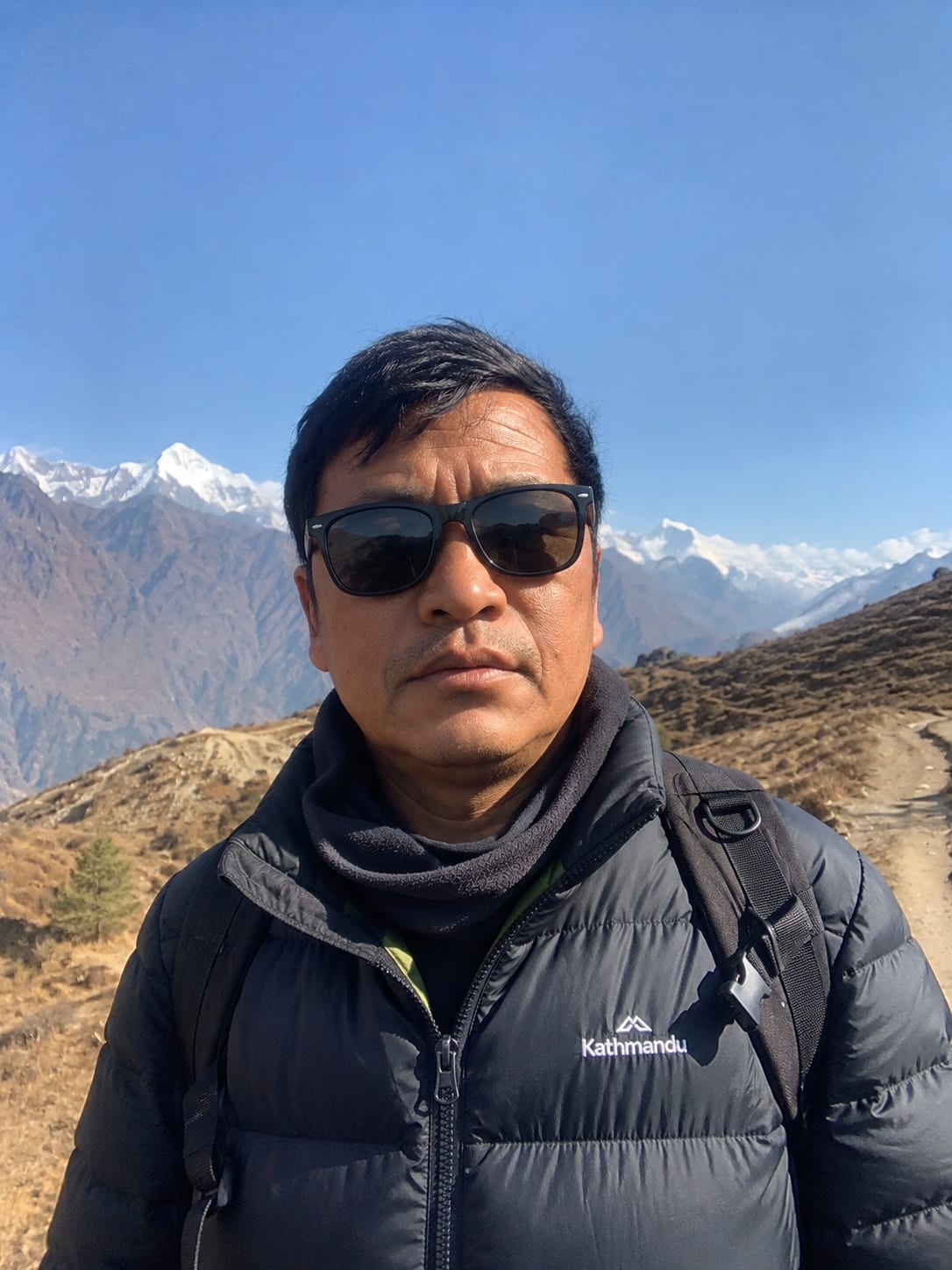
 Written & led by Mingma Sherpa
 Estimated per-person rate for this size — your guide confirms the exact quote.
The Rara Lake Trek is a 6-day teahouse trek to Rara Lake, Nepal's largest lake at 2,990 m, reached by a short domestic flight to the Talcha airstrip followed by a 2 to 3 hour walk, making it the most accessible genuinely remote trekking destination in Nepal's Far West. A 2026 group departure costs USD 700 to 1,000 per person, covering the Rara National Park entry (NPR 3,000), a licensed guide, teahouse accommodation on the lakeshore, and the domestic flight sector between Kathmandu or Nepalgunj and Talcha. Unlike Dolpo, Kanchenjunga, or this same region's own Limi Valley, Rara Lake needs no restricted-area permit and no minimum group size, which is the single biggest practical difference between this trek and Nepal's other far-flung regions.
Mingma Tendi Sherpa, our Senior Guide and Safety Lead, plans logistics for our remote-region departures and put this itinerary together as our Far West route network expands, built around the one detail that sets Rara apart from Dolpo, Kanchenjunga, or Limi Valley: no restricted-area permit, no minimum group size, and a flight in rather than a week of walking to reach it.
Highlights
What our guides know that others don't.
Approach time vs. other whale regions
A single short Talcha flight plus a 2-3 hour walk, against 22 days for a full Dolpo circuit or 22 days for a full Kanchenjunga circuit
Lakeshore lodge growth
Teahouse and homestay count near the lake has grown noticeably over recent seasons as Nepal's post-2023 Far West tourism push takes effect
What permit does the Rara Lake Trek need?
The Rara Lake Trek needs only the standard Rara National Park entry permit at NPR 3,000, with no restricted-area paperwork, no minimum group size, and no liaison officer. This is the clearest practical contrast with Nepal's other remote regions: a Dolpo, Kanchenjunga, or Limi Valley itinerary all require a Department of Immigration restricted-area permit filed through a registered agency with a licensed guide, while Rara's park-entry system needs none of that paperwork. A solo trekker can obtain the Rara permit without joining a fixed-group departure, though Nepal's general 2023 guide requirement for national park routes still applies.
The permit is sold at the park office near the Talcha airstrip or arranged in advance through a registered agency, and unlike a restricted-area filing it needs no advance passport lodging with the Department of Immigration in Kathmandu. Full detail on how this permit system compares with the region's restricted-area alternative sits in the Far West Nepal permits guide, and the Nepal-wide permit map is in the Nepal trekking permits master guide.
The 2023 licensed-guide requirement that applies to most Nepal national park routes is a guide mandate, not a group-size rule, and it applies here the same way it applies on Poon Hill or the Langtang Valley trek, both of which run without a restricted-area permit too. Trekkers weighing whether Rara's lighter paperwork extends to trekking without a guide at all should read the solo trekking guide requirement page, since the two rules, group size and guide mandate, are easy to conflate but govern different things.
How much does the Rara Lake Trek cost in 2026?
TAAN-registered operators quoted USD 700 to 1,000 for a group Rara Lake departure in 2026, positioned above Poon Hill's USD 350 to 600 but below the longer teahouse routes like Langtang Valley's USD 650 to 950, mainly because of the Talcha flight sector rather than trail length. The table above breaks the total down: the flight itself is the single largest line item, more than the park permit, guide, and porter combined, since Kathmandu-Talcha fares are priced separately from the main domestic network and carry less carrier competition than the Kathmandu-Pokhara route.
Lakeshore teahouse and food prices run somewhat above what a valley trek like Langtang or Annapurna Base Camp charges, since every sack of rice and bottle of gas reaches Rara by the same limited flight and porter supply chain that brings trekkers in. Even so, the total stays well under Dolpo or Kanchenjunga's camping-trek day rates, because Rara needs only a guide and light porter support rather than a full cook-and-kitchen crew. Its combination of light logistics and lower permit cost makes Rara Lake one of the site's short Nepal travel packages.
Group size affects the per-person price here the same way it does on every guided departure: the guide's daily wage is a fixed cost split across however many trekkers join, so a full group narrows the gap between the group and private rates shown above, while a private departure of one or two people pays that fixed cost with far less splitting. The flight sector is the one line item group size barely moves, since each trekker books an individual seat regardless of whether the trip is a group or private departure, unlike the porter and lodging costs that scale more directly with headcount.
| Rara National Park entryNPR 3,000 at 2026 rates, no second permit required | $23 |
| Domestic flights, Kathmandu-Talcha return (via Nepalgunj where needed)STOL sector; fares are seasonal and confirmed at booking, not fixed | $300–500 |
| Licensed guide (shared in group)USD 35-40/day, 6 days | $210–320 |
| Porter, one per two trekkersUSD 25/day; light crew, no full kitchen team needed | $90–160 |
| Teahouse and homestay rooms, 4-6 nightsLakeshore rates run above valley teahouses given the limited supply chain | $40–90 |
| Food and drinking waterHigher than a road-served route since supplies fly or walk in | $90–160 |
| Company margin, logistics, staff equipment | $50–130 |
How difficult is the Rara Lake Trek?
The Rara Lake Trek grades easy, with 3 to 5 hours of walking on most days over gentle forest and shoreline trail, no technical terrain, and no pass crossing. This puts it closer to Poon Hill's physical demand than to a moderate-strenuous route like Gosaikunda, since the entire itinerary stays within a roughly 450 m band of total ascent rather than climbing repeatedly to a high pass.
The 2 to 3 hour walk-in from Talcha is the single sustained climb of the trip, and it descends rather than climbs on the return, so the itinerary's hardest single stretch comes on day one, while a trekker is freshest. No acclimatization day is built into the schedule because Rara's 2,990 m ceiling sits under the altitude threshold where that planning becomes necessary, unlike Gosaikunda's built-in rest day before its 4,610 m pass. Fitness for a multi-hour walk on uneven forest trail is still genuinely useful, but this is a trek most reasonably active adults complete without dedicated high-altitude training.
Trail surface is mostly packed dirt and forest floor rather than the stone staircases found on routes like Poon Hill's Ulleri climb, so the walking itself is gentler underfoot even where the distance covered on a given day is similar. Guides still recommend trekking poles for the shoreline trail's occasional root-crossed sections, more for stability on uneven ground than for any sustained steep grade.
What makes Rara Lake ecologically and culturally significant?
Rara Lake sits inside Rara National Park, established in 1976 specifically to protect the lake and its surrounding coniferous forest, and the lake's oval basin and blue-green water are widely recognized as one of the most striking landscapes in Nepal's Far West. The park's forest cover, mostly blue pine and spruce at this elevation, supports wildlife including Himalayan black bear and musk deer, and the lake itself draws migratory waterfowl during the shoulder seasons, though sightings are never guaranteed on any single visit and our guides do not promise specific wildlife encounters.
The villages around the lake and along the Talcha approach are largely Chhetri and Thakuri communities, and the region's culture reflects its long isolation from the rest of Nepal, reachable historically only by multi-day walking routes before Talcha's airstrip opened access by air. This isolation is also why local infrastructure, teahouses, communication, and onward transport, remains genuinely limited compared with Everest or Annapurna, a trade-off this page states plainly rather than glossing over. Trekkers drawn to Rara specifically for its quiet, low-development character should expect that same limited infrastructure as the flip side of what makes the destination distinctive.
Rara's distinction is surface area, not altitude: it is Nepal's largest lake by size, while lakes at genuinely higher elevation, Tilicho Lake on the Annapurna Circuit among them, sit well above 4,000 m and carry the altitude risk this itinerary specifically avoids. Gokyo's lake system in the Everest region is smaller and higher again. Trekkers who want the biggest lake with the least altitude exposure land on Rara; trekkers chasing the highest lake or a glacial lake system tied to an 8,000 m peak are better served by Tilicho or Gokyo, both already built out elsewhere on this site.
How does Rara Lake compare to Nepal's other remote treks?
Rara Lake is the fastest way to reach a genuinely remote, low-traffic corner of Nepal: a single short flight to Talcha and a 2 to 3 hour walk put a trekker on the shore of the country's largest lake, against 18 to 22 days for a full Upper Dolpo circuit or 22 days for a full Kanchenjunga circuit covering both base camps. That access gap is the trek's defining rare attribute, not a marketing claim but a direct function of Rara sitting inside Nepal's interior rather than against the Tibet border, which is why it needs no restricted-area permit at all.
The trade-off is scope, not difficulty: Rara Lake does not offer the high-pass mountaineering of a Dolpo or Kanchenjunga circuit, and its 2,990 m ceiling stays well under the altitude-sickness caution line covered in the altitude on Nepal treks guide. Trekkers with a full three-week holiday and an appetite for a high-pass expedition are better served by Dolpo or Kanchenjunga once those itineraries are published; trekkers with a week or less who still want an off-the-standard-route destination are the trek this itinerary is built for. Teahouse and homestay capacity near the lakeshore has grown noticeably in recent seasons as Nepal's post-2023 tourism policy actively promotes the Far West, though it remains a small fraction of what Everest or Annapurna's trail infrastructure supports.
Within the Far West itself, Rara Lake is the accessible option next to Limi Valley's much longer, camping-based approach through Simikot, covered in the Far West Nepal trek logistics guide. A trekker choosing between the two should weigh a week of teahouse-supported lakeshore walking against a multi-week camping expedition into restricted, border-adjacent terrain; they are different trips serving different appetites, not two versions of the same experience. Limi Valley also requires a Department of Immigration restricted-area permit at USD 50 per person per week, a genuinely different paperwork process from Rara's simple park-entry fee, covered in full in the Far West Nepal permits guide.
Khaptad National Park sits logistically between the two: reached by road or a short flight plus one to two trekking days, with a mixed teahouse-and-camping accommodation model rather than Rara's full teahouse coverage or Limi's full camping requirement. A trekker drawn to the Far West specifically for its plateau grasslands rather than a lake should look at Khaptad as a third distinct option alongside Rara and Limi Valley, not a variation on either.
Set against Nepal's headline routes, Rara Lake also reads as a genuine change of scenery: Everest Base Camp and the Annapurna Circuit both end at a high, dramatic terminus above 5,000 m, while Rara's destination is a still lake surrounded by forest at a comparatively gentle elevation. Trekkers who have already done a high-altitude route and want a lower-key, shorter follow-up trip, rather than a bigger objective, are a real and growing part of who books this itinerary.
When is the best season to trek Rara Lake?
April through June is Rara Lake's strongest window, with the surrounding forest green, the lake at its clearest, and the fewest weather delays of the year on the Talcha flight sector. September through November is the second strong window, cooler and drier as the monsoon clears, arriving slightly later in the Far West than the standard central-Nepal autumn. May stands out specifically as the most reliable single month for both clear lake views and steady Talcha flight operations.
Rara sits in only a partial rain shadow from the Api-Saipal range to the west, so June through August still brings real rainfall and less reliable flights, a genuinely different picture from Dolpo's dry monsoon season and worth stating plainly rather than overselling. Winter, December through February, brings real cold and weather-dependent Talcha flights, though the lake's modest 2,990 m elevation means deep snow rarely closes ground access the way it closes the high passes on a Dolpo or Kanchenjunga circuit, so a short, well-timed winter visit is more realistic here than on either of those routes.
What should you pack for the Rara Lake Trek?
A Rara Lake packing list follows the same core kit as any Nepal teahouse trek: layered clothing, a four-season sleeping bag, and broken-in waterproof boots, with the full checklist on the Nepal trekking packing list. Because this trek stays under 3,000 m, the extreme-cold sleeping bag rating needed for a high-pass route isn't necessary here, though nights near the lake still run cold outside the warmest summer weeks.
Binoculars are worth the extra weight for the lake's migratory bird visitors in the shoulder seasons, and a printed or offline map is a sensible backup given how limited mobile coverage is around Talcha and the lakeshore villages. Cash in Nepali rupees should cover the full trip, since no ATM serves this route once past Kathmandu or Nepalgunj, and device charging at lakeshore teahouses runs on limited solar or generator power, so a spare power bank is worth carrying rather than counting on a wall outlet every night. Trekking poles are a genuine comfort item here even though the terrain is gentle, mainly for stability on the shoreline trail's occasional root-crossed or damp sections after rain.
Waypoints mark named stops on the route; the line between them is a straight-line approximation, not a surveyed trail. Map data © OpenStreetMap contributors.
Day by Day
6-day itinerary, every detail planned.
A short domestic flight reaches the Talcha airstrip, either direct from Kathmandu or via a connecting Nepalgunj sector depending on the week's schedule, followed by a gentle 2 to 3 hour walk down through forest to the lakeshore. A buffer day is not built in here since this sector is booked first in the itinerary, before any onward connections depend on it, and the group's first sight of the lake usually comes in the early afternoon.
What's Included
Transparent, all-in pricing.
Included in your price
Not included
Why Nepal Travel Packages
Built on published proof, not adjectives.
A named, licensed guide before you book
Full name, photo, NMA or TAAN license number, and a direct WhatsApp line. The guide on the page is the guide on the trail.
Itemized pricing, not a lump sum
Permits, guide, porter, lodging, and food broken out on every trip page. You see exactly where the price comes from.
Trail conditions updated monthly
Dated field reports from the guides running the route this season, not boilerplate written once and left to go stale.
Permits handled, not hidden
Every permit fee, checkpoint, and paperwork rule is filed for you and published in the guides — no surprise admin at Lukla.
Keep exploring
Related packages
Planning
Related guides
FAQ
Common questions
Do I need a restricted-area permit for Rara Lake?+
No. Rara Lake needs only the standard Rara National Park entry permit at NPR 3,000, with no restricted-area paperwork, no minimum group size, and no liaison officer, unlike Dolpo, Kanchenjunga, or this same region's own Limi Valley. Full detail is in the Far West Nepal permits guide.
How do I get to Rara Lake?+
Fly from Kathmandu or Nepalgunj to the Talcha airstrip, then walk 2 to 3 hours down to the lakeshore trail. This is one of the shortest approaches to any remote, low-traffic trekking destination in Nepal, covered in the Far West Nepal trek logistics guide.
Is the Rara Lake Trek suitable for a solo traveler?+
Yes. The park-entry permit carries no minimum-group requirement, a genuine contrast with Nepal's restricted areas. Nepal's general 2023 rule requiring a licensed guide on national park routes still applies, but that is a guide mandate, not a group-size rule.
Is altitude sickness a risk on this trek?+
Barely. Rara Lake's 2,990 m maximum sits just under the 3,000 m threshold where altitude effects typically begin, covered in the altitude on Nepal treks guide. No acclimatization day is built into this itinerary because none is needed at this elevation.
Can the Rara Lake Trek be combined with Khaptad or Limi Valley?+
Not on this published itinerary, though the region supports it logistically. Khaptad and Limi Valley both carry different access routes and, in Limi Valley's case, a restricted-area permit, so a combined itinerary needs custom scoping rather than a fixed departure; message us to discuss a Far West itinerary that links more than one destination.
What is the shortest realistic Rara Lake itinerary?+
Six days is the practical minimum, covering the flight in, two full days at the lake, and the return. The 8-day version adds extra lakeshore exploration time rather than rushing the same core itinerary, which most trekkers with the extra days find worthwhile given how quiet the trail is outside the core route.
Is Rara Lake suitable for families with children?+
Generally yes, given the gentle 3 to 5 hour daily walking and 2,990 m elevation ceiling, similar in physical demand to the Poon Hill Trek. The bigger practical constraint is the limited teahouse capacity near the lake rather than the trail itself, so family group sizes and room availability are worth confirming at booking, especially in the busier April-to-June window.
Will I see wildlife at Rara Lake?+
Possibly, though it's never guaranteed on a single visit. Rara National Park's coniferous forest supports Himalayan black bear and musk deer, and the lake draws migratory waterfowl in the shoulder seasons, particularly along the quieter northern shoreline trail. Guides point out signs and tracks along the trail, but no specific sighting is promised as part of this itinerary.
How does Rara Lake compare to Tilicho Lake or Gokyo?+
Rara is Nepal's largest lake by surface area but sits at a much lower, easier elevation than either. Tilicho Lake on the Annapurna Circuit and the Gokyo lake system on the Gokyo Lakes trek both sit well above 4,000 m and carry real altitude risk and acclimatization planning that Rara's 2,990 m ceiling avoids entirely, which is part of why Rara suits a shorter, lower-commitment holiday window.
Is Rara Lake good for photography?+
Yes, particularly early morning during the April-to-June and September-to-November windows, when the lake surface is stillest and reflections of the surrounding forest are clearest before any afternoon breeze. The southern shoreline's ridge viewpoint, covered on day 3 of this itinerary, gives the widest view over the full lake basin.